One rainy-day puddle can become a classroom investigation in observation, prediction, and early science. Explore a simple, repeatable way to help children notice where water goes as a puddle changes—and consider the Building Early Science Foundations course  Buy Now $16.00 for additional strategies to support young children’s inquiry and discovery.
Why does following a puddle matter?
A puddle is familiar, accessible, and full of change. When children return to the same spot and compare what they see, they practice looking closely, remembering earlier observations, describing differences, and asking questions. These habits form the groundwork for scientific thinking; children do not need to master complex explanations to participate meaningfully.
The investigation also makes time and change visible. A child may first notice that the puddle looks smaller, then wonder whether it soaked into the ground, moved, or dried. Rather than correcting a guess immediately, educators can treat it as a starting point: “What could we look for to find out?” Repeated visits invite children to connect their own evidence with a developing explanation.
For providers, this activity offers a practical way to combine outdoor learning with language, early measurement, drawing, and documentation. NAEYC describes how intentional observation can guide teaching and the design of learning experiences; educators can use children’s comments and actions to decide what question or material might extend the investigation. See Using Observation to Guide Your Teaching.
How can educators set up a safe, manageable investigation?
Choose a puddle in a permitted outdoor area that staff can revisit safely. Check the ground for slippery surfaces, traffic, sharp objects, and other hazards; keep children within active supervision and follow program procedures. Do not allow children to drink puddle water or handle potentially contaminated water. If the location is unsuitable, recreate the investigation with a small amount of water in a shallow tray outdoors or indoors.
Invite children to observe the puddle’s shape, approximate size, nearby surfaces, and surrounding weather. Mark its outline with chalk only where permitted, or place a few markers at a safe distance. A photo, drawing, or simple strip of paper can help children compare observations later. Keep materials simple and accessible:
- Clipboard, paper, crayons, or a classroom camera
- Chalk or markers placed around—not in—the puddle
- A simple journal or chart with the time of each observation
- Weather words or picture symbols for sun, clouds, wind, and rain
- 👟 Appropriate footwear and a clear supervision plan for outdoor visits
Establish a return schedule that fits the children’s day—for example, after an hour and again later. Children can participate by looking, pointing, describing, drawing, or communicating in their preferred way. Make the investigation inclusive by offering multiple ways to record and share an idea.
What should children notice and record over time?
Begin with a shared question: “What do you think will happen to this puddle?” Accept a range of predictions and record children’s words or drawings without grading them as right or wrong. At each visit, use the same prompts: “What do you notice now?” “Is the outline the same?” “What changed nearby?” Consistency helps children compare the evidence rather than rely only on memory.
A quick journal can include the observation time, a drawing or photo, a description of the puddle, and a child’s comment. Preschoolers might compare “bigger,” “smaller,” “same,” “wet,” or “dry.” Younger children may show their thinking through gestures, repeated looks, or actions. Document what you actually observe, not assumptions about what a child understands. For additional context on recording children’s learning, see NAEYC’s observation and documentation guidance for infant and toddler settings.
Keep the task light: one photo and one meaningful quote at each check-in may be enough. A visual sequence—first, next, later—can support children who benefit from predictable routines. If rain returns or the puddle is disturbed, record that too; changes in the investigation are useful information, not a reason to abandon the learning.
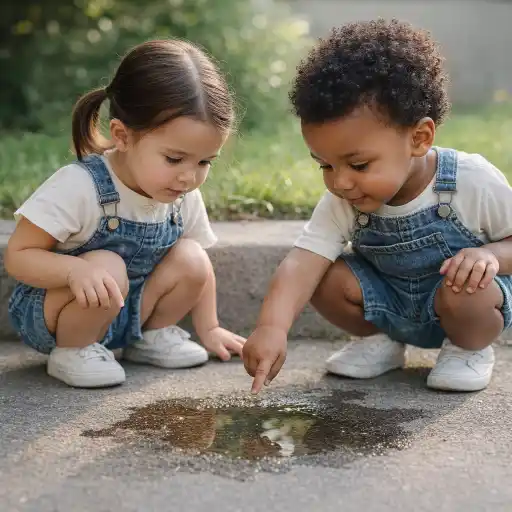
Where does the water go, and how can we explain it?
Children may suggest that the water disappeared, went underground, or was carried away. Each idea can open a conversation about evidence. Some puddle water can soak into the ground, flow to a lower area, or be moved by activity and weather. Some changes into water vapor and mixes with the air through evaporation. Evaporation is a gradual process, and it can be difficult to see directly.
Use accessible language while introducing accurate vocabulary: “The puddle is getting smaller. Some water may be soaking into the ground, and some may be changing into water vapor in the air. That change is called evaporation.” Temperature, sunlight, wind, humidity, the puddle’s depth, and the surface beneath it can affect how quickly a puddle changes. Avoid promising that sunlight alone explains every puddle’s disappearance.
Help children connect their explanation to what they observed. Was the day sunny, cloudy, or windy? Did the puddle shrink evenly, or did one edge change first? Was the ground beneath it soil, pavement, or another material? Children can compare their notes and decide what they think is happening. The goal is not to prove a single cause from one observation, but to build curiosity and an evidence-based explanation. For a practical outdoor puddle investigation, consult KidMinds’ puddle science activity.
How can educators extend the learning without taking over?
The adult’s role is to make children’s thinking visible, not to deliver every answer. Pause to watch and listen, then ask open-ended questions: “What makes you think that?” “How could we check?” or “What might we notice next time?” Give children time to respond through words, drawings, movement, or another communication method. When a child offers an unexpected explanation, invite the group to consider what evidence might help them explore it.
Connect the investigation to other areas of the curriculum while keeping the puddle as the anchor. Children can measure the widest part with a strip of paper, sort weather symbols, tell a story about the puddle’s journey, or create a sequence of drawings. A dramatic-play or movement extension might invite children to act out water warming, rising, and returning as rain, while clarifying that the puddle investigation gives only one small view of the larger water cycle.
For a ready-to-use documentation aid, consider featuring the Disappearing Puddle Investigation Journal as a classroom resource. Its purpose can be to support consistent notes and comparisons—not to replace children’s conversation or educator judgment. You can also build staff knowledge with Basic Science in Early Childhood Buy Now $25.00 or explore how young children engage in scientific inquiry through Tomorrow’s Einsteins: Infant and Toddler Science Buy Now $16.00.
What common pitfalls should providers avoid?
- Explaining too soon: Instead of announcing the answer, ask children what they notice and what evidence could help explore their ideas.
- Changing the observation method: Use a similar viewpoint and recording approach at each visit so comparisons are easier.
- Expecting a quick result: Puddles may change slowly, or rain may interrupt the investigation. Follow the actual conditions and revisit when practical.
- Assuming all children will participate in the same way: Offer drawing, pointing, verbal responses, photos, and supported observation as valid options.
- Overlooking outdoor risk: Check the area, supervise actively, and adapt or move the investigation if the site is not safe. State requirements vary - check your state licensing agency.
These adjustments help protect both the science and the children’s experience. A puddle investigation is not a test of whether a child can name evaporation; it is an opportunity to notice, wonder, compare, and return to a question with care.
Conclusion: How can one puddle become a meaningful science inquiry?
Following one puddle over time gives children a concrete way to practice observation, prediction, comparison, communication, and early scientific reasoning. Set up a safe location, return at planned intervals, record what children actually notice, and use open questions to help them connect evidence with possible explanations. Remember that water may evaporate, soak into the ground, or move elsewhere, and more than one process may be involved.
Keep the experience flexible and responsive: children can contribute through speech, drawing, gestures, or attentive looking, and unexpected weather changes can become part of the record. A simple journal and a thoughtful educator can turn an ordinary rainy-day puddle into a memorable investigation—one that encourages children to keep asking, “Where did the water go?”
Explore more focused professional learning with Building Early Science Foundations Buy Now $16.00, Basic Science in Early Childhood Buy Now $25.00, Tomorrow’s Einsteins: Infant and Toddler Science Buy Now $16.00, Creating the Natural Outdoor Classroom Buy Now $16.00, and Preschool Assessments & Observations Buy Now $24.00. Review each course’s details and verify whether it meets your professional development needs.
- Teacher-Child Interactions for Stronger CLASS® Outcomes
- 1,2,3, Eyes on Me: Classroom Safety
- The Science of Growing Up: Typical and Atypical Development
- Pediatric RSV First Aid & CPR/AED
- Self-Regulation & Change: Helping Children Cope
- Creating Environments that Nurture Growth and Community
- Texas Director Credential
- CDA Infants/Toddlers: Benefits to Observing
- Environments That Inspire Independence and Exploration
- Technology as a Classroom Tool
- Recursos en Español sobre el Sueño Seguro del Bebé
- 10 Ejemplos de Cómo la Cultura Influye en el Desarrollo Infantil
- Proporciones de Cuidado Infantil y Tamaños de Grupo por Edad en Nueva Jersey (Guía Rápida para Centros y Hogares)
- Consejos de Supervisión Activa para Salones de Preescolar y el Juego al Aire Libre
- Retraso del Habla en la Guardería: Cómo Pueden Ayudar los Proveedores
- Canciones, juegos y preguntas de círculo para niños
- Cómo simplificar la capacitación para sus empleados de daycare
- STEM for Preschoolers: Fun Activities That Encourage Curiosity
- Too Wiggly to Sit? Fall Movement Activities Toddlers Will Love
- Rainy Fall Day? 12 Indoor Activities Preschoolers Won’t Want to Stop
- What’s Happening Outside? Fall Science Adventures for Preschoolers
- Examples of Anecdotal Notes for Preschoolers: 10 Real Classroom Moments, Written the Right Way
- How Can Child Care Providers Use Emergent Curriculum to Make Children’s Thinking Visible?
- Why Is Outdoor Play Essential for Healthy Child Development?
- How Can Child Care Providers Teach Children to Choose Clothing for Weather and Activities?
- How Do Classification Questions Build Marine Science Vocabulary?
- How Can Families Help Interpret a Child’s Classroom Discovery?
- How Can the Walk Between Activities Become a Learning Moment?
- Where Did the Puddle Go? How Can Children Follow One Puddle Over Time?
- What Can Children Investigate in a Garden Bed That Has Not Been Planted?
