Preschoolers need more than an occasional trip outside—they need frequent opportunities to move, explore, and recover throughout the day. For practical guidance on balancing active, creative, and quiet periods, explore Balancing Active Play in Child Care  Buy Now $16.00, which can help providers strengthen schedules and classroom practices while earning professional development hours; state requirements vary, so check your state licensing agency.
Why does daily outdoor play matter for preschoolers?
Outdoor play is not simply a break between learning activities. It is a developmentally significant context in which children coordinate their bodies, negotiate with peers, investigate the natural world, and practice self-regulation. The American Academy of Pediatrics encourages active play every day, while the CDC identifies outdoor environments as valuable spaces for running, jumping, climbing, testing limits, and practicing movement skills.
Research and professional guidance connect high-quality outdoor experiences with physical, cognitive, social, and emotional benefits. NAEYC describes outdoor play as an opportunity to build gross-motor skills, support emergent science and literacy, practice cooperation, and take appropriate risks. Nature-rich settings may also promote attention, flexibility, and prosocial behavior.
For directors and providers, the central question is not whether outdoor time is “extra.” It is how the daily schedule can protect enough time for meaningful movement and child-led exploration.
- Outdoor play strengthens balance, coordination, endurance, and body awareness.
- Open-ended materials invite creativity, problem-solving, language, and early STEM thinking.
- Peer play outdoors creates space for cooperation, turn-taking, negotiation, and empathy.
- Movement and natural light can support attention, mood, and healthy routines.
How much physical activity should preschoolers receive each day?
Preschoolers generally benefit from being active throughout the day rather than completing one isolated exercise period. A useful planning target is at least 60 minutes of structured physical activity and at least 60 minutes of unstructured physical activity daily, with additional light movement woven into routines. Some guidance for children ages 3–5 describes approximately three hours of varied activity across the day, including light, moderate, and vigorous movement.
These figures should be treated as planning guidance, not a stopwatch requirement. Children’s energy, abilities, health needs, weather, staffing, and available space all affect the schedule. The goal is to reduce prolonged sitting and provide repeated opportunities to move at different intensities.
Outdoor play may include vigorous running, but it also includes gardening, walking, carrying, balancing, digging, observing insects, and imaginative games. A balanced schedule combines:
- Adult-supported movement such as obstacle courses, follow-the-leader, and ball games.
- Child-directed play such as climbing, pretend play, loose-parts construction, and nature exploration.
- Short movement bursts during transitions, songs, story acting, or waiting periods.
- Quiet outdoor experiences such as reading, drawing, listening walks, or sensory observation.
Track active opportunities across the entire day rather than asking whether one outdoor block “counted.” Several well-planned sessions may be more practical and engaging than a single extended period. January 27’s National Preschool Fitness Day can offer a timely prompt for planning playful movement experiences that reinforce these daily habits.
How should providers organize outdoor time in the daily schedule?
Consistency is more important than elaborate programming. Children benefit when outdoor play occurs at predictable times and staff prepare clothing, materials, supervision zones, and transitions in advance. Many programs find that an outdoor period in the morning and another in the afternoon protects access even when meals, naps, or special activities change the schedule.
Directors can begin with a simple rhythm:
- Conduct a brief weather and hazard check before each session.
- Assign staff to visible supervision zones and review boundaries.
- Offer two to four invitations, such as movement, sensory play, construction, and quiet observation.
- Allow substantial child-directed time without interrupting every investigation.
- Provide a gradual transition indoors with water, handwashing, and reflection.
Small-group rotations can help staff maintain active supervision while reducing long waits. One group might explore a balance path while another gardens and a third engages in chalk drawing or book sharing. Portable bins make this approach possible in small yards, courtyards, or shared spaces.
Connect outdoor experiences to current learning goals without turning play into a worksheet. Children can count collected leaves, compare shadows, dictate observations, act out a story, or design a bridge from loose parts. The NAEYC discussion of outdoor play emphasizes that children’s discoveries can become starting points for emergent curriculum.
What kinds of outdoor play best support preschool development?
Preschoolers need variety, repetition, and appropriate challenge. The best activities invite children to use their whole bodies while making choices and solving problems. A single setup can support multiple developmental levels when teachers adjust distance, height, speed, equipment, or adult assistance.
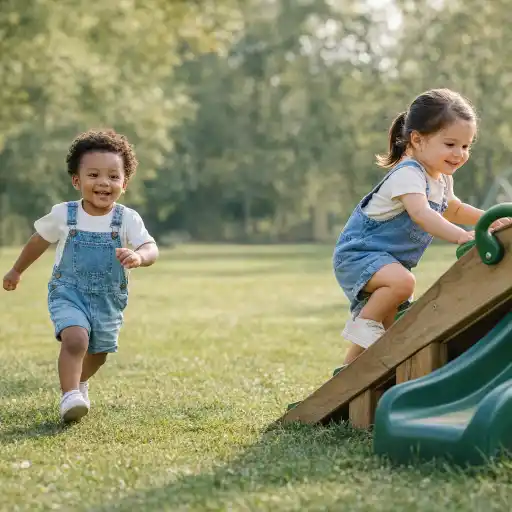
- 🌿 Nature movement hunts: Invite children to walk, squat, reach, carry, and describe safe natural objects they find.
- Obstacle paths: Combine stepping stones, chalk lines, tunnels, hoops, low logs, and cones for crawling, hopping, balancing, and jumping.
- Ball and target play: Use soft balls for rolling, throwing, kicking, catching, and aiming at large nearby targets.
- Gardening and purposeful work: Watering, digging, carrying lightweight containers, and sorting materials build coordination and responsibility.
- Imaginative movement: Encourage children to move like animals, travel through an imaginary river, or create a rescue mission.
- Nature inquiry: Observe puddles, clouds, plants, insects, textures, sounds, and changing light.
Outdoor play should also include manageable risk. Children learn by judging distance, testing balance, and deciding whether a challenge feels appropriate. Providers should remove hazards and intervene when serious injury is likely, a child is distressed, or equipment is unsafe. However, stopping every climb, jump, or unconventional movement can limit opportunities to develop confidence and risk assessment.
Use language that supports thinking: “What is your plan?” “Where will your feet go?” “Would you like the smaller or larger challenge?” This approach preserves children’s agency while keeping adults attentive and available.
How can programs keep outdoor play safe in every season?
Safety makes outdoor play possible, but safety planning should support exploration rather than eliminate it. Before children go outside, staff should inspect the area for broken equipment, sharp objects, glass, animal waste, standing water, poisonous plants, traffic hazards, and excessively hot surfaces. Equipment should be age-appropriate, and climbing areas should have suitable protective surfacing and clear sightlines.
The CDC recommends practical safeguards related to sun, heat, hydration, insects, playground injuries, wheeled equipment, and water play. Use shade, protective clothing, water breaks, and sunscreen procedures consistent with family permissions and program policy. Insect repellent should be used only as directed and with required permissions. Water activities require constant, close supervision because drowning can occur quickly and quietly.
Weather decisions should be consistent across staff. Post a simple “go, shorten, or stay inside” chart that considers temperature, heat index, storms, wind, and air quality. If outdoor conditions are unsafe, preserve the learning intention indoors through movement pathways, sensory materials, dance, construction, or nature observation.
Common mistakes include:
- Skipping the hazard scan because the yard “looked fine yesterday.”
- Allowing staff to supervise from one stationary location with blind spots.
- Overprotecting children by prohibiting all manageable risk.
- Planning activities that exclude children with disabilities or sensory differences.
Adapt distance, equipment, surfaces, instructions, and support so every child can participate. Document observations and follow individual health plans. Remember that state requirements vary - check your state licensing agency.
How can directors evaluate whether children are getting enough outdoor play?
Program improvement begins with simple, useful information. Directors do not need complicated measurement systems to determine whether outdoor play is regular, active, inclusive, and meaningful. Review the schedule, observe several sessions, and ask staff and families what they notice.
Track a few indicators weekly:
- How many outdoor opportunities were offered, and were they protected from avoidable interruptions?
- How much time did children spend moving, exploring, and making choices?
- Which children participated fully, and what adaptations supported access?
- What new vocabulary, social strategies, or problem-solving behaviors emerged?
- Were transitions calmer after outdoor play?
Use photographs, brief anecdotal notes, staff reflections, and family comments to build a fuller picture. Avoid comparing children’s speed, endurance, or willingness to climb. Developmental progress may appear as persistence, improved body control, greater confidence, or increased cooperation.
Staff development can strengthen consistency. Creating the Natural Outdoor Classroom Buy Now $16.00 offers practical ideas for using natural materials, sensory features, and outdoor environments as extensions of the curriculum. For supervision, Active Supervision: A Strategy That Works Buy Now $35.00 focuses on watching, listening, interacting, monitoring, and preventing problems during child care activities.
Share one positive observation with families each week. A message such as “Maya balanced across three stepping stones and encouraged a friend” communicates both learning and joy.
Summary: How much outdoor play do preschoolers need each day?
Preschoolers need frequent, varied movement throughout the day, including substantial opportunities for both adult-supported and child-directed outdoor play. A practical target is at least 60 minutes of structured physical activity and at least 60 minutes of unstructured physical activity daily, with additional movement, exploration, and quiet outdoor experiences included as schedules permit. The quality, accessibility, safety, and consistency of these opportunities matter as much as the number of minutes.
- Protect outdoor play as part of the curriculum, not as an optional reward.
- Use several predictable sessions and include active, imaginative, sensory, and quiet experiences.
- Support manageable risk while removing serious hazards and maintaining active supervision.
- Adapt materials and environments so every child can participate.
- Use brief observations and family communication to guide continuous improvement.
When outdoor play is planned thoughtfully, children build stronger bodies, flexible minds, positive relationships, and growing confidence—while educators gain a joyful, authentic setting for learning.
Additional ChildCareEd courses for outdoor play practice
- 45 Hour Preschool Methods and Materials
- Moving About the Classroom: Effective Transitions for Everyday
- Engaging Indoor Activities for Inclement Weather
- CDA Bridge Bundle: Family Child Care without Portfolio Review
- Art from the Heart for Preschoolers: Open Ended Art Projects that Build Self-Esteem
- CDA Bridge Bundle: Infant/Toddler without Portfolio Review
- CDA Bridge Bundle: Preschool without Portfolio Review
- Sensitive Periods in Montessori: Guiding Natural Learning
- Texas Director Credential
- Mindful Supervision: Balancing Safety & Independence in Montessori
- ❄️ ¿Qué actividades al aire libre funcionan bien para los niños de Illinois en cada estación? 🌷🍂
- ¿Cuáles son las mejores actividades del Día de la Tierra para niños en casa o en el aula?
- Actividades de Motricidad Gruesa que Desarrollan el Equilibrio, la Coordinación y la Fuerza
- Capacitación en Salud y Seguridad Preventiva en Línea para Proveedores de Cuidado Infantil
- Normas de Licenciamiento de Cuidado Infantil en Virginia para Centros Diurnos Infantiles y Hogares Diurnos Familiares
- Actividades de Otoño Fáciles para Preescolares esta Temporada
- Lista para Guardería en Casa en Illinois: Cómo Iniciar una Guardería en el Hogar
- Capacitación Previa al Servicio para Proveedores de Cuidado Infantil en Dakota del Norte
- How can child care programs boost physical activity for young children?
- How Can We Teach Preschoolers Through Play?
- Celebrando la amistad en el cuidado infantil durante el Día de los Mejores Amigos
- First Week of Preschool Lesson Plans: 5 Days of Easy Activities and Routines
- Preschool Classroom Schedule: A Full-Day Example from Arrival to Pick-Up
- Mixed-Age Daycare Schedule: How to Plan a Day for Different Age Groups
- Preschool Schedule That Works: When to Plan Centers, Circle Time, and Outdoor Play
- How Much Structured Learning Do Preschoolers Really Need?
- How Much Outdoor Play Do Preschoolers Need Each Day?
- How Can You Create a Daily Routine That Helps Preschoolers Feel Secure?
- Is Your Preschool Day Too Sedentary—and How Can You Tell?
- What Should a Daily Preschool Schedule Include?
