Weather is a science lab that arrives every day—sometimes outside the door, sometimes at the window. Build a playful routine with Building Early Science Foundations  Buy Now $16.00 to strengthen your skills in supporting children’s inquiry, and explore Engaging Indoor Activities for Inclement Weather Buy Now $24.00 for ideas to keep learning active when outdoor plans change.
Why is weather a meaningful topic for young children?
Children encounter weather through everyday questions: Is it windy? Do I need a coat? Why are there puddles? Those observations create natural openings for science, language, movement, mathematics, and self-help skills. Providers do not need elaborate equipment or a formal unit; a short, repeated invitation to notice and describe can turn the day’s conditions into a rich learning experience.
Weather exploration also makes children’s thinking visible. When a child predicts that a dark cloud may bring rain, compares today’s temperature with yesterday’s, or chooses boots for a puddle walk, they are connecting evidence with an idea. Adults can support that process without rushing to supply every answer.
- Use open questions: “What do you notice?” “What might happen next?”
- Introduce specific words such as breeze, drizzle, cloudy, warm, and chilly.
- Welcome different observations and revisit them as conditions change.
Small, familiar routines are often more effective than one-off demonstrations. A daily weather check can become a shared classroom ritual that gives every child a chance to observe, contribute, and build confidence.
How can providers build a simple daily weather routine?
Make weather observation brief, predictable, and participatory. At morning meeting, invite a child to look through a window or join an adult outdoors and describe the sky, wind, and how the air feels. Record the observation on a picture chart, then return to it later to see whether the conditions stayed the same. A simple journal—with drawings, symbols, or dictated words—helps children notice patterns over several days.
Pair the routine with practical decisions. Children can match clothing pictures to the day’s conditions, choose a raincoat for a supervised walk, or decide whether a shaded outdoor activity or an indoor investigation fits the plan. This connects observation with everyday problem-solving.
- 🧭 Rotate roles such as weather reporter, chart helper, or clothing matcher.
- Use picture symbols alongside spoken and written weather words.
- Compare observations: “Was yesterday sunnier?” “What changed?”
- Invite children to draw what they see rather than requiring precise writing.
Keep the chart descriptive rather than evaluative: no weather type is “bad.” Rain, wind, cloud cover, and sunshine all offer different possibilities for inquiry. For ready-to-use matching, clothing-choice, movement, and observation activities, explore ChildCareEd’s Kids Weather Activities Buy Now $0.99 resource.
Which outdoor activities turn weather into hands-on learning?
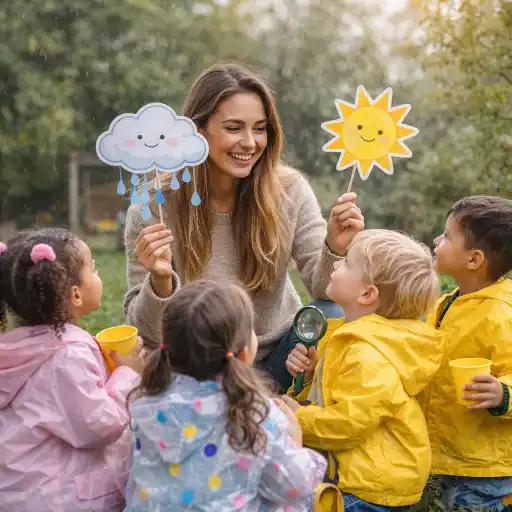
Outdoor exploration lets children experience weather directly through sight, sound, touch, and movement. Choose short activities that focus attention on one or two observable features, and let children’s questions guide the conversation. On a calm day, children can watch clouds move; on a breezy day, they can observe how ribbons or a windsock respond to the air.
- Cloud watching: Look for shapes, changes, and movement. Invite children to describe what they notice or draw a cloud afterward.
- Wind investigation: Compare how ribbons, leaves, or pinwheels move in different conditions. Ask what seems to move more or less.
- Rain measurement: With an adult-prepared rain gauge placed safely outdoors, compare water levels after rainfall and record results together.
- Shadow tracing: On a suitable sunny day, trace a fixed object’s shadow with chalk and return later to notice changes.
- Weather movement: Move like a drifting cloud, gentle breeze, or falling raindrop, then pause and describe the motion.
Connect these experiences to vocabulary and simple comparison rather than expecting young children to master complex meteorology. Children can say “the ribbon is moving more” or “the shadow is longer,” building observation and early reasoning in accessible ways. For outdoor learning design ideas, see ChildCareEd’s Creating the Natural Outdoor Classroom Buy Now $16.00 course.
What weather investigations work well indoors?
Indoor activities can extend outdoor observations or provide a meaningful alternative when conditions are unsuitable for going outside. Offer open-ended materials that let children represent, compare, and explore weather ideas through play. A movement game can meet an active need, while a sensory or art invitation provides a quieter way to investigate. For more ideas to keep children engaged on wet-weather days, explore these rainy-day activities for preschoolers.
- Weather movement game: Call out sunny, windy, rainy, or snowy and invite children to move safely in a way that represents each condition.
- Cloud and rain model: Use a clear container, water, and adult-managed materials to watch colored drops travel through a shaving-cream “cloud.” Supervise continuously and check all materials for age-appropriate use.
- Weather sorting: Match weather symbols to clothing, activities, or pictures, and ask children to explain their choices.
- Forecast dramatic play: Provide a weather chart, pretend microphone, and picture cards so children can share a simple forecast.
- Rain sound exploration: Compare gentle tapping and louder drumming with safe classroom objects, then describe the sounds.
Keep directions concise, model safe use, and leave room for children to repeat or adapt an activity. The purpose is not to produce identical projects; it is to help children notice, test, communicate, and wonder. ChildCareEd’s Basic Science in Early Childhood Buy Now $25.00 course offers additional professional learning on planning meaningful opportunities for children to investigate and experiment.
How can providers balance safety, inclusion, and children’s curiosity?
Weather activities should respond to children’s needs and the day’s conditions. Before outdoor time, follow your program’s weather, air-quality, and supervision procedures; check the play area for hazards and ensure children have suitable clothing, shade, and access to water as needed. If conditions are unsafe or uncomfortable, move the experience indoors rather than treating outdoor access as a requirement. State requirements vary—check your state licensing agency.
Safety planning can preserve children’s agency. Offer choices within clear boundaries: observe from a sheltered spot, explore a designated area, or use an indoor weather station. Adapt tools and participation so children with different mobility, sensory, communication, or developmental needs can take part. Some children may prefer to watch before joining, and observation is a valid form of engagement.
Avoid common pitfalls:
- Do not assume all children experience temperature or sound in the same way; check in and offer alternatives.
- Do not use small, sharp, hot, or otherwise unsuitable materials in demonstrations; adults should manage any higher-risk steps.
- Do not let a weather chart replace current safety checks or your program’s established policies.
- Do not overexplain; listen to children’s ideas and use follow-up questions to extend their thinking.
Thoughtful planning helps weather inquiry remain joyful, accessible, and grounded in real experiences.
How can you keep weather learning going across the week?
A short sequence of related experiences helps children revisit ideas and notice change. Start with a daily observation, then choose one indoor or outdoor activity that follows the children’s interests. At the end of the week, look back at charts or drawings and invite children to describe what they remember. This creates continuity without requiring a lengthy, tightly scripted unit.
For example, children might notice wind during the morning check, test ribbons outdoors, then use scarves to represent moving air indoors on a rainy afternoon. Another group may chart cloudy days, create cloud art, and compare their drawings with the sky. These connections help children see that inquiry can move between settings.
Conclusion: Providers can make weather a practical, engaging science topic by helping children observe, describe, compare, and represent what they experience. Use a consistent weather routine, choose simple indoor and outdoor investigations, and adapt plans to safety and individual needs. When adults treat children’s questions as worthwhile, everyday skies become invitations to learn together.
For further professional learning, consider Building Early Science Foundations Buy Now $16.00, Engaging Indoor Activities for Inclement Weather Buy Now $24.00, Basic Science in Early Childhood Buy Now $25.00, Creating the Natural Outdoor Classroom Buy Now $16.00, and Balancing Physically Active Play in Child Care Buy Now $25.00.
- Science of Reading Foundations in the Pre-K Classroom
- CDA Subject Area 2
- Building Early Science Foundations
- Engaging Indoor Activities for Inclement Weather
- Texas Director Credential
- Montessori Cultural Activities: Exploring the World Through Play and Learning
- Enhancing STEM Education for Infants and Toddlers
- Environments That Inspire Independence and Exploration
- Every Moment Matters: Schedules and Transitions
- Family Child Care: Building, Premises, and Outdoor Safety
- Bye Bye Winter: The Role of Outdoor Play in Early Childhood Development
- CDA Certification en Español: Recursos y Consejos para Educadores Bilingües
- Capacitación en Salud y Seguridad Preventiva en Línea para Proveedores de Cuidado Infantil
- Proporciones de Cuidado Infantil y Tamaños de Grupo por Edad en Maryland (Guía Rápida para Centros y Hogares)
- Proporciones de Cuidado Infantil y Tamaños de Grupo por Edad en Virginia (Guía Rápida para Centros y Hogares)
- Consejos de Supervisión Activa para Salones de Preescolar y el Juego al Aire Libre
- Air Quality and Child Care in California: Outdoor Play Safety Tips
- How can Nevada child care programs keep children safe outdoors when air quality is poor?
- How can Washington programs observe children safely during indoor and outdoor play, rain or shine?
- Daycare Temperature Regulations in Hawaii: Keeping Children Safe Indoors and Outdoors
- How Can Child Care Programs Keep Young Children Safe in Cold Weather?
- How Can Child Care Programs Beat the Heat and Keep Children Safe on Hot Days?
- How to Plan Safe Outdoor Activities During Hot Weather and Poor Air Quality
- What’s Happening Outside? Fall Science Adventures for Preschoolers
- How Can Providers Bring Nature-Based Learning Into Any Program?
- How Can Child Care Programs Balance Indoor and Outdoor Learning Across the Week?
- How Can Child Care Providers Help Children Explore Weather Indoors and Outdoors?
- How Can Educators Turn Indoor Insect Interest into Outdoor Investigation?
- How Can You Add Outdoor Learning Without Rebuilding the Playground?
- Bad Weather on a Field Trip: When Should Child Care Programs Change the Plan?
