A mysterious track can turn an ordinary outdoor moment into a lively science investigation—but children need help distinguishing what they see from what they imagine it means. The [Building Early Science Foundations course](https://www.childcareed.com/courses-building-early-science-foundations-3921.html) supports providers in encouraging developmentally appropriate exploration, experimentation, and discovery; pair it with [Creating the Natural Outdoor Classroom](https://www.childcareed.com/courses-creating-the-natural-outdoor-classroom.html) for ideas on making outdoor spaces rich with learning opportunities. Read on for practical prompts that honor children’s theories while keeping evidence at the center.
Why does the difference between observing and guessing matter?
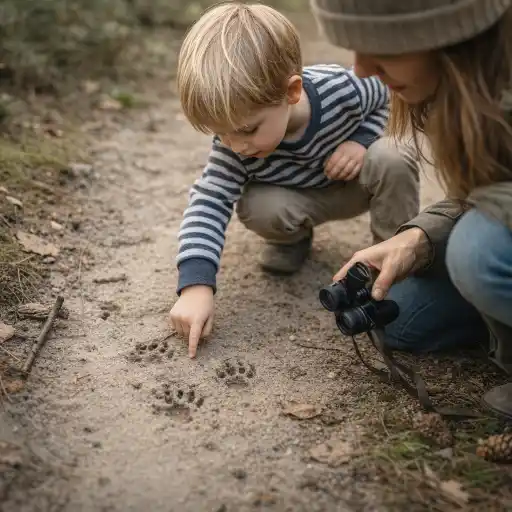
When a child sees a mark in mud and says, “A fox ran to the tree,” several kinds of thinking are happening at once. The child may have noticed a narrow shape, inferred an animal made it, and imagined where it went. That imaginative leap is valuable—but helping children name which part they directly observed and which part is a possible explanation builds early scientific reasoning.
An observation describes information gathered through the senses or a tool: “There are four marks,” “The shape is pointed,” or “The tracks are close together.” An inference is an interpretation based on clues: “A small animal may have made these.” Inferences can be sensible without being certain. A track can suggest a story, but it rarely proves exactly who passed by, when, or why.
This distinction also protects children’s confidence. The goal is not to label a child’s idea as wrong; it is to invite them to explain what supports it and what remains unknown. Outdoor learning offers authentic opportunities to practice this process, and research on preschool explorations notes that children can develop complex ideas about nature when educators provide sensitive guidance and room to investigate.
- Observation: “The marks are in soft mud.”
- Inference: “An animal walked through here.”
- Question to explore: “What other clues could help us decide?”
How can educators help children separate clues from interpretations?
Start by slowing the conversation down. When children announce an answer, respond warmly and ask what they noticed first. Try “What do you see that makes you think that?” or “Which part can we describe without naming the animal?” This keeps curiosity alive while directing attention back to visible evidence.
Offer a simple two-column chart labeled “We notice” and “We wonder.” Children can dictate, draw, point to picture choices, or describe a clue in their home language. For example, a group might record “three marks in a row” under observations and “maybe a bird” under ideas. The chart makes thinking visible and reminds everyone that a theory can change when new information appears.
Use specific, non-leading prompts and allow wait time. Rather than asking, “That must be a rabbit, right?” ask:
- “What shape, size, or pattern do you notice?”
- “What do you know for sure from looking?”
- “What are you wondering or imagining?”
- “What else could have made a mark like this?”
- “What clue might help us compare those ideas?”
Then model revising an idea: “I thought the marks were close together. Looking again, I see a longer space between this pair.” That kind of honest noticing shows children that careful observation is ongoing, not a test with one quick answer.
What is a practical outdoor track investigation?
Choose a familiar, safe area where children may find tracks or other signs in mud, sand, soft soil, or snow. Before heading out, set a clear boundary, review how the group will stay together, and scan the site for hazards. Bring only a few useful items, such as a magnifier, clipboard, paper, washable markers, and picture cards. Keep all tools age-appropriate and avoid small parts that could pose a choking risk.
Invite children to look without stepping on or disturbing a clue. Ask them to describe its shape, size, direction, spacing, and the surface around it. If appropriate, compare the pattern with a reference card, while emphasizing that a match is a possibility rather than proof. Animal movement affects track patterns, and size and shape can offer clues, but weather, overlapping marks, and the kind of ground can make identification uncertain.
- 🕵️ Begin with “What do you notice?” before offering animal names.
- Sketch or photograph the clue only when program policy and permissions allow.
- Follow the pattern with your eyes, not by trampling the trail.
- Look nearby for context, such as a tree, bush, or other habitat feature.
- Return indoors to compare records and discuss what the evidence can—and cannot—tell you.
If no real tracks are visible, children can explore toy-animal prints in trays of sand or play dough, or compare their own footprints made in different ways. Make the distinction clear: a model helps children study patterns, but it is not evidence of an animal visit outdoors.
How can teams document children’s thinking without treating guesses as facts?
Documentation can capture the thinking process, not just a final animal label. Record a child’s words accurately and separate them from an educator’s interpretation. For example: “Leo said, ‘A bird made these.’ He pointed to two narrow marks and noted they were smaller than his boot prints.” The first sentence records the child’s idea; the second describes the clues the child used.
Photographs, sketches, simple maps, and “notice/wonder” charts make it easier to revisit the inquiry. Ask children to compare their first ideas with what they notice later. Did a new clue strengthen a theory, weaken it, or create another possibility? The purpose is not to force a definitive answer when the evidence is incomplete; it is to help children explain how they are thinking.
Keep records brief and useful for planning. A photograph with one child quote may reveal more than a worksheet that captures only a guessed species. Use what children return to—the shape, the route, a nearby habitat—to decide whether to offer a book, compare another track, or create a classroom model. Nature-based early learning guidance likewise emphasizes documenting children’s investigations in ways that support reflection and future planning.
- Write observations in descriptive, neutral language.
- Label an interpretation as a possibility, not a verified fact.
- Invite children to draw or dictate what they notice.
- Follow program procedures for photographs, privacy, and family communication.
What common pitfalls should providers avoid?
One frequent pitfall is naming the animal before children have had time to look closely. This can turn an investigation into a recall exercise: children try to guess the answer the adult expects instead of attending to the evidence. Pause first, invite descriptions, and let children’s observations guide the next prompt.
Another is treating one clue as conclusive. A mark may resemble a familiar print, yet be distorted by weather, another footprint, or the surface. Say, “That is one possibility,” and ask what additional clues would help. Also avoid following tracks into unsafe or restricted areas; the learning opportunity is never more important than supervision and boundaries.
Keep participation flexible. Some children may prefer to observe from a distance, point, sketch, or share an idea with a partner instead of speaking to a group. Visual supports and accessible tools can help more children take part. Check materials for age suitability, supervise closely, and follow program procedures for outdoor activities. State requirements vary - check your state licensing agency.
- Instead of “You’re wrong,” try “What do we know, and what are we still wondering?”
- Instead of “This is definitely a rabbit,” try “The shape resembles this picture; what other clues could we find?”
- Instead of rushing to the next activity, allow time to return to the clue or revisit documentation.
For further professional learning, consider [Basic Science in Early Childhood](https://www.childcareed.com/courses-basic-science-in-early-childhood-3744.html), [Tomorrow’s Einsteins: Infant and Toddler Science](https://www.childcareed.com/courses-tomorrow-s-einsteins-infant-and-toddler-science.html), and [Preschool Assessments & Observations](https://www.childcareed.com/courses-preschool-assessments-observations.html). Each offers a different focus for strengthening science or observation practice.
How can providers answer “What made this track?” responsibly?
A thoughtful answer may be, “We don’t know yet—but we can look closely at the clues.” Help children describe the mark, explain their ideas, and consider what additional evidence might be useful. An animal track can spark stories and hypotheses, while careful language keeps those ideas distinct from what the group has actually observed.
When providers make room for both wonder and uncertainty, children learn that changing an idea is part of investigation. Use open-ended prompts, document observations separately from interpretations, and return to clues when children remain curious. The question “What made this track?” then becomes more than a hunt for a name: it becomes a meaningful practice in noticing, reasoning, communicating, and learning together.
To continue building this approach, [Building Early Science Foundations](https://www.childcareed.com/courses-building-early-science-foundations-3921.html) provides a focused learning opportunity on supporting young children’s curiosity and early scientific inquiry.
- 45 Hour Child Growth and Development
- Creating the Natural Outdoor Classroom
- From Tantrums to Triumphs: Equipping Preschoolers with Self-Regulation Skills
- 45 Hour Infant and Toddler Methods and Materials
- Pediatric RSV First Aid & CPR/AED
- CDA Bridge Bundle: Family Child Care without Portfolio Review
- CDA Bridge Bundle: Infant/Toddler without Portfolio Review
- CDA Bridge Bundle: Preschool without Portfolio Review
- 40-Hour Director's Course
- CDA Infants/Toddlers: Benefits to Observing
- CDA Certification en Español: Recursos y Consejos para Educadores Bilingües
- 🔍 ¿Qué ves cuando observas a un niño aprender?
- Recursos en Español sobre el Sueño Seguro del Bebé
- ¿Cuáles son las mejores actividades del Día de la Tierra para niños en casa o en el aula?
- ¿Cuánto tiempo se tarda en obtener una certificación CDA?
- 10 Ejemplos de Cómo la Cultura Influye en el Desarrollo Infantil
- Capacitación en Salud y Seguridad Preventiva en Línea para Proveedores de Cuidado Infantil
- Regulaciones de Licenciamiento de Cuidado Infantil en California para Centros y Hogares de Cuidado Infantil Familiar
- Proporciones de Cuidado Infantil y Tamaños de Grupo por Edad en Maryland (Guía Rápida para Centros y Hogares)
- Proporciones de Cuidado Infantil y Tamaños de Grupo por Edad en Virginia (Guía Rápida para Centros y Hogares)
- Lista para Guardería en Casa en Texas: Cómo Iniciar una Guardería en el Hogar
- Cómo Ser Maestra de Preescolar en Wisconsin
- Cómo Ser Maestra de Preescolar en Maryland
- Can Toddlers Do STEM in the Sandbox at Minnesota Daycares?
- Celebrando la amistad en el cuidado infantil durante el Día de los Mejores Amigos
- Cómo simplificar la capacitación para sus empleados de daycare
- What Belongs in a Family Communication Log—and What Should Stay Out?
- How Can You Write Objective Child Observation Notes?
- What Should Be Included in a Child Care Incident Report?
- What Made This Track? How Can Providers Separate Outdoor Observations from Guesses?
