Could a daily classroom under trees transform how your children learn, grow, and self-regulate? If you are exploring a forest preschool or want to bring more consistent nature-based experiences to your program, practical training and a clear plan make the difference. A great next step is the 45‑Hour Preschool Curriculum  Buy Now
 $399.00$275.00 course on ChildCareEd, which helps programs shape meaningful, standards‑aligned nature curricula and earns you deep, usable content to adapt to outdoor settings. Pair that with Lesson Planning for Preschoolers Buy Now $24.00 for hands-on sequencing and documentation strategies.
What is a forest preschool and why does it matter?
Forest preschools (also called nature‑based preschools or forest schools) center daily learning in natural settings—woods, greenways, or richly naturalized yards—so children spend large portions of the day outdoors, in all seasons, engaging in child‑led exploration and scaffolded teacher guidance. Research and practice show benefits across physical health, attention, literacy opportunities, and teacher wellbeing (see recent summaries and studies in the references). In short: a forest approach is not a gimmick; it reframes the environment as a powerful curriculum partner.
Why it matters: children who regularly learn in natural settings typically show stronger gross motor skills, improved self‑regulation, richer language tied to sensory experience, and more sustained curiosity. For staff and programs, outdoor routines reduce indoor crowding, create more flexible small‑group moments, and support emergent, project‑based learning—useful when you must align to standards and accreditation. Investing in training like the 45‑Hour Child Growth and Development Buy Now $399.00 course helps educators read child cues and design nature moments that meet developmental goals.
Across this article, you’ll see practical steps you can apply whether you are a director redesigning a yard or a lead teacher planning a weekly forest day. Remember: state requirements vary - check your state licensing agency.
How do I adapt curriculum and daily routines to a nature‑based model?
Shift from “indoors then outside” to “outdoors as the primary learning environment.” That does not mean abandoning structure—successful forest programs weave routines, rituals, and short teacher‑led provocations into open investigation time. Use learning goals to anchor messy play: a counting goal can be fulfilled by collecting and sorting pinecones; a literacy goal can emerge from oral storytelling around a sit spot.
Practical moves:
- Map your standards to outdoor experiences (math, language, science, social‑emotional).
- Write short, layered lesson plans that include one clear objective, two activity tiers (emergent and scaffolded), and a documentation note—Lesson Planning for Preschoolers is useful here.
- Establish predictable outdoor rituals (welcome circle, gear routine, sit spots, cleanup songs) so children feel safe and can transition to deeper play.
- Train staff in Developmentally Appropriate Practice for outside contexts; consider the DAP for Preschool Buy Now $35.00 course to adapt activities across ages.
How do we manage safety, risk, supervision, and licensing outdoors?
Safety planning is both policy and daily practice. Forest preschools intentionally include appropriate risk—climbing low limbs, using simple tools, mud play—because such risks build resilience and motor competence. That said, risk ≠ hazard: conduct site hazard scans, create written risk assessment plans, and document mitigation strategies. The National guidance and tools recommend a risk assessment plan for higher‑risk activities; this should be shared with staff and families.
Key operational elements:
- Active supervision models and clear staff roles. Take an instructor course such as Effective Supervision in Child Care Buy Now $25.00 to formalize scanning, positioning, and communication procedures.
- Ratios and distances: adapt adult: child ratios based on activity and terrain; when traveling offsite or deeper into a forest, increase supervision. State requirements vary - check your state licensing agency.
- Health & weather plans: sun protection, tick checks, hydration protocols, and air‑quality/heat rules. Follow CDC guidance on outdoor play safety when applicable.
- Written risk assessments, family consent forms, and staff training logs. Use a sample Risk Assessment Plan to explain benefits and mitigation to families.
What are the practical steps, materials, and site adaptations I need to start?
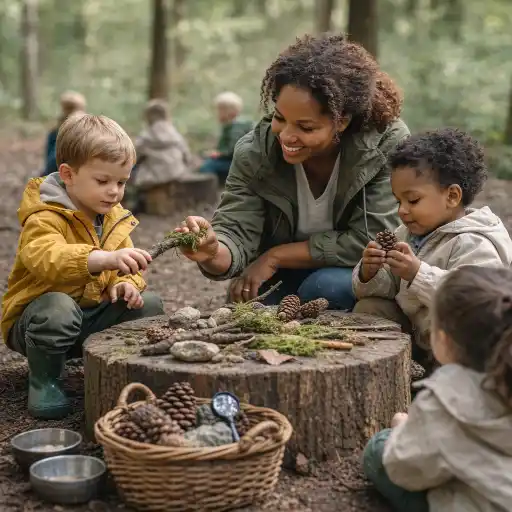
Begin small and iterate. You do not need acres—many programs start with a daily nature walk and a naturalized play yard. Gather low‑cost materials and portable kits so outdoor learning is reproducible across seasons and staff. Below is a starter checklist you can adapt.
- 🌲 Portable Nature Kit (clipboards, pencils, magnifiers, sit‑pads, first‑aid, hand sanitizer)
- Loose parts: buckets, rope, tarps, sticks, rocks, pinecones, shells
- Weather gear: spare rain pants, boots, sunscreen, sun hats
- Simple furniture: stumps or crates for meeting circles, bucket seats (see CoOL toolkit tips)
- Documentation tools: camera, observation sheets, nature journals
Site adaptations to consider: create defined learning zones, small clearings for circle time, a mud kitchen or garden bed, and accessible trails. Prioritize shade and sheltered options for sudden weather. Start with a pilot group, run brief daily debriefs with staff, and refine your schedule. For curriculum alignment and deeper planning, the 45‑Hour Preschool Curriculum Buy Now $399.00$275.00 course provides templates and sequences you can adapt outdoors.
How do we assess learning, document outcomes, and involve families?
Assessment in nature settings should be light, frequent, and tied to observable behaviors. Focus on snapshots: a photo, a child quote, and a one‑sentence learning note that links to a goal. Over time, build portfolios showing process work—mud art, time‑lapse plant growth, recorded conversations about findings.
Practical documentation moves:
- Use short rubric notes: motor, language, social, cognitive for each child after a session.
- Encourage child journals or group reflection boards to capture emergent questions and project ideas.
- Share weekly highlights with families—photos + short learning statements. Clear field trip permission and gear lists help families participate; when transporting children, remember to review transportation and permission procedures.
- For structured assessment skills, consider Preschool Assessments & Observations Buy Now $24.00 to tighten your evidence for developmental goals and program evaluation.
Common mistakes — how can we avoid pitfalls?
Programs often stumble by overplanning, treating outdoor time as a reward, or applying indoor expectations unchanged to outdoor play. Avoid these by keeping outdoor learning goal‑oriented but flexible, practicing routines, and training staff to interpret messy play as meaningful learning (and document it). Communicate proactively with families about safety, clothing needs, and learning goals; a lending gear bin prevents inequities in access.
FAQ
Q: Do we need a separate license to be a forest preschool?
A: Licensing depends on your state and program type—some states (or pilots) have specific guidance for outdoor preschools. State requirements vary - check your state licensing agency.
Q: How often should we go outside?
A: Aim for daily outdoor blocks; Minnesota and other exemplary programs suggest multiple outdoor sessions that total several hours, adjusted for age and weather.
Q: What about allergies and ticks?
A: Use family medical forms, follow CDC insect‑bite guidance, and incorporate tick checks into routine. With consent, use EPA‑registered repellents per label guidance.
Conclusion
Bringing a forest preschool model into your program is a feasible, high‑impact shift when you combine clear learning goals, training, safety planning, and family partnerships. Start with small pilots, portable kits, and consistent rituals. Training options on ChildCareEd—such as 45‑Hour Preschool Curriculum Buy Now $399.00$275.00, Lesson Planning for Preschoolers Buy Now $24.00, 45‑Hour Child Growth and Development Buy Now $399.00, Effective Supervision in Child Care Buy Now $25.00, and Preschool Assessments & Observations Buy Now $24.00—give you concrete skills to design safe, standards‑aligned outdoor learning. Your next step: pick one learning goal, plan three outdoor sessions, and document one child’s progress to build momentum. Your program—and your children—will benefit from more #forest time outdoors and a nature‑rich #curriculum that supports holistic development.
- 👶 ¿Cuáles son las proporciones y grupos requeridos en Dakota del Norte? 🏫
- Requisitos Para Ser Maestra Principal En Un Daycare: Lo Que Necesitas Para Empezar
- Recursos en Español sobre el Sueño Seguro del Bebé
- 10 Ejemplos de Cómo la Cultura Influye en el Desarrollo Infantil
- Cómo Empezar una Guardería en Casa: Requisitos y Pasos
- Proporciones de Cuidado Infantil y Tamaños de Grupo por Edad en Virginia (Guía Rápida para Centros y Hogares)
- Lista para Guardería en Casa en Illinois: Cómo Iniciar una Guardería en el Hogar
- Lista para Guardería en Casa en Texas: Cómo Iniciar una Guardería en el Hogar
- Cómo Ser Maestra de Preescolar en Maryland
- How can Washington forest and nature center field trips work well on a rainy day?
- Summer Field Trips for Daycares in Illinois
- Online Early Childhood Education Courses in Canada with Certificates
- Celebrando la amistad en el cuidado infantil durante el Día de los Mejores Amigos
- Canciones, juegos y preguntas de círculo para niños
- Cómo simplificar la capacitación para sus empleados de daycare
- Can forest preschool activities be integrated into traditional programs?
- How can I bring a Forest Preschool (nature-based learning) to my program?
- Can traditional child care programs add forest preschool activities without starting a new program?
- How Can Providers Bring Nature-Based Learning Into Any Program?
