A rain-washed sidewalk can feel like the end of a child’s artwork—but it can also be the beginning of a compelling investigation into change, water, and evidence. Explore practical ways to help children turn that surprise into meaningful inquiry, and consider Building Early Science Foundations  Buy Now $16.00 for deeper professional learning about supporting children’s curiosity, experimentation, and discovery.
Why can disappearing chalk art become a valuable learning moment?
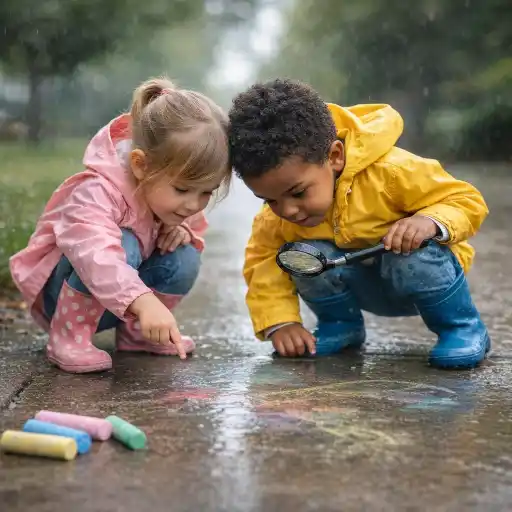
When rain fades a chalk drawing, children encounter a real change in a familiar place. Their questions—“Where did it go?” or “Will it come back?”—offer a natural entry point to observe, predict, test, and explain. Rather than treating the artwork’s disappearance as a problem to fix, providers can honor the moment as an invitation to investigate.
Children can notice that rain makes chalk look darker, softens or spreads some marks, and may eventually wash visible pigment from the pavement. They can compare what happens on a damp day with what happens when the sidewalk dries in sunshine. These observations connect art with early ideas about materials, water, weather, and evaporation. A wet-chalk exploration can also prompt discussion of texture, color, pressure, patterns, and shapes, as described in Chalk Magic.
The value is not in delivering a technical lecture or expecting one correct explanation. It is in helping children attend to evidence and express what they think. When educators listen closely, children’s spontaneous discoveries can guide the next activity and make the curriculum responsive to their interests.
How can providers set up a simple chalk-and-rain investigation?
Keep the invitation low-prep and focused on one question, such as “What happens to our chalk drawings when they get wet?” Choose an appropriate outdoor area, check weather and surface conditions, and make sure the group can be actively supervised. Offer only a few materials at first so children can concentrate on what changes.
- Gather sidewalk chalk in several colors, a small amount of water or a gentle-mist spray bottle, and a clipboard or chart for recording ideas.
- Invite children to make a drawing or a few colored lines on dry pavement. Let them choose what to create; the investigation is about the material, not producing a matching product.
- Before adding water, ask what they think might happen. Record their predictions using their words or simple drawings.
- Add water gently, or observe the marks after a light rain. Pause to notice color, texture, edges, and whether the chalk moves or fades.
- Return to the same area later, if practical, and compare the wet surface with the dry one.
Actual rain is not necessary. A spray bottle or carefully controlled drips can provide a repeatable alternative. Testing wet and dry chalk side by side helps make comparisons easier; wet chalk can appear brighter or smoother before it dries, as illustrated in Exploring Wet vs. Dry Chalk.
What questions help children investigate instead of simply watch?
Thoughtful prompts focus children’s attention without taking over their work. Start by observing and listening. Then offer open-ended questions that invite a child to describe what they notice, share a prediction, or propose a way to test an idea.
- “What do you notice about the chalk now?”
- “How does this wet mark look or feel different from the dry one?”
- “What do you think will happen if we wait until the sidewalk dries?”
- “Where could we look for a clue about what changed?”
- “What could we try if we want to compare two colors?”
Give children time to respond in speech, gesture, home language, movement, or drawing. A child might say the color “ran away,” while another points to a lighter patch or traces the edge of a puddle. Those responses are useful evidence of thinking. Educators can build on them with words such as wet, dry, darker, lighter, spread, fade, and evaporate, while keeping explanations accessible and connected to what children can see.
Inquiry develops through a cycle of noticing, predicting, testing, and sharing—not through rapid-fire questioning. The ECE Resource Hub’s overview of inquiry similarly emphasizes observing, predicting, experimenting, recording, and communicating. Follow the children’s interest: if they wonder whether the sun changes the marks, revisit the drawings later and compare what has happened.
How can educators make children’s observations visible over time?
A brief record can help children revisit their thinking and help staff plan what comes next. Before the experiment, note a child’s prediction. During and after the activity, capture one observation in the child’s own words. A quick photo of the chalk before and after water is added can make the change especially clear, provided your program’s permissions and documentation practices are followed.
- Draw a simple two-column chart labeled “Before water” and “After water.” Children can add marks, pictures, or dictated observations.
- Compare two conditions: chalk left dry and chalk gently sprayed with water. Keep other factors as similar as possible.
- Revisit the location after a short interval and again after it dries. Ask what changed and what stayed the same.
- Invite children to explain their results to a peer or family member using a drawing, photograph, or short description.
These records need not become formal tests. They provide a practical way to notice whether children are comparing, making predictions, and revising ideas. A related outdoor activity, Disappearing Water, uses water painting and puddle tracing to help children observe drying and evaporation. Educators can connect that experience to the chalk investigation while avoiding the suggestion that every visible change has one simple cause: rain can move or dilute chalk, while water can also evaporate as a surface dries.
What common pitfalls should providers avoid?
Some challenges are easy to anticipate. The first is explaining too soon. When an adult immediately supplies a scientific term or answer, children may lose the chance to compare evidence and develop their own questions. Begin with “What do you think?” and build vocabulary from children’s observations.
Another pitfall is expecting every drawing to remain intact. The investigation is about change, and the changing artwork is part of the experience. If a child is attached to a particular picture, offer a choice: photograph it before testing, make a separate investigation drawing, or keep that artwork dry. Respecting children’s feelings supports participation without turning the activity into a demand.
- Use only a small, controlled amount of water; avoid slippery areas and maintain close supervision.
- Do not require children to go outside in unsafe weather. Recreate gentle “rain” with an adult-controlled spray bottle when appropriate.
- Adapt participation with seated access, larger chalk pieces, visual choices, or a watching role for children who prefer not to touch wet materials.
- Keep the activity focused: test one change at a time when you want children to make a clear comparison.
- 💧 Treat cleanup and handwashing as part of the routine, and follow your program’s procedures for outdoor materials and weather decisions.
Safety and access are not obstacles to inquiry; thoughtful planning allows more children to take part. State requirements vary—check your state licensing agency.
How can this investigation grow into a larger learning sequence?
One brief chalk experiment can lead to several connected explorations. Children might compare chalk on pavement with chalk on dark paper, examine how different amounts of water affect marks, or use broad brushes to “paint” with water on a dry surface and watch the water disappear. Keep the focus on observable changes and let children’s questions determine which extension makes sense.
Art, language, math, and science can develop together. Children can sort chalk by color, describe lines and shapes, compare wet and dry areas, or dictate a short account of what they observed. If they become interested in what rain does to other materials, offer safe objects or art media for comparison under close adult supervision. The NSTA’s rain and art-media investigation illustrates how questions about materials can emerge during creative work.
For providers who want a fuller grounding in play-based inquiry and developmentally appropriate science experiences, explore Building Early Science Foundations Buy Now $16.00. You may also find these related ChildCareEd courses useful for extending the practice:
- Basic Science in Early Childhood Buy Now $25.00 — strategies for planning meaningful science experiences and supporting children’s reasoning.
- Creating the Natural Outdoor Classroom Buy Now $16.00 — ideas for designing outdoor spaces that invite exploration.
- Enhancing STEM Education for Infants and Toddlers Buy Now $16.00 — ways to support early STEM discovery with younger children.
- Children at the Wheel ONLINE Buy Now $24.00 — an emergent-curriculum approach that builds from children’s interests.
Conclusion: When rain erases chalk, providers can help children turn a fleeting art moment into an investigation. Invite predictions, compare what happens before and after water, listen for children’s explanations, and document just enough to revisit the question. The aim is not to preserve the drawing or deliver a perfect answer; it is to nurture curiosity, careful observation, and the confidence to ask, “What could we find out next?”
- 45 Hour Child Growth and Development
- CDA Home Visitor Subject Area 3 Part 3 Birth to 5
- The ABCs of Behavior: Turning Challenges into Learning Opportunities
- Children at the Wheel: Emergent Curriculum
- Art from the Heart for Preschoolers: Open Ended Art Projects that Build Self-Esteem
- Creating Environments that Nurture Growth and Community
- Texas Director Credential
- Montessori Cultural Activities: Exploring the World Through Play and Learning
- Enhancing STEM Education for Infants and Toddlers
- CDA Certification en Español: Recursos y Consejos para Educadores Bilingües
- Cómo Abrir Una Quardería En Casa Sin Dinero?
- Requisitos Para Ser Maestra Principal En Un Daycare: Lo Que Necesitas Para Empezar
- Recursos en Español sobre el Sueño Seguro del Bebé
- Apoyo en Español para Capacitaciones Grupales Presenciales y por Zoom en Cursos Selectos
- 10 Ejemplos de Cómo la Cultura Influye en el Desarrollo Infantil
- Normas de Licenciamiento de Cuidado Infantil en Virginia para Centros Diurnos Infantiles y Hogares Diurnos Familiares
- Proporciones de Cuidado Infantil y Tamaños de Grupo por Edad en Nueva Jersey (Guía Rápida para Centros y Hogares)
- Proporciones de Cuidado Infantil y Tamaños de Grupo por Edad en Virginia (Guía Rápida para Centros y Hogares)
- Lista para Guardería en Casa en Texas: Cómo Iniciar una Guardería en el Hogar
- Retraso del Habla en la Guardería: Cómo Pueden Ayudar los Proveedores
- Cómo Ser Maestra de Preescolar en Illinois
- Cómo Ser Maestra de Preescolar en California
- Cómo Ser Maestra de Preescolar en Maryland
- Las Mejores Ideas de Excursiones para Guarderías en Dakota del Norte
- Celebrando la amistad en el cuidado infantil durante el Día de los Mejores Amigos
- Canciones, juegos y preguntas de círculo para niños
- Cómo simplificar la capacitación para sus empleados de daycare
- Where Did the Puddle Go? How Can Children Follow One Puddle Over Time?
- When Rain Erases the Chalk, How Can Disappearing Art Become a Science Investigation?
