When children play side by side, they are already building the comfort and peer awareness that can lead to collaboration. Learn how to honor that stage while creating gentle, practical pathways toward shared play; From Play to Planning: Building Culturally Competent, Child-Centered Curriculum  Buy Now $55.00 offers deeper strategies for play, scaffolding, problem-solving, and inclusive planning. For a focused look at relationships and peer problem-solving, explore Supporting Social Learning: Creating Classrooms that Care Buy Now $24.00 as a practical professional-learning next step.
Why is parallel play a meaningful foundation for cooperation?
Parallel play occurs when children play near one another but follow separate ideas or goals. Two children may build their own towers at the same table, push cars along different paths, or draw side by side. They may glance at, imitate, or comment on one another, but they are not yet coordinating a shared activity. This is not failed cooperation; it is a meaningful way to become comfortable with peers and a shared setting.
Play stages are best treated as flexible patterns, not a timetable or a test. Children may move between parallel, associative, and cooperative play depending on the activity, their familiarity with peers, energy, communication, and comfort. A child who watches before joining is still gathering information. ZERO TO THREE’s professional guide to parallel play emphasizes that observing and playing alongside peers can support learning and that development does not follow rigid deadlines.
With repeated opportunities, children may begin to exchange materials, talk about each other’s activities, and eventually plan together. Cooperative play involves a shared idea, goal, role, or rule—such as deciding to build one town together. It draws on communication, turn-taking, flexible thinking, and emotional regulation. Recognizing the value of parallel play helps educators choose an appropriate next step rather than rushing children into group interaction.
How can teachers recognize and respect each child’s readiness?
Begin with careful observation before offering a prompt. Notice whether a child watches peers, imitates an action, moves closer, accepts an offered material, responds to a comment, or stays focused on an independent goal. These small actions offer clues about the child’s interests and comfort. Jot down what happened, the context, and what support—if any—helped, rather than labeling a child as “shy” or “antisocial.”
Readiness is individual and situation-specific. A child may enjoy building near a familiar friend but prefer independent exploration in a loud dramatic-play center. Language differences, sensory needs, temperament, culture, and previous experiences can shape how a child approaches peers. A pause, a gesture, or watching quietly may be a meaningful way to participate. Allow time for children to observe and keep independent options available.
- Look for brief peer awareness, imitation, shared attention, or interest in similar materials.
- Offer an invitation rather than a demand: “Would you like to put a block beside Maya’s?”
- Accept nonverbal communication, home-language words, gestures, and assistive communication as valid participation.
- Keep children’s independent play available; joining a group should not be the price of access to materials.
Warm, responsive relationships help children feel secure enough to explore peer connections. CSEFEL’s guidance on building positive teacher-child relationships highlights following children’s interests, listening, and using calm, simple language. These practices create a supportive base from which children can take social risks at their own pace.
How can the classroom environment invite shared play?
Classroom design can make interaction easier without requiring it. Create clearly defined, accessible centers where children can see what is available and find peers with similar interests. Place related materials together—such as vehicles near blocks, dishes in dramatic play, or large paper at an art table—so shared ideas can emerge naturally. Open-ended materials invite children to invent uses and negotiate a plan, while duplicates help prevent scarcity from becoming the main focus.
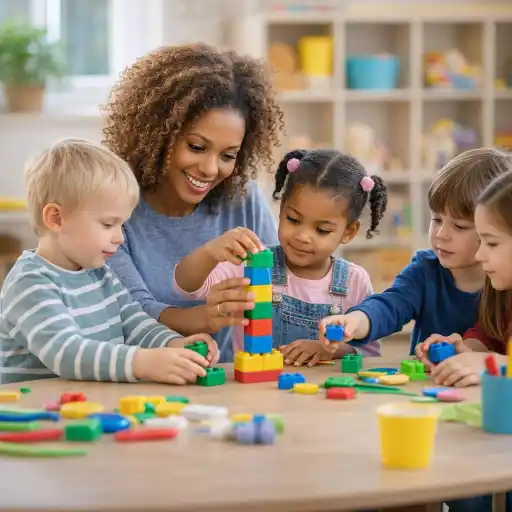
Protect enough uninterrupted play time for children to settle in, observe, and develop an idea. Keep pathways clear and balance active areas with quieter spaces. Small groups, often pairs or three children, can make a shared task feel manageable. Familiar themes based on children’s interests—building a neighborhood, setting up a pretend café, or creating a garden—offer accessible entry points and multiple possible roles.
- 🧱 Provide open-ended materials, such as blocks, fabric, boxes, art supplies, and pretend props.
- Use labeled, child-accessible containers so children can select and return materials independently.
- Offer both duplicate materials for side-by-side exploration and a few shared items that invite turn-taking.
- Arrange centers so children can see one another’s work without crowding or blocking supervision.
- Extend a child’s existing interest with a small addition, such as a bridge piece, map, sign, or role card.
Resist the urge to turn every center into a group project. The aim is to offer a welcoming environment where interaction can grow from children’s own curiosity. Notice which spaces naturally bring children together and adjust the layout and materials in response.
Which teaching strategies help children take the next step?
Use responsive scaffolding: observe, make one small helpful move, then pause. A teacher might narrate, “You’re making a road, and Leo is driving a car nearby,” giving children language for noticing one another without requiring a response. If a child shows interest, suggest a brief shared goal: “Could your road connect to Leo’s?” Keep the idea open-ended so children remain in charge of how play develops.
Model concise, reusable language during calm moments and in the flow of play. Puppets or role-play can make practice light and low-pressure. Useful phrases include “Can I play?”, “What are you making?”, “Can I have a turn when you’re finished?” and “Let’s make one together.” Visual role cards, picture cues, gestures, timers, and communication tools can support children who benefit from concrete ways to understand and express choices.
- Start with a paired task, such as carrying materials together or adding pieces to one shared structure.
- Offer complementary roles: one child gathers blocks while another places them, then invite them to switch if they wish.
- Describe cooperation specifically: “You listened to Amira’s idea and added a window.”
- When a child is watching, offer a low-pressure role such as choosing a sign, passing a prop, or observing before joining.
Step back when children are engaged. Too many adult questions or directions can interrupt their ideas and shift ownership from children to teacher. For practical play-planning and scaffolding approaches, consider The Best Promotion is Play Buy Now $24.00. The goal is not to produce a polished group project; it is to help children experience themselves as capable contributors.
How can teachers respond to conflict and include every child?
Disagreement is a normal part of shared play: children may want the same prop, disagree about a story, or have different ideas about what to build. Stay close enough to keep everyone safe, describe the problem neutrally, and acknowledge feelings: “You both want the long block. You look frustrated.” Give children a moment to respond, then invite a solution: “What could work for both builders?” If they need help, offer a few concrete options, such as a timer, a similar material, taking turns, or changing the plan.
Avoid forcing immediate sharing, taking away a desired toy at the first disagreement, or solving every problem before children can try. A visible turn-taking tool can make waiting more understandable than a broad command to “share.” If emotions rise or safety is at risk, intervene calmly and revisit problem-solving when children are ready. Repair might mean returning a prop, rebuilding a structure, or finding a new way to include a peer; a forced apology is not the only meaningful response.
Inclusion means making participation accessible, not expecting every child to play in the same way. Adapt group size, materials, sensory conditions, communication supports, and roles. Some children may contribute through a gesture, a brief turn, parallel activity, or watching before joining. Collaborate with families and relevant specialists when a child benefits from individualized supports. Directors can help staff use consistent language and reflect on which adjustments increase participation. State requirements vary - check your state licensing agency.
Conclusion: What helps children move from parallel to cooperative play?
Children move toward cooperation through time, relationships, accessible environments, and repeated low-pressure opportunities—not through pressure to “play nicely” on demand. Parallel play is a valid form of participation and a foundation for noticing, imitation, and comfort with peers. Teachers can support the next step by observing readiness, connecting children’s interests, modeling simple language, offering small shared goals, and coaching conflict without taking over.
Remember these practical takeaways:
- Value parallel play and treat play stages as flexible, not as deadlines.
- Design inviting spaces with open-ended materials, duplicates, and enough time for play to deepen.
- Use brief prompts, clear roles, and specific encouragement, then allow children to lead.
- Adapt participation so children with different communication styles, abilities, and sensory preferences can contribute.
- Notice small steps—watching, imitating, asking to join, taking a turn, or adapting a plan—as evidence of growing connection.
The central goal is to help each child find a comfortable, meaningful way to connect with peers. With patient and consistent support, side-by-side play can become shared stories, collaborative projects, and joyful classroom community.
Explore five relevant ChildCareEd courses
- From Play to Planning: Building Culturally Competent, Child-Centered Curriculum Buy Now $55.00
- Supporting Social Learning: Creating Classrooms that Care Buy Now $24.00
- The Best Promotion is Play Buy Now $24.00
- Social Foundations and Responsive Classrooms Buy Now $24.00
- You’re Not My Friend Anymore: Learning Conflict Resolution Buy Now $16.00
- The Best Promotion is Play
- From Play to Planning: Building Culturally Competent, Child-Centered Curriculum
- Birth to Five CDA Credential with Portfolio Review
- CDA Bridge Bundle: Family Child Care without Portfolio Review
- CDA Bridge Bundle: Infant/Toddler without Portfolio Review
- The Best Promotion is Play
- Play, Learn, Grow
- Creating Engaging and Meaningful Learning Experiences
- Creating Environments that Nurture Growth and Community
- Every Moment Matters: Schedules and Transitions
- 10 Ejemplos de Cómo la Cultura Influye en el Desarrollo Infantil
- How can indoor creative play encourage teamwork for preschoolers in California?
- Celebrando la amistad en el cuidado infantil durante el Día de los Mejores Amigos
- Canciones, juegos y preguntas de círculo para niños
- Cooperative Play vs. Parallel Play: What’s the Difference?
- Define Cooperative Play: Examples for Preschool and Child Care
- How can child care providers encourage cooperative play among preschool children?
- Team-Building Games for Preschoolers That Teach Cooperation
- Preschool Team-Building Activities for Better Communication and Friendship
- First Week of Pre-K Activities That Help Children Feel Comfortable
- How Can Bingo Games Support Turn-Taking and Social Skills?
- What Developmental Milestones Should Teachers Know From Birth to Age 5?
- How Can Child Care Providers Teach Sharing Without Forcing It?
- What Should a 2-Year-Old Be Learning at Daycare?
- What Are the Social-Emotional Milestones From Birth to Age 5?
- How Do Parallel Play, Associative Play, and Cooperative Play Differ?
- At What Age Do Children Start Playing Together?
- What Is the Difference Between Parallel Play and Cooperative Play?
- What Are the Best Ways to Support Cooperative Play in Preschool?
- How Can Teachers Help Children Move From Parallel Play to Cooperative Play?
