Gratitude becomes meaningful to young children when they experience how care, help, and shared effort make a difference. Through cooperative play, providers can help children notice one another’s contributions and practice expressing appreciation in ways that feel genuine; Brighter Futures: Social Emotional Development  Buy Now $16.00 offers focused professional learning on emotional development and responsive interactions. For a deeper look at how play supports cooperation, creativity, and problem-solving, explore The Best Promotion is Play Buy Now $24.00 as a practical next step for your classroom practice.
Why does gratitude belong in cooperative play?
Gratitude is more than saying “thank you” on cue. In early childhood, it begins with noticing that someone helped, thinking about what that help made possible, feeling appreciation, and finding a comfortable way to express it. Shared play gives children concrete experiences to make those connections: a peer holds a block while another builds, a group gathers materials for a pretend picnic, or children create a mural together.
These moments also support empathy, communication, and belonging. When educators name the contribution and its effect—“You passed the blue crayon, and now Maya can add a flower”—children begin to connect actions with other people’s experiences. This approach reflects the relational, practice-based view of gratitude described in age-appropriate gratitude teaching.
Cooperative play is not a shortcut to instant sharing or perfect teamwork. It is a low-pressure setting where children can try, struggle, repair, and try again with adult support. As the ChildCareEd guide to empathy, kindness, and cooperation emphasizes, ordinary classroom experiences offer repeated opportunities to practice social skills.
How can educators make gratitude developmentally appropriate?
Children’s capacity to collaborate and express appreciation grows over time, and individual children may be ready for different kinds of participation. Match your language, activity, and expectations to the child rather than treating gratitude as a performance or a fixed milestone.
- Infants: Use warm, responsive language during shared moments: “Thank you for looking at the book with me.” Infants benefit from predictable care and the emotional tone of appreciative interaction.
- Toddlers: Keep the connection immediate and concrete: “You gave Alex a block. That helped him build.” Offer a gesture, picture, or brief phrase as an optional way to respond.
- Preschoolers: Invite reflection about shared effort: “Who helped us finish the road?” or “What did your partner do that made the game fun?” Children may answer verbally, draw, dictate, or demonstrate.
Some children are still learning to play alongside peers before they can sustain a shared goal. Parallel and associative play are valuable experiences, not evidence that a child is ungrateful or unwilling to cooperate. Adjust group size, provide duplicate materials when possible, and offer clear roles. These flexible approaches are consistent with the varied stages of cooperative play in preschool.
Which cooperative activities help children notice others’ contributions?
Choose activities with a shared purpose and more than one meaningful role. The aim is not to require a scripted “thank you,” but to create authentic reasons for children to depend on and appreciate one another.
- 🤝 Build it together: Invite a small group to construct a bridge, animal home, or pretend town. Prompt children to request materials and notice how each idea shapes the finished structure.
- Make one big picture: Provide a large sheet of paper and shared art materials. Children can add to one scene, comment on a peer’s contribution, and decide together what the picture needs next.
- Plan a pretend picnic: Assign flexible roles such as setting out plates, choosing pretend food, or welcoming guests. At the end, reflect on how each job helped the group.
- Help-and-notice cleanup: Make cleanup a shared mission. Afterwards, name specific contributions: “You gathered the books while your friend sorted the blocks.”
- Pass a rhythm: Children take turns creating a clap or movement for the group to copy. Encourage them to notice how listening and joining in made a shared pattern.
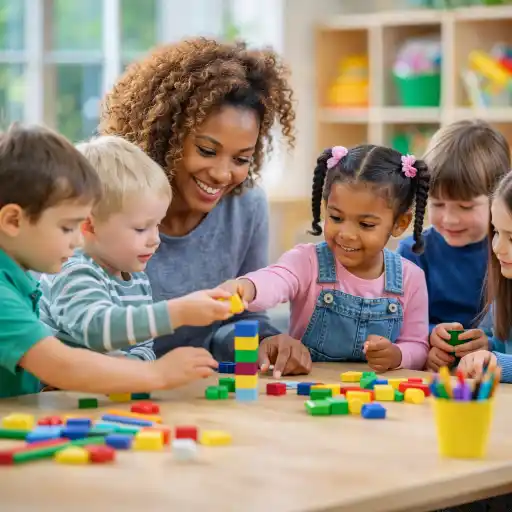
For additional activity ideas, educators can adapt cooperative games that build sharing, turn-taking, and empathy. Keep activities brief enough for children’s attention and repeat favorites so they can build familiarity and confidence.
What should educators say and do while children play?
Adults make the learning visible by modeling appreciation and narrating specific actions without taking over the play. Instead of relying on general praise such as “Good job,” describe what happened and how it affected the group: “You waited for the shovel, and now both of you can dig.” This connects a child’s choice to a real outcome.
Use open-ended prompts that invite children to observe and reflect rather than search for a single correct answer:
- “What did your friend do to help the game continue?”
- “How did we figure out what to build together?”
- “What could we say or do to show we noticed that help?”
- “Would you like to tell them, draw something, or show them with a gesture?”
When conflict arises, stay calm and coach the next step: name the problem, acknowledge feelings, and offer simple choices. For example, “You both want the basket. You can take turns carrying it, or we can find another basket.” A child who is frustrated may not be ready to express appreciation right away. Protect the relationship first; reflection can come later.
Educators can further develop these skills through Supporting Social Learning: Creating Classrooms that Care Buy Now $24.00, which focuses on community building, relationships, problem-solving, and open dialogue. Specific, respectful modeling helps #gratitude grow naturally alongside #empathy and #cooperation.
How can programs make cooperative gratitude inclusive?
Children and families express appreciation in different languages, gestures, traditions, and everyday practices. A welcoming classroom does not assume that every child celebrates the same holidays, speaks comfortably in a group, or wants to offer public thanks. Keep activities centered on shared care and everyday contributions, and let children decide how they participate.
- Offer ways to communicate beyond speech, including drawing, movement, signs, photographs, home-language words, and adult-recorded dictation.
- Provide multiple roles so children with different interests, abilities, sensory preferences, and communication styles can contribute.
- Use flexible language such as “someone who helped you” or “something that made play easier,” rather than assuming a particular family structure or tradition.
- Invite family ideas and share the classroom’s approach so appreciation practices can connect with home without placing demands on families.
Families can share a phrase for appreciation in a home language or describe ways their child likes to contribute. The goal is partnership, not asking families to perform or represent an entire culture. As the kindness and cooperative-learning guidance notes, group activities can give children meaningful practice in inclusion and teamwork.
Observe whether every child has a genuine opportunity to join and whether materials, group size, or timing create barriers. Adapt the environment before interpreting a child’s hesitation as disinterest. When planning family events, collecting images, or sharing children’s work, follow program policies; state requirements vary - check your state licensing agency.
How can providers sustain the practice and avoid common pitfalls?
Gratitude grows through repeated, ordinary interactions—not a single themed lesson or a display that children are expected to fill. Choose a manageable routine, such as a brief reflection after group play, and keep it consistent. Record observations of children noticing help, offering materials, inviting a peer, or describing how a shared effort felt. Look for progress over time rather than expecting every child to use the same words.
Common pitfalls are easy to understand, especially on busy days, and small adjustments can keep the practice supportive:
- Forcing a thank-you: Model appreciation and offer a choice of response; do not require a child to perform gratitude on demand.
- Turning cooperation into competition: Emphasize shared effort and collective problem-solving rather than speed, winners, or a single “best” helper.
- Taking over conflict: Give children time to try a solution, then offer short, concrete language and support as needed.
- Assuming every child is ready for group play: Start with a partner, parallel play, or a brief shared task and build gradually.
- Praising only visible or verbal contributions: Notice quiet participation, nonverbal communication, persistence, and behind-the-scenes help too.
Directors can support consistency by discussing observation notes in team meetings and agreeing on a few respectful phrases staff can use. Professional learning such as Opportunity for Growth: Emotional Development Buy Now $16.00 can help providers connect children’s emotional development with emerging social skills. This course link, along with the two introductory links, provides relevant next steps for building practical knowledge; confirm whether any training meets your program or local professional-development requirements.
Conclusion: How does cooperative play nurture gratitude?
Cooperative play gives young children real experiences of interdependence: someone shares a material, listens to an idea, offers help, or contributes to a shared goal. Educators can help children connect those actions to their effects by modeling specific appreciation, asking gentle reflective questions, and offering several ways to participate. The strongest practice is developmentally responsive, inclusive, and repeated in ordinary classroom life.
Start small: choose one collaborative activity this week, make sure every child has an accessible role, and name the contributions that help the group succeed. Avoid forced thanks and perfection-based expectations; instead, value noticing, effort, and repair. With steady support, #play becomes a meaningful pathway for children to practice #kindness, recognize one another, and build a caring classroom community.
- CDA Home Visitor Subject Area 3 Part 3 Birth to 5
- CDA Home Visitor Subject Area 2 Part 3 Birth to 5
- The Best Promotion is Play
- The Best Promotion is Play
- Emergent Learning & Development
- Play with Purpose: Supporting Children with Autism
- Texas Director Credential
- Montessori Cultural Activities: Exploring the World Through Play and Learning
- Supporting Families and Caregivers in Language and Literacy
- Professional Integrity in Child Care
- Gift of Gratitude: Fostering Emotional Intelligence in Children through Acts of Kindness
- Deck the Halls with Emotional Wellness: Family Traditions That Foster Connection
- CDA Certification en Español: Recursos y Consejos para Educadores Bilingües
- 🔍 ¿Qué ves cuando observas a un niño aprender?
- 10 Ejemplos de Cómo la Cultura Influye en el Desarrollo Infantil
- Cómo Trabajar en el Cuidado Infantil en Carolina del Norte: Requisitos y Pasos
- How can rainy day indoor activities help preschoolers learn kindness and cooperation in Georgia?
- Celebrando la amistad en el cuidado infantil durante el Día de los Mejores Amigos
- Canciones, juegos y preguntas de círculo para niños
- How can childcare providers effectively teach gratitude to young children?
- How Can Early Childhood Educators Teach Gratitude in Authentic, Age‑Appropriate Ways?
- What Are Age-Appropriate Ways to Teach Gratitude Before Thanksgiving?
- How Can Cooperative Play Help Young Children Learn Gratitude?
- How Can You Plan a November Preschool Curriculum Around Gratitude and Community?
- How Can Gratitude Activities Teach Kindness and Positive Behavior?
- How Can Teachers Help Children Express Gratitude and Understand Their Emotions?
- How Can Gratitude Activities Build Kindness and Teamwork in School-Age Children?
- How Can Gratitude Activities Support Kindergarten Readiness?
- What Simple November Activities Build Cooperation and Social Skills?
- How Can November Classroom Activities Help Preschoolers Build School Readiness Skills?
