When children seem to ignore one another during play, providers may wonder whether they are ready—or expected—to play together. Social play develops gradually, and understanding its stages helps educators respond with realistic expectations and purposeful support. For practical guidance on using play to strengthen cooperation and development, explore The Best Promotion is Play  Buy Now $24.00, which can help you earn professional development hours while improving classroom play environments.
There is no single birthday when children suddenly begin playing together. Instead, children generally move from solitary and onlooker play toward parallel, associative, and cooperative play as language, self-regulation, attention, and social understanding develop. The ages associated with each stage are helpful reference points, not rigid deadlines.
When do children typically begin playing near other children?
Many children begin showing interest in peers during the second year of life. Around 18 months to 2 years, children often watch other children, imitate their actions, or play near them while remaining focused on their own materials. This is commonly called parallel play. The difference between parallel and cooperative play is that parallel play involves proximity without a shared plan, whereas cooperative play involves coordinated activity and a common purpose.
Parallel play may look deceptively inactive because children are not yet having sustained conversations or sharing a pretend storyline. In reality, children are observing social cues, learning how close to sit, noticing how peers use materials, and gaining comfort in a group setting. They may copy a peer’s block design, glance toward a child who is crying, or briefly exchange a toy. These small moments are meaningful signs of growing social awareness.
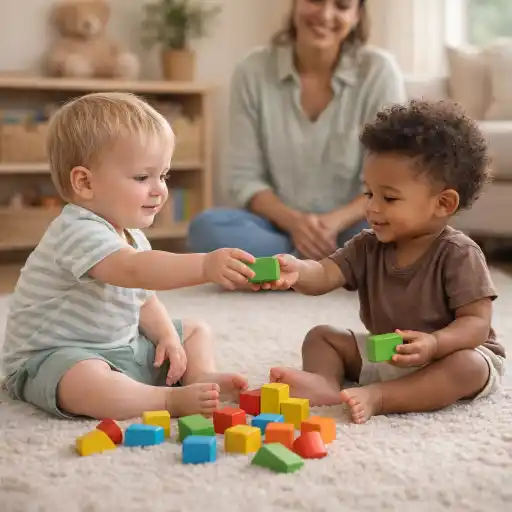
Providers can support this stage by arranging duplicate or similar materials side by side. Two baskets of cars, neighboring easels, or several bins of play dough allow children to participate near one another without creating unnecessary competition. Adults can narrate connections without demanding interaction: “You are both making roads,” or “Maya is rolling the blue car next to your truck.”
- Offer calm, predictable opportunities to play near peers.
- Respect a child’s need to observe before joining.
- Avoid treating parallel play as a problem that must be corrected.
What happens after parallel play?
Associative play often begins during the third year and becomes more noticeable between approximately 3 and 4 years. Children at this stage show greater interest in one another and may share materials, talk about what they are doing, imitate actions, or join the same activity. However, they may still pursue separate goals rather than organizing a shared game.
For example, three children may use the same block area, exchange pieces, and comment on each other’s structures while each builds an individual tower. At the art table, children may pass crayons back and forth and discuss their drawings without producing one group project. These exchanges represent important progress because children are practicing communication, flexibility, and early negotiation.
Providers can extend associative play by adding language and manageable social challenges. A teacher might ask, “How could you make room for Jordan’s bridge?” or offer a shared material such as a long cardboard tube that invites children to connect their separate constructions. Open-ended prompts are more effective than directing every action because they preserve children’s ownership of the play.
During this stage, children still need support with ownership and turn-taking. Instead of insisting that a child “share everything,” teach concrete alternatives:
- “You can say, ‘I’m using it. You can have it when I’m finished.’”
- “Would you like to trade, wait, or choose another piece?”
- “Let’s find a way for both plans to fit.”
These strategies recognize that social competence is built through repeated practice, not through pressure.
Why does playing together matter for development?
Playing together integrates several developmental domains at once. Children use language to propose ideas, clarify meaning, negotiate roles, and respond to peers. They practice executive-function skills by remembering a shared plan, inhibiting impulses, shifting strategies, and waiting for turns. They also encounter perspectives different from their own, creating opportunities to develop empathy and social understanding.
Play is also a powerful context for cognitive and physical learning. A collaborative block project involves spatial reasoning, balance, planning, and fine-motor coordination. Dramatic play strengthens symbolic thinking and narrative language. Outdoor group games support motor development while also requiring attention to peers and shared rules. As summarized in ChildCareEd’s overview of how play supports brain development, play is not separate from learning; it is one of the primary ways young children construct knowledge.
Directors can support staff by protecting uninterrupted play blocks, discussing developmentally realistic expectations, and using observation notes to identify emerging strengths. State requirements vary - check your state licensing agency when adjusting schedules, groupings, or classroom arrangements.
How can providers help children move toward shared play?
Effective support begins with observation. Notice whether a child is watching peers, imitating actions, approaching materials, communicating interest, or leaving when the group becomes overwhelming. Then offer the smallest useful scaffold rather than taking control of the play.
- Begin with one peer. Pair a child with a familiar, flexible partner before expecting participation in a larger group.
- Use a clear shared goal. Invite two children to build one road, carry a basket together, or make a collage with a shared piece of paper.
- Model short social phrases. Practice “Can I play?”, “My turn next,” “Let’s build together,” and “Do you need help?”
- Assign temporary roles. In dramatic play, use picture cards such as cook, customer, driver, or helper, then rotate roles.
- Provide visual and sensory supports. Timers, predictable sequences, quieter spaces, and adapted materials can make participation more accessible.
- Coach instead of commandeering. Ask one question, model one action, and step back to allow children to lead.
😊 A simple daily practice is a 10-minute partner activity with one goal, followed by a brief reflection: “What did you do together?” Keep the emphasis on effort and process—waiting, asking, noticing, helping, and repairing—not on producing a perfect group result.
For children with language delays, autism, sensory differences, or other support needs, adapt the entry point rather than assuming a lack of interest. Play with Purpose: Supporting Children with Autism Buy Now $55.00$40.00 offers additional training on inclusive play, communication, sensory regulation, and engagement.
What common mistakes should providers avoid?
Well-intentioned adults can accidentally make social play more difficult by expecting skills that children have not yet developed. The first common mistake is pushing children into large-group interaction too quickly. A child who is successful beside one peer may need several weeks of supported practice before joining four or five children.
A second mistake is equating sharing with immediate surrender of a desired object. Young children are still developing concepts of ownership, time, and perspective. Timers, duplicates, turn-taking language, and collaborative alternatives are generally more instructive than simply removing the toy.
A third mistake is over-directing the play. When adults assign every role, correct every storyline, or solve every disagreement, children have fewer opportunities to practice negotiation. Stay close for safety, intervene when needed, and use brief coaching that returns responsibility to the children.
A fourth mistake is relying on age alone. Developmental ranges describe broad patterns, not guarantees. Compare a child’s skills across time and settings rather than comparing the child with a more outgoing peer. The developmental milestones resource can support informed observation, but milestones should not be used as a diagnosis.
Consider consultation with a family and qualified professionals when a child shows limited social communication across settings, does not respond consistently to familiar people, loses previously acquired skills, or when concerns persist. Providers should share observations respectfully and avoid labeling. Early discussion can help families access appropriate screening or support when needed.
Conclusion: at what age do children start playing together?
Children begin showing interest in peers during toddlerhood, often playing alongside others around 18 months to 2 years. Associative play commonly develops around age 3, while cooperative play—shared goals, roles, and rules—typically emerges during the preschool years and becomes more refined between approximately 4 and 5 years. These ranges overlap, and children continue to move among different forms of play throughout development.
The practical answer is that children start playing together gradually, not all at once. Providers can help by valuing parallel play, arranging inviting environments, offering small-group experiences, modeling social language, adapting materials, and allowing children enough time to practice. With patient guidance, everyday play becomes a rich setting for communication, #cooperation, problem-solving, empathy, and growing confidence.
For additional professional learning, providers may explore Supporting Social Learning: Creating Classrooms that Care Buy Now $24.00, Play, Learn, Grow Online Version Buy Now $16.00, The Science of Growing Up: Typical and Atypical Development Buy Now $55.00, and Creating Environments that Nurture Growth and Community Buy Now $55.00. Together, these courses can deepen professional knowledge and translate developmental understanding into responsive classroom practice.
- 45 Hour Child Growth and Development
- CDA Home Visitor Subject Area 3 Part 3 Birth to 5
- Bienvenido! Welcoming All Families
- 45 Hour School Age Methods and Materials
- The Best Promotion is Play
- Play, Learn, Grow
- Play with Purpose: Supporting Children with Autism
- Playing with a Purpose: Infant/Toddler Lesson Planning
- Terrible Two's Can Be Terribly Fun!
- Bye Bye Winter: The Role of Outdoor Play in Early Childhood Development
- The“Puzzle Pieces” of Sleep Stages in Children and How they Fit Together
- Capacitación en Salud y Seguridad Preventiva en Línea para Proveedores de Cuidado Infantil
- Proporciones de Cuidado Infantil y Tamaños de Grupo por Edad en Maryland (Guía Rápida para Centros y Hogares)
- Proporciones de Cuidado Infantil y Tamaños de Grupo por Edad en Nueva Jersey (Guía Rápida para Centros y Hogares)
- Lista para Abrir una Guardería en Casa en Virginia: Cómo Empezar
- Lista para Abrir una Guardería en Casa en Carolina del Norte: Cómo Empezar
- Lista para Guardería en Casa en Illinois: Cómo Iniciar una Guardería en el Hogar
- Lista para Guardería en Casa en Texas: Cómo Iniciar una Guardería en el Hogar
- Capacitación Previa al Servicio para Proveedores de Cuidado Infantil en Dakota del Norte
- What Are Developmental Milestones and How Can We Track Them in Early Childhood?
- How Typical and Atypical Development Differ in Preschoolers
- Social Studies Activities for Toddlers: Start With Home, Helpers, and Their Little World
- How Do Parallel Play, Associative Play, and Cooperative Play Differ?
- At What Age Do Children Start Playing Together?
- How Can Educators Help Children Negotiate When Pretend-Play Rules Change Midgame?
- What Is the Difference Between Parallel Play and Cooperative Play?
- Head Start Attendance: Looking for Barriers Behind Repeated Absences
- What Are the Best Ways to Support Children Who Struggle with Sharing?
