When children play beside one another, are they already playing together—or still following separate ideas? Knowing the difference helps child care providers plan responsive environments and support social growth without rushing children. For a deeper look at how play supports development and how to foster it in your classroom, explore The Best Promotion is Play  Buy Now $24.00; this course offers practical professional learning on types of play, classroom environments, and cooperation.
Why does the distinction matter in a child care classroom?
Play is not simply a break from learning: it is one of the settings in which children practice language, self-regulation, problem-solving, and relationships. Noticing whether children are playing near each other or coordinating a shared activity helps providers choose an appropriate next step. A child absorbed in an individual block structure may need time and space; a pair already exchanging ideas may be ready for a small shared challenge.
These distinctions are useful for observation, not labels or deadlines. Parten’s stages of social play include parallel, associative, and cooperative play, but children may move among forms depending on the materials, their comfort, the group, or the day. As guidance from ZERO TO THREE on parallel play emphasizes, stages overlap and should not be treated as rigid developmental timetables.
Understanding play helps staff recognize strengths that can be easy to miss. Quiet observation, imitation, and comfortable participation in a shared space all matter, even when children are not yet collaborating. This perspective supports respectful planning for every #child and helps teams focus on the skills children are practicing—not only on whether they appear to be “playing together.”
What does parallel play look like?
Parallel play occurs when children play near one another while pursuing separate ideas. They may use similar materials, watch or imitate a peer, and share a play area, but they do not coordinate their actions around one common goal. For example, two children may build separate towers on the same rug, draw at one table, or push different cars along a play mat without creating a shared story.
Proximity and peer awareness are key; silence is not required. Children might exchange a glance, briefly comment, or copy an action and still be engaged primarily in parallel play. A brief interaction does not automatically mean that they have organized a joint activity.
Parallel play is a valuable, low-pressure way to explore being near peers. Children can observe new approaches, practice managing space and materials, and pursue their own interests without the language and negotiation demands of group play. It is common among toddlers and younger preschoolers, but children of different ages may choose it when they are exploring unfamiliar materials, settling into a room, or needing a quieter experience.
Providers can make this play welcoming by offering similar or duplicate materials, clear areas to work, and enough room to concentrate. Rather than insist that children share a plan, narrate what you notice: “You’re both making roads, and each road is different.” This validates their play while leaving the next move to them.
How is cooperative play different?
Cooperative play involves children coordinating around a shared idea, plan, or goal. They may take roles, agree on simple rules, exchange ideas, and adjust what they are doing in response to one another. Two children building one bridge for their cars or several children deciding who will be the cook, customer, and server in a pretend restaurant are examples of cooperative play.
The central distinction is not whether children use the same toys or sit together, but whether they are organizing play around a common purpose. In parallel play, each child follows an individual plan. In cooperative play, the children contribute to a shared activity—even if their contributions and roles differ.
Between these forms, children may show associative play: they talk, exchange materials, or respond to each other while continuing to pursue separate goals. For instance, children may share blocks and discuss their buildings without deciding to make one structure together. This intermediate pattern is a useful reminder that social participation develops in gradual, overlapping ways.
- Parallel: Nearby play, separate plans.
- Associative: Interaction and material-sharing, but no coordinated common goal.
- Cooperative: Shared plan or goal, with coordinated contributions.
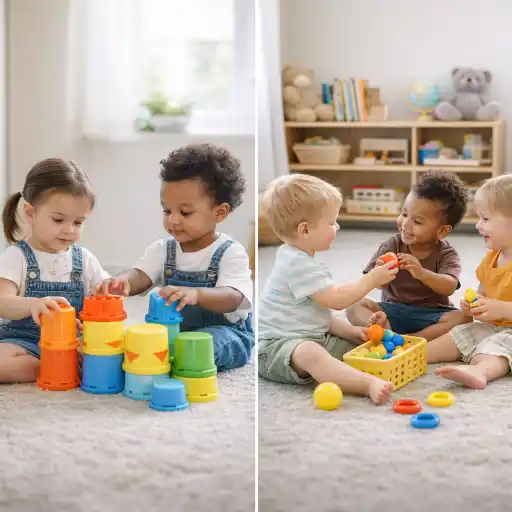
These forms can all be meaningful. Cooperative play creates opportunities to practice communication and compromise, while parallel play supports independence and peer awareness. Neither form is inherently “better” in every moment.
What skills do children practice in each kind of play?
Parallel play gives children space to explore an activity while becoming more comfortable with peers nearby. They may notice how another child uses a tool, imitate a movement, or learn new words by listening. They also practice concentration, managing personal space, and using materials in a shared environment. These experiences can provide a foundation for later peer interaction without requiring a child to perform socially before they are ready.
Cooperative play brings a different set of challenges and learning opportunities. Children must communicate ideas, listen, wait, negotiate, and sometimes revise a plan. A group mural, for example, may involve choosing where to place materials and finding a way to include several children’s ideas. Pretend play may ask children to remember roles and respond to the storyline their peers create.
Play supports learning across developmental domains, not just social development. Construction can invite spatial reasoning and fine-motor practice; pretend play can expand vocabulary and narrative thinking; group games can involve self-control and attention. The NAEYC discussion of playful learning in early childhood settings describes play as a meaningful context for active, socially interactive learning.
Providers can observe process rather than judge outcomes. Look for small signs of growth: a child watches before joining, accepts a nearby peer, offers a material, asks for a turn, or helps sustain a shared idea. These are useful notes for planning next steps and communicating with families.
How can providers support movement toward shared play?
Start with observation: What does the child seem interested in? Are they watching peers, imitating, exchanging materials, or showing signs that the group feels overwhelming? Then offer the smallest helpful invitation and give children time to respond. Responsive support preserves children’s agency; the goal is to make interaction possible, not to turn every play period into a teacher-directed group task.
- Arrange accessible, open-ended materials, including duplicates so children can begin side by side without competing for one item.
- Pair children around a shared interest before introducing a larger group.
- Offer a simple joint goal, such as making one road for two cars or adding pieces to one large collage.
- Model short, usable phrases: “Can I join?” “Your turn, then mine,” or “What should we make together?”
- Try picture cues, brief role cards, or turn-taking supports when they make the activity easier to understand.
- Notice and name specific efforts: “You listened to her idea,” or “You found a way for both builders to help.”
😊 A short partner activity can be a gentle starting point: invite two children to carry a basket of blocks to the rug and build one “home” for their toy animals. Offer a phrase or role if needed, then step back so the children can shape the play.
Children vary in temperament, communication, sensory preferences, and comfort with peers. Some may benefit from a quieter space, a familiar partner, visual supports, or additional time to observe. If concerns about a child’s social communication persist across contexts, share objective observations with the family and follow your program’s procedures for discussing further support. State requirements vary - check your state licensing agency.
What common pitfalls should providers avoid?
A common pitfall is treating parallel play as a problem that must be corrected. Children do not need to collaborate every time they are near peers. Allowing them to follow their own ideas can build confidence and make the classroom feel safer for exploration. Offer invitations, but respect a child’s choice to watch or play independently.
Another pitfall is expecting children to enter large-group play before they have practiced smaller interactions. A child who is comfortable alongside one peer may not yet be ready for a busy group. Begin with a brief paired activity, a familiar theme, or a small helper role, then gradually increase the social demand when children show interest.
Long instructions can also make play harder to join. Keep language brief, demonstrate an action, and use a visual cue or role card when useful. Likewise, avoid solving every disagreement immediately by removing the toy. When everyone is safe, support children in naming the problem, considering options, and trying a simple repair, such as taking turns or finding a second material.
Finally, avoid interpreting an age range as a deadline or comparing children with the most outgoing peer in the room. Play stages overlap, and participation varies by context. Document what children do and what supports help; consult families and appropriate specialists when ongoing concerns warrant a closer look. The aim is inclusion and meaningful participation, not a particular performance of sociability.
Conclusion: How can you tell the difference and respond supportively?
Parallel play means children are near one another but pursuing separate plans. Cooperative play means they coordinate around a shared idea, goal, or activity. Associative play—interaction without a shared plan—may appear between or alongside these forms. Children can move among all of them, and age ranges are broad reference points rather than fixed expectations.
For providers and directors, the practical response is to observe carefully, value side-by-side exploration, and offer small, accessible opportunities for collaboration when children are ready. Open-ended materials, manageable groupings, brief social scripts, and specific encouragement can make it easier for children to connect without taking control away from them.
In short, parallel play is not failed cooperation; it is a meaningful form of participation. By understanding the difference, educators can plan with greater confidence and support children’s emerging communication, #cooperation, and relationships at a pace that respects each child.
For additional professional learning, explore ChildCareEd’s The Best Promotion is Play Buy Now $24.00, which focuses on recognizing types of play and creating classroom experiences that foster development, problem-solving, and cooperation.
- The Best Promotion is Play
- Bienvenido! Welcoming All Families
- From Play to Planning: Building Culturally Competent, Child-Centered Curriculum
- CDA Bridge Bundle: Family Child Care without Portfolio Review
- CDA Bridge Bundle: Infant/Toddler without Portfolio Review
- The Best Promotion is Play
- CDA Bridge Bundle: Preschool without Portfolio Review
- Play, Learn, Grow
- Creating Environments that Nurture Growth and Community
- Texas Director Credential
- ❄️ ¿Qué actividades al aire libre funcionan bien para los niños de Illinois en cada estación? 🌷🍂
- ¿Cuáles son las mejores actividades del Día de la Tierra para niños en casa o en el aula?
- 10 Ejemplos de Cómo la Cultura Influye en el Desarrollo Infantil
- Regulaciones de Licenciamiento de Cuidado Infantil en California para Centros y Hogares de Cuidado Infantil Familiar
- Consejos de Supervisión Activa para Salones de Preescolar y el Juego al Aire Libre
- How can indoor creative play encourage teamwork for preschoolers in California?
- Canciones, juegos y preguntas de círculo para niños
- Cooperative Play vs. Parallel Play: What’s the Difference?
- Define Cooperative Play: Examples for Preschool and Child Care
- How can child care providers encourage cooperative play among preschool children?
- Team-Building Games for Preschoolers That Teach Cooperation
- How Do Children Learn Through Play?
- How Can Child Care Providers Teach Sharing Without Forcing It?
- How Do Parallel Play, Associative Play, and Cooperative Play Differ?
- At What Age Do Children Start Playing Together?
- What Is the Difference Between Parallel Play and Cooperative Play?
- What Are the Best Ways to Support Cooperative Play in Preschool?
- How Can Teachers Help Children Move From Parallel Play to Cooperative Play?
- How Can You Support a Toddler When an Older Sibling Takes Over a Project?
- How Can Cooperative Play Help Young Children Learn Gratitude?
