When preschoolers learn to plan, create, and solve problems together, play becomes a powerful setting for practicing communication and belonging. Explore practical ways to support those moments—and consider ChildCareEd’s From Play to Planning: Building Culturally Competent, Child-Centered Curriculum  Buy Now $55.00, which offers strategies for play, problem-solving, scaffolding, and inclusion. If you would like focused professional learning on classroom community and peer problem-solving, Supporting Social Learning: Creating Classrooms that Care Buy Now $24.00 is another relevant course to explore.
Why does cooperative play matter in preschool?
Cooperative play occurs when children share a plan or goal, coordinate their actions, and contribute ideas or roles. It differs from parallel play, where children play alongside one another without yet organizing a shared activity. Both forms of play are developmentally meaningful; children do not need to be hurried from one stage to another.
Shared play gives children authentic reasons to use language: asking to join, suggesting a plan, describing an idea, listening, and negotiating. It also invites practice with self-regulation and flexible thinking as children wait, remember roles, adapt plans, and respond to another person’s perspective. Play supports social, language, cognitive, and self-regulation development, as NAEYC notes in its overview of play and learning.
For educators, these are not simply pleasant moments between lessons. Cooperative play is a meaningful learning context in which children test ideas, build relationships, and experience themselves as capable contributors. A group project need not end in a perfect product; the valuable learning is often in how children work through the process together.
How can classroom spaces and routines invite collaboration?
The classroom environment can make it easier—or harder—for children to notice one another and build a shared activity. Arrange centers with clear pathways and accessible materials, and create a balance of active and quiet spaces. Blocks, dramatic play, art, and sensory materials can all support peer interaction when children can reach, choose, and return items independently.
Try small environmental adjustments: place toy vehicles near blocks, provide a large sheet of paper for a shared mural, or add familiar props to dramatic play. Observe which materials draw children together and which children prefer to watch before joining. Planning with children’s interests and strengths in mind can create natural entry points; NAEYC’s example of planning for individuality illustrates how a simple materials change may support peer engagement.
- 🧱 Keep open-ended materials in labeled, child-accessible containers so children can start play without waiting for an adult.
- Protect an uninterrupted play period when the schedule allows; complex shared play often needs time to develop.
- Use predictable routines and rotating classroom jobs to give children authentic opportunities to contribute.
Which activities help children practice working toward a shared goal?
Choose activities that require children to communicate or coordinate, while leaving room for their own ideas. A shared goal provides a reason to collaborate; it should not dictate every step. Start with pairs or small groups, then adjust the challenge to the children’s interests, language, and abilities.
- Build together: Invite a pair or small group to make a bridge, house, or town. Offer a prompt such as, “How could your structure hold the animals?” rather than a model to copy.
- Make a group mural: Use a long sheet of paper and invite children to decide what the scene includes. They can negotiate space, materials, and contributions.
- Set up a pretend community: A restaurant, clinic, or grocery store invites children to create roles and routines. Props and picture role cards can help new players enter.
- Try a cooperative movement challenge: Roll a ball around a circle or move a soft ball on a play parachute together. Emphasize coordination and shared enjoyment, not winning.
- Solve a puzzle as a team: Give children a large floor puzzle and invite them to find pieces, compare shapes, and decide where they fit.
Activities such as collaborative art and group problem-solving are most useful when teachers attend to the process: whose ideas are heard, how children divide tasks, and what happens when a plan changes. Adapt materials and group size so every child has a genuine way to participate.
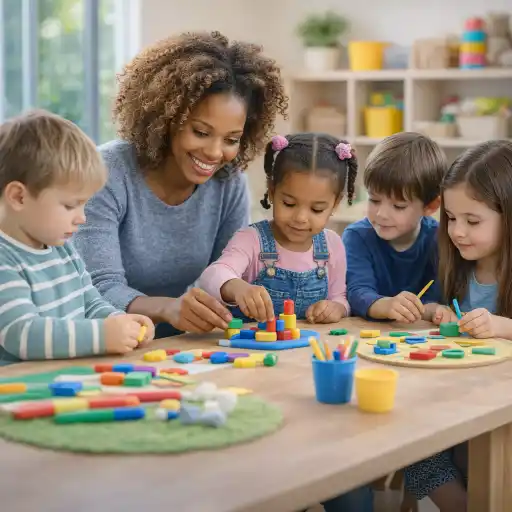
How can educators coach without taking over?
Children benefit from adults who are present, attentive, and ready to scaffold—but not eager to manage every part of play. Watch first. If children are engaged, allow them time to try their own ideas. When support is needed, use a brief prompt or model a phrase, then step back so children retain ownership.
Helpful coaching language is specific and neutral. Try “You both want the long block. What could work for each of you?” or “I see you made space for another builder.” Questions can help children notice the shared problem and consider options without requiring them to guess the adult’s preferred answer.
- Model useful phrases: “Can I play?” “What are you making?” “Can I have a turn when you’re finished?”
- Offer a manageable role to a child who is observing, such as passing materials, choosing a sign, or taking a picture for the project.
- Name the cooperative action you observed: “You listened to Sam’s idea and added it to the plan.”
- Use visuals, gestures, communication devices, or home-language words when they help children express choices and join the interaction.
Children differ in temperament, communication, sensory preferences, and prior experience with group play. Inclusion means adjusting the environment and the interaction so that children with varied abilities can participate meaningfully—not expecting every child to join in the same way or at the same pace.
What can teachers do when disagreements arise?
Disagreement is a normal part of shared play, and it can become a chance to teach emotional language, perspective-taking, and problem-solving. First, ensure safety and help children settle enough to communicate. Then describe what you see without assigning blame: “You both reached for the same truck. You look frustrated.” Acknowledging feelings helps children feel heard and opens the way to talk.
Next, invite each child to explain what they want, and frame the situation as a problem to solve together. Ask, “What could we try?” Offer a small number of choices if they are stuck, such as using a timer, finding another similar prop, trading, or changing the play plan. Check that the children understand and accept the solution. NAEYC’s three-step approach to conflict offers a useful sequence: identify behavior and feelings, explain the impact, and guide an appropriate next step.
Avoid insisting that children share immediately or imposing a solution before they have a chance to communicate. Taking turns with a clear timer may be more concrete than a broad instruction to “share.” If emotions are too high or safety is at risk, adults should step in calmly and revisit the problem when children are ready. State requirements vary—check your state licensing agency.
How can programs notice progress and sustain the practice?
Cooperative play grows through repeated opportunities, responsive adult support, and thoughtful planning. Directors can help staff make the practice consistent by choosing one focus at a time—such as inviting peers into play, taking turns, or negotiating roles—and discussing it during short team reflections. Brief coaching at the classroom level can help educators share language and respond consistently.
Observation is more useful when it focuses on specific actions rather than labels such as “good at sharing.” Notice whether a child asks to join, responds to a peer’s idea, accepts a role, waits for a turn, or helps repair a disagreement. A short anecdotal note can guide next steps: perhaps a child needs a visual cue, a smaller group, a more familiar play theme, or additional time to observe before participating.
- Record a few examples of peer interaction during regular play, noting the context and adult support provided.
- Share concrete, strengths-based observations with families and invite them to describe children’s interests and play at home.
- Review materials and routines periodically: are children able to access props, move freely, and find a meaningful role?
Conclusion: The best ways to support cooperative play are to create inviting spaces, offer open-ended shared activities, coach with simple language, make participation accessible, and treat conflict as a chance to learn. Children may move between solitary, parallel, and shared play, and that variation is expected. With patient, consistent support, your classroom can help every child experience the pleasure and learning of working toward a goal with others.
Five ChildCareEd courses to explore
- The Best Promotion is Play Buy Now $24.00 — play’s role in development, cooperation, and classroom practice.
- You're Not My Friend Anymore: Learning Conflict Resolution Buy Now $16.00 — developmentally appropriate ways to teach conflict resolution.
- Building Equity: Inclusionary Practices in Preschool Buy Now $10.00 — creating welcoming experiences across abilities and identities.
- CDA Home Visitor Subject Area 3 Part 3 Birth to 5
- The Best Promotion is Play
- Building Equity: Inclusionary Practices in Preschool
- From Tantrums to Triumphs: Equipping Preschoolers with Self-Regulation Skills
- Bienvenido! Welcoming All Families
- CDA Bridge Bundle: Preschool
- Working Together: Teachers & Preschoolers
- The Best Promotion is Play
- CDA Bridge Bundle: Preschool without Portfolio Review
- Creating Environments that Nurture Growth and Community
- How motor skills shape child development and creative ways educators can foster them.
- CDA Certification en Español: Recursos y Consejos para Educadores Bilingües
- ❄️ ¿Qué actividades al aire libre funcionan bien para los niños de Illinois en cada estación? 🌷🍂
- Consejos de Supervisión Activa para Salones de Preescolar y el Juego al Aire Libre
- Can simple indoor movement games teach listening and cooperation to preschoolers in Oklahoma?
- Team-Building Activities for Daycare: Helping Children Learn Together
- Celebrando la amistad en el cuidado infantil durante el Día de los Mejores Amigos
- Canciones, juegos y preguntas de círculo para niños
- Team-Building Games for Preschoolers That Teach Cooperation
- Belonging Activities for Kids Who Feel Left Out: Simple Ways to Help Them Join In
- How Can Bingo Games Support Turn-Taking and Social Skills?
- How Can You Support an Autistic Child in a Preschool Classroom?
- How Can Teachers Help Two Children Build Together When They Disagree on the “Right” Way?
- What Is the Difference Between Parallel Play and Cooperative Play?
- What Can Preschool Teachers Learn from a Child’s Play Preferences?
- How Can Providers Plan Meaningful After-School Choices for Seven- and Eight-Year-Olds?
- How Can Holiday-Neutral Movement Activities Create a More Inclusive Classroom?
- What Are the Best Ways to Support Cooperative Play in Preschool?
- What Are the Best Ways to Support Cooperative Play in Preschool?
