When children play side by side, exchange materials, or build a shared story, they are practicing different levels of social participation—not simply “playing” in the same way. For practical strategies that connect play stages with cognitive, physical, social, and emotional development, explore The Best Promotion is Play  Buy Now $24.00, which can strengthen classroom planning and professional knowledge.
Why does understanding play stages matter?
Child care providers often feel pressure to move children quickly toward group cooperation. Yet healthy development is not a race. Parten’s framework—unoccupied, solitary, onlooker, parallel, associative, and cooperative play—offers a useful lens for observing how children participate with peers. OpenStax describes play as a context for cognitive, physical, emotional, and social development, while research on preschool interaction emphasizes that peer play provides opportunities for communication, problem-solving, and social competence (OpenStax; systematic review of children’s social interaction).
These categories should guide observation rather than become rigid labels. A child may engage in cooperative play during a familiar dramatic-play routine and return to parallel or solitary play when tired, overwhelmed, or exploring a new material. Temperament, language, sensory processing, culture, familiarity with peers, and the classroom environment all influence participation.
- Play builds language, self-regulation, motor coordination, and problem-solving.
- Different forms of play provide different levels of social demand.
- Adults can support growth without treating parallel play as a deficit.
- State requirements vary - check your state licensing agency.
What is parallel play, and why is it valuable?
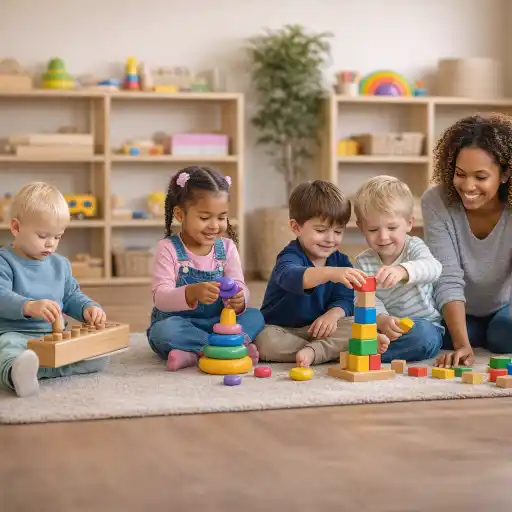
Parallel play occurs when children play near one another, often with similar materials, but without coordinating their actions toward a shared goal. Two toddlers may build separate towers, draw at the same table, or scoop sand from the same bin while remaining focused on their own activities. The defining feature is proximity without sustained collaboration.
Parallel play is especially common during the toddler and early preschool years, although children of any age may choose it in particular circumstances. The age ranges associated with play stages are approximate; Baylor’s overview of Parten’s classification emphasizes that development progresses through overlapping forms rather than fixed compartments.
For children, parallel play offers a low-pressure way to become aware of peers. They can observe actions, imitate techniques, tolerate shared space, and practice managing materials without the language and negotiation demands of a group project. It can also support independence, concentration, fine-motor development, and confidence.
Providers can honor parallel play by arranging duplicate or comparable materials, allowing adequate personal space, and resisting unnecessary prompts to “play together.” Narrate what children notice—“You are both making roads”—without requiring them to combine their work. This validates participation while leaving room for spontaneous interaction.
How is associative play different from parallel play?
Associative play represents an increase in social interaction. Children may talk with one another, share or exchange materials, imitate ideas, ask questions, and comment on each other’s activities. However, they are not yet organized around one shared plan or outcome. For example, three children may use the same block area, suggest pieces to one another, and discuss their buildings while still constructing separate structures.
The distinction is subtle but important: parallel play involves playing alongside peers with limited interaction; associative play involves interaction without a coordinated common goal. Associative play therefore provides a bridge between independent activity and true collaboration. Children practice communication, resource negotiation, emerging empathy, and flexible thinking while retaining substantial control over their own play.
Adults can support this stage through descriptive language and carefully timed invitations:
- “Maya gave you the long block. What could you say to thank her?”
- “You are both making homes. What do you notice about each other’s designs?”
- “Would you like to share the animals, or would two baskets help?”
Avoid turning every interaction into a demand for cooperation. The purpose is to expand children’s social possibilities, not to erase independent intentions. Observe whether children are initiating, responding, exchanging materials, and sustaining brief conversations; these behaviors are meaningful evidence of growing social competence.
How can providers support movement from parallel to cooperative play?
The most effective support is responsive scaffolding: observe the child’s current participation, make a small adjustment, and step back. NAEYC describes teachers as observers, planners, guides, and mediators who use children’s play to extend learning without removing children’s agency (NAEYC). The same principle applies to social play.
- Arrange the environment with accessible, open-ended materials and enough duplicate items for parallel participation.
- Pair children with compatible interests before introducing a larger group.
- Use short shared goals, such as “build one road for both cars.”
- Model concise phrases: “Can I join?” “Your turn, then mine,” and “Let’s make a plan.”
- Offer role cards, picture sequences, timers, or visual turn-taking supports when helpful.
- Praise specific behaviors: “You listened to her idea,” or “You found a way for both builders to contribute.”
Guided play should preserve children’s ownership. Rather than directing every action, add a prop, vocabulary word, question, or problem and then pause. For children with language delays, autism, sensory differences, or other support needs, individualized adaptations may include predictable routines, communication systems, preferred materials, peer modeling, and reduced sensory demands. Evidence-based inclusive practice recommends arranging environments, selecting interaction-promoting materials, incorporating child preferences, and coordinating with specialists (inclusive social-play research). For related professional learning, consider Play with Purpose: Supporting Children with Autism Buy Now $55.00$40.00.
How can directors and providers apply this framework?
A practical team approach begins with a shared vocabulary. During staff meetings, review brief observations and ask: What form of play was occurring? What skills were visible? What barrier limited participation? What is the smallest next step? This turns play observation into collaborative curriculum planning rather than a judgment of children or teachers.
Plan a balanced daily environment:
- quiet spaces for solitary exploration and regulation;
- duplicate materials and side-by-side centers for parallel play;
- shared loose parts, books, and props that invite associative interaction;
- small-group projects with clear roles and flexible goals for cooperation;
- uninterrupted play periods long enough for children to move beyond setup.
Family communication is equally important. Explain that children may play near one another before they play together, and invite families to share familiar songs, stories, pretend themes, and social routines. Document strengths rather than only conflicts: “Jordan watched the group, selected a matching car, and later accepted a turn.” This language helps families see development as a process.
For broader training on play’s developmental role, The Best Promotion is Play Buy Now $24.00 offers a focused professional-learning next step. Providers who want to deepen their general child-development foundation may also explore Play, Learn, Grow Buy Now $25.00.
Conclusion: What should providers remember about the three forms of play?
Parallel play means children play beside one another with limited coordination. Associative play adds conversation, sharing, and interaction, but no unified goal. Cooperative play involves shared plans, roles, rules, and sustained collaboration. These forms are related, but they are not rigid steps that children must complete on a schedule.
The central question is not whether a child is “playing correctly,” but what the child is communicating and practicing through play. Respect parallel exploration, notice associative connections, and intentionally scaffold cooperative experiences when children show readiness. With thoughtful environments, responsive language, inclusive adaptations, and careful observation, providers can help children develop social confidence while preserving the joy and agency that make play such a powerful context for learning.
- The Best Promotion is Play
- Balancing Physically Active Play in Child Care
- From Play to Planning: Building Culturally Competent, Child-Centered Curriculum
- The Best Promotion is Play
- Play, Learn, Grow
- Play with Purpose: Supporting Children with Autism
- Creating Engaging and Meaningful Learning Experiences
- Texas Director Credential
- Balancing Active Play in Child Care
- Montessori Cultural Activities: Exploring the World Through Play and Learning
- 🪁¿Cómo puede el juego apoyar de manera poderosa a los niños con autismo?🧩
- 🥦✨ ¿Cómo apoyar a los niños selectivos a probar nuevos alimentos sin presión?
- ❄️ ¿Qué actividades al aire libre funcionan bien para los niños de Illinois en cada estación? 🌷🍂
- ¿Cómo explicar los colores a un niño ciego? Actividades con tacto, sonido y emociones
- ¿Cuáles son las mejores actividades del Día de la Tierra para niños en casa o en el aula?
- ¿Cómo puedo usar escenarios de juego de roles de primeros auxilios en mi aula?
- Actividades de Motricidad Gruesa que Desarrollan el Equilibrio, la Coordinación y la Fuerza
- 10 Ejemplos de Cómo la Cultura Influye en el Desarrollo Infantil
- Actividades de Otoño Fáciles para Preescolares esta Temporada
- Por Qué la Supervisión Activa Es Clave para la Seguridad en el Cuidado Infantil
- Consejos de Supervisión Activa para Salones de Preescolar y el Juego al Aire Libre
- Celebrando la amistad en el cuidado infantil durante el Día de los Mejores Amigos
- Canciones, juegos y preguntas de círculo para niños
- Cooperative Play vs. Parallel Play: What’s the Difference?
- Define Cooperative Play: Examples for Preschool and Child Care
- Cómo Planificar Actividades al Aire Libre Seguras Durante el Calor y la Mala Calidad del Aire
- How Do Children Learn Through Play?
- How Do Parallel Play, Associative Play, and Cooperative Play Differ?
- At What Age Do Children Start Playing Together?
- What Is the Difference Between Parallel Play and Cooperative Play?
