When center time turns into crowding, grabbing, or repeated disputes, the problem is rarely solved by telling children simply to “share.” A thoughtful mix of room design, clear teaching, and calm coaching can help children feel safe while learning to negotiate space and play alongside peers. For practical support with peer problem-solving, explore You’re Not My Friend Anymore: Learning Conflict Resolution  Buy Now $16.00; the course can deepen your strategies for guiding children through everyday disagreements.
Why is sharing space during center time challenging?
Center time asks children to manage several demands at once: choose an activity, enter an ongoing game, protect a project, notice peers’ cues, and communicate about materials and physical boundaries. These skills are developing, not automatic. A child who insists on a particular spot or pushes into a play area may be communicating excitement, uncertainty, limited language, sensory needs, or a wish to join—not necessarily trying to disrupt others.
It also helps to distinguish sharing space from handing over a toy. Children can play beside one another, take different roles in a shared activity, or use a center at different times. The goal is not constant agreement or uninterrupted cooperative play; it is safer participation and gradual growth in communication, flexibility, and self-regulation. Peer interactions offer opportunities to practice those skills, as the CSEFEL guidance on promoting positive social interactions explains.
Expectations should fit children’s ages, abilities, communication styles, and experiences. Some children benefit from a clear phrase or picture cue; others need extra time to observe before joining. Treat recurring conflict as information about the environment and the support children need—not as evidence that a child is “bad at sharing.”
- Notice what happens before conflicts: crowding, a popular material, a transition, or a change in play.
- Distinguish a safety concern from a disagreement children may be able to work through with support.
- Recognize that a child may need help asking to join, keeping a boundary, or finding room to play.
How can the room and routine prevent crowding?
Look at center time from a child’s perspective. Are pathways clear? Can children see where one center ends and another begins? Are highly preferred materials concentrated in a tight area? The physical environment influences movement and peer interaction. Head Start’s guidance on designing learning environments emphasizes accessible spaces, thoughtful layout, meaningful materials, and groupings that support engagement and safety.
Make manageable adjustments before adding more rules. Move furniture to clarify boundaries without blocking supervision, ensure children have room to work, and place materials where they can be reached independently. When feasible, provide additional popular items or create complementary materials in nearby areas. If a center has a genuine capacity limit, communicate it with a simple visual and teach children what they can do while they wait.
Predictable routines also reduce pressure. Give a warning before cleanup, protect enough uninterrupted play for children to develop ideas, and make transitions easy to understand. Observe when congestion occurs and adjust center availability or group size as appropriate. For more ideas about planning and designing centers, see ChildCareEd’s Spicing Up the Classroom: Learning Centers Buy Now $16.00.
- 🧩 Use rugs, low shelves, or picture signs to make center boundaries visible while preserving sightlines.
- Keep busy pathways open and separate noisy, active areas from quieter choices when possible.
- Offer visual turn cues or a waiting choice when a limited space is full.
- Revisit the setup when observation shows repeated congestion or exclusion.
What skills should teachers teach before conflicts arise?
Children are more likely to use social skills during busy play when they have practiced them in calm moments. Teach a few short, useful phrases and demonstrate what they look and sound like: “Can I play here?”, “I’m still using this space,” “Can I have a turn when you’re finished?” and “I need more room.” A puppet, a brief role-play, or a teacher modeling a center scenario can make the language concrete without singling out a child.
Pair words with visuals, gestures, signs, or communication devices when helpful. Children should be able to express a choice or boundary without relying on spoken language alone. Model how to respond to a peer, too: make room when possible, ask before moving someone’s work, and respect “stop” or a clear signal that a child needs space.
Practice more than one way to participate. Children might build next to one another, share a large work surface, take complementary roles, or wait with another activity. These options show that cooperation does not require giving up a meaningful project. The ZERO TO THREE resource on helping young children with sharing likewise highlights the value of safety, emotion acknowledgment, and supported solutions rather than expecting instant turn-taking.
- Rehearse phrases with puppets or familiar center materials during group time.
- Use photos or simple symbols to show “join,” “wait,” “turn,” and “more space.”
- Notice specific attempts to communicate or accommodate a peer: “You asked before joining.”
How should teachers respond when children clash in the moment?
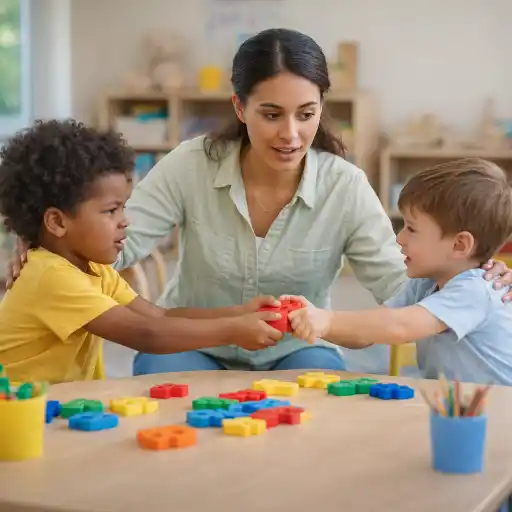
Start with safety and regulation, not a lecture. Move close, calmly block unsafe actions if needed, and check whether anyone is hurt or distressed. Set a brief limit: “I won’t let you push. Bodies need to be safe.” Then describe what you observe without assigning blame: “You both want room at the table, and you look frustrated.” Naming the situation and feelings helps children understand the problem without labeling either child as selfish or difficult.
Once children are calm enough to engage, help each communicate what they want. Use a short prompt, offer words, or point to a visual. Then invite a practical solution: “Would you like to make room, work side by side, take turns at the table, or choose another space?” Keep options safe and realistic, and check whether the plan works for the children involved. The Head Start resource Problem Solving in the Moment offers tools for helping teachers guide children through social problems as they arise.
Do not insist that children resolve every disagreement independently. Stay present, adjust the level of support to the children’s developmental and communication needs, and follow up if the plan breaks down. When harm has occurred, support meaningful repair after children are regulated—such as rebuilding a structure or checking whether a peer is okay. Avoid demanding immediate affection or a scripted apology.
- Protect children and stop unsafe behavior with a clear, calm limit.
- Describe the conflict and acknowledge feelings without blame.
- Help children express what they need using accessible communication.
- Offer a few workable choices and confirm the next step.
- Follow up and support repair when appropriate.
How can teachers include children with different needs and play styles?
Participation does not look the same for every child. One child may enter a group by watching first; another may prefer parallel play or need a quiet break when a center becomes noisy. Children may communicate through words, gestures, signs, movement, or communication devices. Treat these differences as part of classroom planning, not as reasons to exclude a child from valued activities.
Observe individual patterns: which centers invite engagement, what conditions make joining easier, and what cues a child uses to indicate interest or discomfort. Provide a gradual entry point, such as a defined role, a familiar prop, a smaller group, or a nearby place to work. Consult families about children’s interests, communication, and successful approaches at home, and collaborate with specialists when additional support may help. NAEYC’s discussion of planning for individuality in preschool spaces emphasizes using observation and family relationships to build on each child’s strengths.
Keep expectations equitable. Do not routinely expect one child to surrender space, materials, or control to accommodate others. Teach everyone to ask, listen, wait, and respect boundaries. If an issue is persistent, document objective observations—what happened, where, when, and what support was offered—then use the information to refine the environment and teaching plan. State requirements vary - check your state licensing agency.
- Offer more than one way to join an activity, including observing or taking a defined role.
- Use home-language words and accessible visual supports where useful.
- Plan quiet alternatives without framing them as punishment or exclusion.
How can a teaching team build consistent practice?
Consistency comes from shared principles, not identical responses in every situation. Directors and teachers can agree on a few common scripts for safety, joining play, and making space. Rehearse them during team meetings so adults can use calm, concise language when the room is busy. Discuss how staff will supervise each center and where a visual cue or environmental adjustment could help.
Use observation to guide decisions. Briefly record where conflicts occur, what materials or routines are involved, what children communicate, and which adult supports help. Review these patterns together without blaming children or colleagues. A crowded block area may need a layout change; repeated difficulty entering a game may call for role-play and supported invitations; frustration during cleanup may signal that children need more time or a clearer warning.
Share strengths-based, specific observations with families and invite their perspective. “We’re practicing asking before joining a play area; what words or gestures work well for your child?” keeps the conversation collaborative. Professional learning such as Supporting Social Learning: Creating Classrooms that Care Buy Now $24.00 can help educators extend their understanding of classroom community, relationships, and children’s problem-solving.
- Choose one shared skill to focus on this week, such as asking to join or making room.
- Model and practice the skill, then notice children’s attempts during authentic play.
- Review observations as a team and make one manageable environmental or routine adjustment.
Conclusion: What should teachers do when children struggle to share space?
When children struggle to share space during center time, teachers can respond with prevention, explicit teaching, and calm in-the-moment coaching. Arrange centers to reduce unnecessary crowding, teach simple phrases and ways to enter or leave play, protect safety, and help children choose workable solutions. Respect different communication styles, developmental levels, and needs for space.
The goal is not a conflict-free classroom or instant, independent cooperation. It is a learning community where children gradually practice communicating, respecting boundaries, and participating with peers. Observe what is happening, adjust the environment, and recognize small steps—an invitation, a pause, or a child making room—as meaningful progress.
- Turning Behavior Around for Toddlers and Preschoolers
- Moving About the Classroom: Effective Transitions for Everyday
- A Better Space For All
- CDA Home Visitor Subject Area 3 Part 3 Birth to 5
- CDA Home Visitor Subject Area 2 Part 3 Birth to 5
- Pediatric RSV First Aid & CPR/AED
- Texas Director Credential
- Bienvenido! Welcoming All Families
- Moving About the Classroom: Effective Transitions for Everyday
- ❄️ ¿Qué actividades al aire libre funcionan bien para los niños de Illinois en cada estación? 🌷🍂
- Recursos en Español sobre el Sueño Seguro del Bebé
- ¿Cómo pueden los equipos de cuidado infantil practicar habilidades rápidas de primeros auxilios en situaciones reales?
- Capacitación en Salud y Seguridad Preventiva en Línea para Proveedores de Cuidado Infantil
- Normas de Licenciamiento de Cuidado Infantil en Virginia para Centros Diurnos Infantiles y Hogares Diurnos Familiares
- Lista para Guardería en Casa en Illinois: Cómo Iniciar una Guardería en el Hogar
- Lista para Guardería en Casa en California: Cómo Iniciar una Guardería en el Hogar
- Retraso del Habla en la Guardería: Cómo Pueden Ayudar los Proveedores
- Capacitación Previa al Servicio para Proveedores de Cuidado Infantil en Dakota del Norte
- Las Mejores Ideas de Excursiones para Guarderías en Texas
- Celebrando la amistad en el cuidado infantil durante el Día de los Mejores Amigos
- Canciones, juegos y preguntas de círculo para niños
- When Learning Feels Hard: Positive Discipline Strategies for Children Who Struggle
- Stop Giving the Answer: How Teachers Can Build Independent Thinkers in the Classroom
- How Can Teachers Ease Separation Anxiety at Drop-Off?
- What Should Teachers Do When Children Don’t Want to Play Outside?
- How Can Child Care Providers Create a Predictable Morning Arrival Routine?
- How Can Teachers Support Children Who Become Frustrated During Fine-Motor Activities?
- How Can Teachers Support Children Who Struggle to Make Decisions Independently?
- What Should Teachers Do When Children Struggle to Share Space During Center Time?
