Tantrums happen. They are loud, tiring, and can make the day hard for staff and other children. This article helps child care providers and directors build simple prevention plans that work. You will find clear steps, in-the-moment tools, and ideas for team plans you can use right away. We use short lists and links to trusted ChildCareEd resources so your staff can learn more: for example How To Manage Temper Tantrums and Using Reflective Listening to Defuse Tantrums.
Why it matters: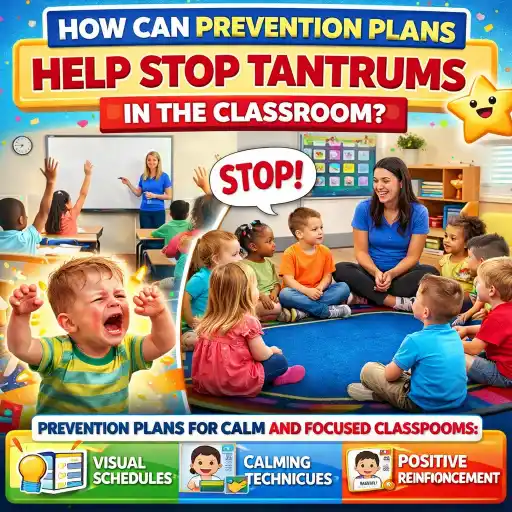
1) Early prevention saves time and keeps the room calmer so teachers can teach. 2) When children learn words and ways to calm, they replace big outbursts with safer choices. 3) Strong plans help staff feel supported and families feel included. For practical classroom tips, see Prevention and solutions to challenging behaviors.
Quick note: state requirements vary - check your state licensing agency.
What causes classroom tantrums and how can we spot the triggers?
Tantrums often mean a child is overwhelmed, hungry, tired, or needs help using words. Step-by-step detection helps you make a prevention plan.
- 🔎 Observe and record: Watch when tantrums happen. Note time, activity, and who was near. Use a simple behavior log for 1 week. See guidance in How can we handle challenging behaviors in the classroom? and the CSEFEL brief on functional steps (CSEFEL What Works Brief).
- 📋 Look for patterns: Is it a transition, loud noise, or waiting time? Common triggers include hunger, tiredness, and hard tasks. The CDC details when behavior may need extra help (CDC behavior overview).
- 🗣️ Talk with families: Share observations and learn what soothes the child at home. Family partnership is essential—ChildCareEd outlines ways to involve families in plans (How to Support Children with Challenging Behaviors).
- 🧩 Consider learning or trauma: Some children have sensory needs or stress history. See trauma-focused info at Trauma and Tantrums.
Spotting triggers gives you targets for #prevention and teaches staff to read the child’s cues before a full meltdown. Use short notes and share them at staff meetings so everyone follows the same plan. Remember: behavior is communication—when you decode it, you can design better supports for #children in your #classroom and reduce #tantrums while helping kids feel #calm.
What prevention steps should our team include in a plan?
A good prevention plan has simple routines, a calm space, teaching moments, and consistent adult actions. Use these building blocks to create a team-ready plan that fits your program.
- 🧭 Predictable routine: Add visual schedules and countdown warnings. Practice transitions daily. See proactive ideas in Proactive Behavior Guidance.
- 🧩 Environment changes: Rearrange noisy centers, limit numbers in busy areas, and add quiet corners. ChildCareEd has room-arrangement suggestions in their management articles (for example Managing Behaviors).
- 🎯 Teach replacement skills: Teach simple scripts ("My turn?", "Help please") and calm tools during calm times. Use Functional Communication Training ideas from CSEFEL and ChildCareEd resources like Emotions for Kids.
- 👏 Catch and praise: Notice 3 quick wins each hour. Use specific praise: "You used gentle hands—thank you!" See reinforcement tips in Proactive Behavior Guidance.
- 🤝 Team consistency: Train staff with the same language and visuals. Consider courses like Classroom Management is Collaboration!
 Buy Now $16.00 or Mysteries of Challenging Behavior Solved Buy Now
 $24.00$18.00.
Why these steps work: predictable routines reduce surprise, practiced skills give children better choices, and consistent adult responses teach what will happen next. A prevention plan is not one-size-fits-all—use your observation notes, tweak tools, and repeat. These moves reduce triggers and cut down on #tantrums by teaching children how to ask for help and how to be #calm in the #classroom.
What in-the-moment strategies help reduce tantrum length and intensity?
When a tantrum starts, safety first. Then use a short pattern: Connect → Calm → Coach. Keep words tiny, stay at the child's level, and use reflective listening. The ChildCareEd piece on reflective listening gives a clear script and steps (Using Reflective Listening to Defuse Tantrums).
- 🧑🤝🧑 Connect: Stop other tasks, get down to eye level, and give full attention. Say what you see: "You look really upset." This helps the child feel heard.
- 😮💨 Calm: Use a breathing cue or heavy work. Try 1–2 breaths together or offer a squeeze ball. See calm tools in How can child care teams de-escalate....
- 💬 Reflect and set the limit: Name feeling, validate it, and set one short rule: "You can be mad. Hands stay gentle." Reflective language reduces escalation (reflective listening).
- 🔁 Offer a choice: Give 2 safe options: "Choose to sit with me or use the calm corner." Choices reduce power struggles and help the child regain control.
- 🧭 Coach after calm: When settled, teach a short replacement skill ("Next time, try saying 'help' or show this card"). Document the episode briefly for team review.
Extra tips: keep a calm-down kit and practice the steps during circle time. Use visuals and short games so children know the routine before a meltdown. For sample calm area checklists, see ChildCareEd resources like Calm Down Posters and calm-corner guidance (Calm-down strategies).
When should we get extra help and how do we write a practical prevention plan?
Most tantrums will improve with consistent prevention and teaching. Ask for extra help when:
- 🛑 Safety is at risk (child or others are hurt),
- 📈 Episodes happen many times a day and don't respond to usual tools, or
- ⏳ Problems persist for weeks despite consistent strategies.
Team steps to get help:
- 📒 Collect data: Use an ABC log (Antecedent, Behavior, Consequence). The training The ABCs of Behavior Buy Now
$55.00$45.00 teaches this well. - 👥 Hold a team meeting: Include family, director, teacher, and a mental health consultant if available. Share patterns and choose 3 clear actions: prevention, teaching, and response.
- 🧩 Write a short plan: 1–2 prevention steps, 1 teaching step (what to practice), and 1 response step (what staff will do during a tantrum). Use Functional Communication Training ideas from CSEFEL to pick a replacement skill.
- 📚 Train and practice: All staff should rehearse the plan and use the same words. Consider ChildCareEd courses like Turning Behavior Around Buy Now $25.00 or Mysteries of Challenging Behavior Solved Buy Now
$24.00$18.00. - 🔄 Review: Re-check outcomes after 2 weeks. If no progress, refer for further assessment (specialist, early intervention, or local mental health consultant). The CDC page on behavior problems can guide referrals (CDC).
Common mistakes and how to avoid them:
- 🚫 Mistake: Inconsistency across staff. ✅ Fix: Short training and a one-page plan everyone posts.
- 🚫 Mistake: Teaching only during meltdowns. ✅ Fix: Practice replacement skills daily during calm moments.
- 🚫 Mistake: Using calm corners as punishment. ✅ Fix: Teach the area as a choice and model visits.
Short FAQ:
- Q: When should we use a formal FBA? A: If behavior keeps happening and affects safety or learning—start data collection and team planning. See CSEFEL.
- Q: Is time-out always bad? A: No—brief, safe breaks can fit into a positive plan when used carefully. See guidance in ChildCareEd trainings.
- Q: How do we include families? A: Share observations, ask about home routines, and agree on 1–2 consistent strategies to use both places.
- Q: Where can staff get more training? A: ChildCareEd courses listed above and local mental health consultants are good next steps.
Summary: Build a prevention plan with routine, environment tweaks, taught replacement skills, consistent staff responses, and family partnership. Use short data logs and ask for help when safety or progress are concerns. For quick staff training and printable tools, explore ChildCareEd resources like How To Manage Temper Tantrums, Reflective Listening, and Classroom Management is Collaboration Buy Now $16.00. Keeping plans simple and practiced helps children learn new skills and makes your #classroom a calmer place for #children to grow without frequent #tantrums—helping everyone feel more #calm through thoughtful #prevention.
- 45 Hour Child Growth and Development
- 45 Hour Preschool Methods and Materials
- From Tantrums to Triumphs: Equipping Preschoolers with Self-Regulation Skills
- Money Matters in Medicine
- 45 Hour Infant and Toddler Methods and Materials
- 45 Hour School Age Methods and Materials
- Texas Director Credential
- Wellness in Action: Teaching Healthy Habits to Children
- CDA Certification en Español: Recursos y Consejos para Educadores Bilingües
- Recursos en Español sobre el Sueño Seguro del Bebé
- 10 Ejemplos de Cómo la Cultura Influye en el Desarrollo Infantil
- Proporciones de Cuidado Infantil y Tamaños de Grupo por Edad en Nueva Jersey (Guía Rápida para Centros y Hogares)
- Proporciones de Cuidado Infantil y Tamaños de Grupo por Edad en Virginia (Guía Rápida para Centros y Hogares)
- Lista para Guardería en Casa en Texas: Cómo Iniciar una Guardería en el Hogar
- Cómo Trabajar en el Cuidado Infantil en Carolina del Norte: Requisitos y Pasos
- How can New York preschool programs safely handle aggressive behavior?
- Celebrando la amistad en el cuidado infantil durante el Día de los Mejores Amigos
- Diversión fresca de verano: actividades del Día Nacional del Helado para niños
- How can child care teams best support children during tantrums and emotional outbursts?
- How can child care providers understand and respond to tantrums?
- How Many Tantrums a Day Is Normal for a 2-Year-Old?
- When Learning Feels Hard: Positive Discipline Strategies for Children Who Struggle
- Why Is This Child Acting Out? How Can Providers Find the Need Behind Challenging Behavior?
- Why Do Young Children Show Challenging Behavior, and What Are They Trying to Communicate?
- How Can Child Care Providers Respond Effectively to Temper Tantrums in the Classroom?
- Why Is My Preschooler Suddenly Aggressive, and How Can Child Care Providers Help?
- Why Do Toddlers Throw Tantrums and How Should Teachers Respond?
- Why Do Children Repeat the Same Challenging Behavior?
