Open-ended activities give children choice and room to try ideas. These invitations help kids talk, share, solve problems, and feel proud. This short guide shows easy activities, how to set them up in your #classroom, how to keep play safe and inclusive, and how to share results with families. Use small steps and watch big growth in #creativity, #language, #socialskills, #play, and #preschoolers.
Why do open-ended activities help children learn and why does it matter?
Open-ended play asks children to decide what to do. They plan, test ideas, and use words to tell stories. This builds thinking and talking skills. Research on pretend play shows strong links between play, language, and thinking skills. See ideas and research in Why Open-Ended Play Is Essential for Healthy Child Development and classic work on pretend play at ECRP.
Why it matters:
- Children practice problem solving when a tower falls or when mixing colors.
- They use words to describe play and to negotiate roles — this grows #language.
- They learn to take turns, share ideas, and feel confident — strong #socialskills follow.
Programs that support open-ended time help children become creative thinkers and better communicators. For more on teacher roles and play promotion, see The Best Promotion is Play Buy Now $35.00. For practical strategies and concrete activity examples that deepen creativity in preschoolers, see Tiny Hands, Big Dreams: Fostering Creativity in Preschoolers.
What simple open-ended activities can I set up tomorrow?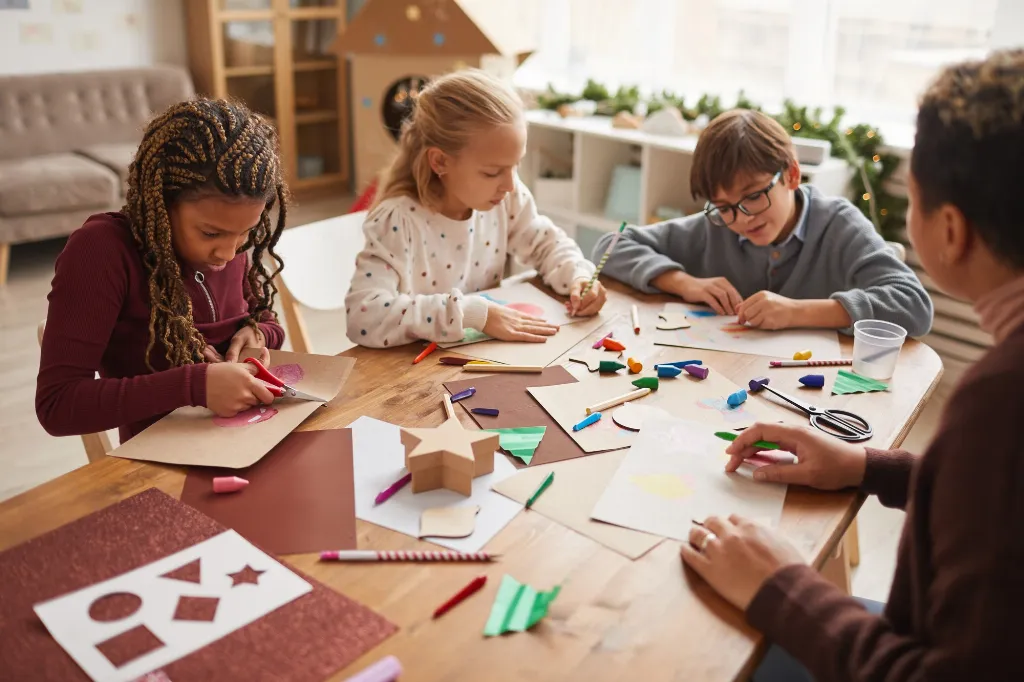
Try 1–3 of these invitations. Keep materials reachable and rotate often. Each idea below lists a quick setup and the learning it supports.
- 🎨 Open-ended art tray
- Set out paper, washable paint, sponges, and loose parts (buttons, yarn).
- Invite: “Make a picture that smells like a garden.” Supports #creativity and fine motor skills. See Open-Ended Art Activities.
- 🔧 Loose-parts discovery bin
- Fill a low bin with bottle caps, corks, boxes, and fabric scraps.
- Invite sorting, building, or storytelling. Loose parts boost imagination and problem solving; read Loose Parts Play.
- 🧪 STEAM tray
- Tray with droppers, funnels, cups, and colored water. Ask: “What happens if we mix blue and yellow?”
- Supports observation language and trial-and-error.
- 📚 Story props in dramatic play
- Read a short book then leave props in the block or house area so children act the story. This extends vocabulary and role play; see Open-Ended Activities That Help Preschoolers Learn.
- 🌿 Nature collage
- Collect leaves, seeds, and petals for collages. Great for descriptive words and sorting.
Keep invitations low-prep and flexible. A single new basket or tray can spark hours of play.
How do I set up the space and teacher routines to support creativity, language, and social growth?
Design the room so children can choose and return materials independently. Use low shelves, clear bins with pictures, and a simple rotation plan. For help picking materials, see What classroom materials best foster learning and creativity?
- Space and materials
- 📌 Low shelves, labeled bins, a messy zone, and a quiet zone.
- Rotate materials every 2–6 weeks to keep interest high.
- Teacher role
- Observe first, then scaffold with one question or a new loose part.
- Describe what you see to build vocabulary ("I see you stacked the blue blocks!").
- Inclusion and safety
- Adapt tools (bigger crayons, picture prompts) for diverse learners — see Adapting Activities for Children with Developmental Delays.
- Quick safety check: remove choking hazards for little ones. Note: state requirements vary - check your state licensing agency.
- Support social play
- Use routine jobs and peer roles to create natural chances for turn-taking and teamwork. CSEFEL offers practical strategies for peer interactions: CSEFEL peer interaction brief.
Make documentation quick: photo + one sentence or a child quote. This shows families the learning behind the play.
How do I involve families, avoid common mistakes, and measure success?
Families want to know their child is learning. Share simple notes and one photo each week. Invite safe donations and explain how materials are used.
- Family connection
- 📸 Send one photo and a short line: what the child did and one word it shows (e.g., "sharing").
- Invite parents to try a home provocation: "Try mixing paint with a spoon this weekend." See family communication tips in Open-Ended Activities.
- Common mistakes & fixes
- ❌ Overfilling shelves → ✅ Offer 1–2 baskets at a time and rotate.
- ❌ Over-directing play → ✅ Ask an open question and let children lead.
- ❌ Skipping safety checks → ✅ Quick item inspection and age bins.
- Measuring progress
- Take photos, note one child quote, and pick 1–2 goals (new words, sharing, trying again).
- Use simple checklists or a short caption to show growth over weeks.
- Quick FAQ
- Q: How long should open play be? A: Aim for 20–40 minutes when possible; add short invitations daily.
- Q: Will parents want crafts? A: Some do—offer 1 product project monthly and explain learning from daily play.
- Q: How often rotate materials? A: Every 2–6 weeks or when interest drops.
Try one change this week: add a loose-parts basket or an open art tray. Watch children's ideas grow and share a photo with families. For more lesson plans on social skills, see Social Skills Lesson Plan Buy Now $0.00.
Summary
- Open-ended activities build thinking, talk, and friendship.
- Start small: one tray, one bin, one open question.
- Keep materials safe, reachable, and rotated.
- Document with a photo + sentence and share with families.
You are doing important work. Small invitations to #play give children big chances to learn. Share ideas with your team and try one new open-ended invitation this week.
- CDA Home Visitor Subject Area 3 Part 3 Birth to 5
- CDA Home Visitor Subject Area 2 Part 3 Birth to 5
- Birth to Five CDA Credential with Portfolio Review
- Open Ears: Listening in Child Care
- Play Safe, Think Big: Literacy Through Play
- Effective Supervision in Child Care: For Workforce Solutions
- Art from the Heart for Preschoolers: Open Ended Art Projects that Build Self-Esteem
- Texas Director Credential
- CDA: Stand With Respect and Professionalism
- Montessori Cultural Activities: Exploring the World Through Play and Learning
- "Junk" Art
- Bye Bye Winter: The Role of Outdoor Play in Early Childhood Development
- Montessori for Toddlers: Fostering Independence and Learning
- The Family Day Care Chronicles: Tales of Laughter, Learning, and Unexpected Adventures
- Tiny Hands, Big Dreams: Fostering Creativity in Preschoolers
- Hungry for Play: The Power of Play-Based Learning in Early Education
- How motor skills shape child development and creative ways educators can foster them.
- Actividades de Otoño Fáciles para Preescolares esta Temporada
- Learning Through Creative Daycare Activities
- How Do Art Activities Support Cognitive Growth in North Dakota Preschoolers?
- Calabazas, hojas y manzanas: actividades de otoño para preescolares
- Canciones, juegos y preguntas de círculo para niños
- Open-Ended Preschool Activities for Creativity, Language, and Social Skills
- Do Toys Come Alive: How Can Pretend Play Spark Creativity in Your Daycare?
- Preschool Team-Building Activities for Better Communication and Friendship
- How Can Flag Design Help Children Explore Symbols, Patterns, and Individual Expression?
- How Can You Plan Patriotic Crafts Without Limiting Children’s Creativity?
- How Do Cut-and-Paste Activities Build Fine-Motor Control and Planning?
- How Can a Simple Watermelon Craft Build Fine-Motor and Language Skills?
- What Should You Do When Children Disagree with a Storybook’s Ending?
