Looking for practical ways to lift attention, language, motor skills and classroom community in short, repeatable lessons? Music and movement are high‑yield, low‑prep strategies that reliably support children’s learning and self‑regulation — and you can start this week. For a practical, evidence‑informed next step, explore Mind's Medicine: Music in Early Childhood  Buy Now $16.00 to gain ready activities and a CEU certificate; also consider Balancing Active Play in Child Care Buy Now $16.00 to align movement time with daily schedules and learning goals.
Why should I prioritize music and movement in my program?
Why it matters: brief, intentional musical moments and movement breaks scaffold attention, memory and social learning in ways that general instruction often cannot. When songs pair with gestures or actions, vocabulary becomes memorable and routines become predictable — a powerful combination for young learners. Research syntheses and practice guides show consistent near‑transfer effects for phonological awareness, working memory and self‑regulation when children actively sing, move, and keep a steady beat (see the ECRP literature review summarized in our references).
Practical benefits for your program:
- Shorter, smoother transitions and fewer behavior incidents during routines.
- Stronger language gains: songs highlight syllable boundaries, rhyme and prosody.
- Improved motor skills and bilateral coordination from patterned movement.
Use music as a pedagogical tool — not background noise — and link each song or movement to a clear goal (language, regulation, motor planning). For ready classroom scripts and printable song-cards, ChildCareEd’s Mind's Medicine Buy Now $16.00 course offers practical materials and assessments. Embed the practice across routines (arrival, transitions, calm‑down) so gains are cumulative. #music #movement #development
What easy, developmentally appropriate activities can I use tomorrow?
Keep it short, repeatable and varied. The simplest activities produce the biggest returns when repeated daily.
- Welcome song (30–90 seconds): name each child, one line per child.
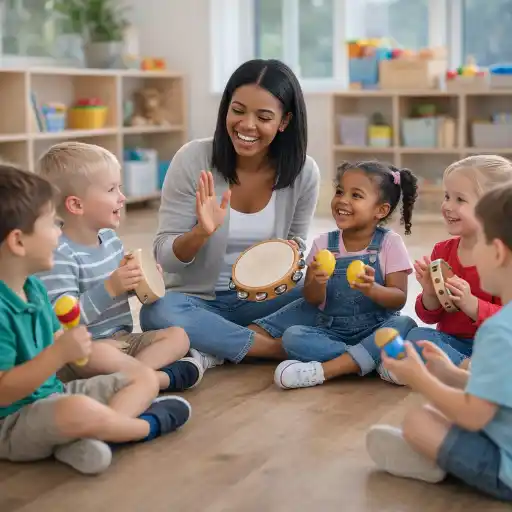
- Steady‑beat station (3–5 minutes): shakers or body percussion to tap the pulse.
- Action rhyme (2–4 minutes): “Head, Shoulders, Knees & Toes” or a two‑step choreography for large‑motor practice.
- Calming music moment (2–4 minutes): slow tempo + deep breaths before nap or focused work.
- Rotation model for a short music day (15–25 minutes total) — video dance, instrument play, and a calm/sensory corner. As part of Can a Music‑Video‑Themed Movement Day Boost Learning and Inclusion in My Program? you’ll find station scripts and inclusion tips.
- 🎵 Emoji tip: use a scarf or prop at one station to invite creative movement — props help children with different engagement preferences join in.
Dos and don'ts: choose 3 anchor songs per week (welcome, movement, calm); repeat them; keep group times under 10–15 minutes for preschoolers and briefer for toddlers. Low prep, high repetition beats complex lesson plans for daily implementation.
How do music and movement support language, memory and motor development?
Mechanisms are practical and observable. Music organizes language into rhythm and melody, which supports phonological awareness and recall. Melody and predictable phrasing act like a mnemonic: children rehearse vocabulary embedded in song and gesture, strengthening retrieval. Rhythm and steady beat exercises entrain timing systems that support sequencing, attention, and motor planning. Educators interested in connecting rhythmic learning with Montessori practice can also explore how Montessori principles meet music and rhythm.
Key points from evidence and practice:
- Phonological gains: repeated melodic patterns make syllable boundaries and rhyme more salient — a proven link in preschool studies (see the ECRP literature review for emergent literacy outcomes).
- Working memory & chunking: songs naturally chunk multi‑step routines (e.g., clean‑up sequence), reducing working memory load.
- Motor development: paired movement (marching, clapping, scarf waves) builds balance, bilateral coordination and timing.
In practice, active participation (singing, playing, moving) shows larger effects than passive listening. For classroom staff looking to translate research into usable lessons, ChildCareEd’s Language Development in Early Childhood Buy Now $16.00 and Mind's Medicine Buy Now $16.00 course descriptions outline specific activity types and measurable learning targets to connect music activities to language and literacy goals. #rhythm #development
How can I adapt activities for inclusion, sensory needs, and limited space?
Inclusion is practical: design multiple entry points so every child can participate. Small changes in materials, volume and response methods often produce big gains in access and engagement.
Adaptation checklist:
- Multiple response modes: sing, hum, sign, point to a picture, or play an instrument.
- Seating & movement options: standing spots, stools, cushions or a nearby quiet corner.
- Volume control: soft instruments, headphones or lower playback levels for sensory sensitivities.
- Alternate roles: instrument keeper, visual‑card pointer, or beat leader so nonverbal children have a meaningful role.
Space solutions: use tape lines, balloon games, or seated marches when floor space is limited. Always document adaptations in lesson notes and coordinate with families and therapists for consistent strategies. Remember: state requirements vary - check your state licensing agency when planning equipment, visitor participation or off‑site performances. For culturally responsive repertoire and family partnership strategies, see ChildCareEd’s Montessori Cultural Activities Buy Now $24.00 and the Supporting Families and Caregivers in Language and Literacy Buy Now $16.00 course.
How do I train staff, measure impact, and avoid common mistakes?
Staff confidence is the linchpin of sustained practice. Prioritize short modeling sessions, peer coaching and simple checklists rather than one long workshop.
Practical staff plan:
- Model one 5‑minute routine and follow with a 10‑minute coached practice.
- Use a one‑page fidelity checklist: engagement, transition timing, adaptation use, child responses.
- Rotate responsibilities so every teacher leads one music moment per week.
Common mistakes and fixes:
- 🚫 Too‑long sessions — Fix: break into 1–5 minute bursts and repeat across the day.
- 🚫 One response mode only — Fix: provide 2–3 ways to join each activity.
- 🚫 Random playlists with no cue meaning — Fix: teach the meaning of each anchor song and pair a visual cue.
Measure impact with simple, repeatable metrics: weekly transition incident counts, % of children stopping on cue, or two short anecdotal notes per child each week. For staff PD resources and program-level guidance, ChildCareEd’s Balancing Active Play Buy Now $16.00 and Supporting Families and Caregivers in Language and Literacy Buy Now $16.00 offer practical modules you can assign to staff for CEUs.
Conclusion: Can a few minutes of music and movement really change outcomes?
Yes. The cumulative effect of short, intentional musical and movement moments is substantial: improved transitions, stronger language and memory for targeted vocabulary, better motor planning, and greater classroom cohesion. Start with three anchor songs, two brief movement bursts, and one simple checklist to measure change. Prioritize active participation, provide multiple entry points for inclusion, and coach staff with short, classroom‑based modeling.
Next steps: enroll staff in Mind's Medicine: Music in Early Childhood Buy Now $16.00 to get ready‑to‑use lesson scripts and CEUs; pilot a 15‑minute music rotation this week and record one measurable outcome (e.g., transition time). With small, consistent steps you’ll see measurable improvements in attention, language, motor skills and community. #inclusion
- CDA Subject Area 2
- CDA Home Visitor Subject Area 3 Part 3 Birth to 5
- CDA Home Visitor Subject Area 2 Part 3 Birth to 5
- Sensitive Periods in Montessori: Guiding Natural Learning
- Mind's Medicine: Music in Early Childhood
- Texas Director Credential
- Montessori Cultural Activities: Exploring the World Through Play and Learning
- Access for All: Inclusion and the ADA
- Wellness in Action: Teaching Healthy Habits to Children
- Exploring the Cognitive Benefits of Movement in Early Childhood Classrooms
- Can simple indoor movement games teach listening and cooperation to preschoolers in Oklahoma?
- How can music and movement strengthen early childhood programs in North Dakota?
- Canciones, juegos y preguntas de círculo para niños
- How Can I Make Circle Time Activities Work for Preschoolers?
- One, Two, Eyes on You: A Fun Way to Build Listening Skills
- How can music and movement help New York preschoolers?
- How can bilingual music transform your early childhood classroom?
- Can a Music‑Video‑Themed Movement Day Boost Learning and Inclusion in My Program?
- How Does Singing Together Build Community in the Classroom?
- How Can You Celebrate Black Culture and Music Effectively in Your Program?
- How can I keep Children Active Indoors On Cold Days?
- How do singing, rhythm, movement and musical play support language, memory and social development in young children?
- How Can Child Care Programs Celebrate Mexican Culture Beyond Stereotypes?
- Can Dance Support Young Children's Physical and Emotional Development?
- How Can Music and Movement Activities Boost Learning and Inclusion for Young Children?
- How Can Child Care Programs Celebrate Hispanic Heritage Month Meaningfully?
- How Can Music and Movement Enrich Early Childhood Learning?
- How Can Child Care Providers Use Art and Creative Expression to Support Young Children?
