A freeze-dance party is a low-preparation, high-impact way to bring joy, #music, and intentional #movement into your child care program. By combining active dancing with clear stop-and-start cues, children can strengthen gross motor skills, balance, coordination, listening, self-control, and group participation. This guide gives child care providers and directors a practical playbook for explaining why movement activities matter, preparing a safe dance space, selecting age-appropriate music, including children with different abilities and sensory needs, and leading each stage of the activity with confidence.
To strengthen your ability to plan developmentally appropriate music and movement experiences, explore ChildCareEd’s self-paced online course Mind’s Medicine: Music in Early Childhood  Buy Now $16.00. The training examines the importance of music in child development and curriculum and helps educators design appropriate musical activities for children from birth through age five. You can also use ChildCareEd’s article How to Lead Dance Parties That Get the Wiggles Out for practical ideas such as simple repeatable movements, short activity lengths, child-led dance turns, and freeze-dance cues that support listening and coordination. For ways to integrate visual arts, drama, and music across your curriculum and to find related training courses for providers, see Children and the Arts. State requirements vary, so always check with your state licensing agency.
Why should my daycare host a freeze-dance party?
Why it matters: short, guided bursts of music-and-movement support attention, regulation, social skills, and gross-motor development. Research and practitioner summaries emphasize that movement benefits cognitive functions like inhibitory control and working memory — exactly the skills a freeze-dance game practices when children stop on cue (see Exploring the Cognitive Benefits of Movement and The Connection Between Movement and Cognitive Growth).
- Physical: practice balance, coordination, and spatial awareness.
- Social: share space, take turns, and follow group cues.
- Emotional: offer a predictable outlet for energy and self-regulation.
Practical wins: freeze-dance is adaptable to mixed ages, works indoors/outdoors, and can be used for transitions or a scheduled #preschoolers party. For classroom-ready tips and scripts, review ChildCareEd’s practical post on leading dance parties (How to Lead Dance Parties).
How do I plan and schedule a safe, engaging freeze-dance party?
Use a planning checklist to make the event both safe and fun. Consider time, space, staffing, and supplies. Follow public-health and program safety recommendations (see CDC safety guidance and ChildCareEd’s safety checklist).
- 📅 Schedule: 5–15 minutes per session for preschoolers; multiple short rounds keep attention high.
- 📍 Space: clear a 6–8-foot radius per child if possible; remove tripping hazards and check surfaces. Outdoor asphalt or indoor carpet with taped boundaries both work well.
- 👀 Supervision & ratios: ensure enough adults to observe sightlines and intervene; plan a staff positioning map so every child is visible.
- 🧯 Safety prep: check footwear, remove jewelry with loops, and keep hydration/sun protection in mind for outdoor events.
- 📣 Communication: post a simple agenda for staff and families; state requirements vary - check your state licensing agency.
Resources: use ChildCareEd lesson plans (e.g., Color Dance Parade Buy Now $0.00) for themes and transitions, and consult the CDC playground and ECE safety pages for injury prevention guidelines (CDC Safety).
What music, props, and cues work best for different ages?
Song selection, tempo, and props shape how children move and how you scaffold control. Use intentional choices to match developmental levels and learning goals.
- Music choices
- 🎵 Fast/slow alternation: alternate upbeat and calm songs to vary arousal.
- 🔉 Volume: keep music at a comfortable level; lower volume for sensory-sensitive children.
- 🔗 Use predictable songs with clear beats for younger children (ChildCareEd and Sing Play Create have great classroom playlists; see ChildCareEd tips and Sing Play Create: Brain Breaks).
- Props & themes
- 🧣 Scarves and ribbons encourage large-arm movement and visual tracking.
- 🥁 Shakers/drums for rhythmic play and turn-taking.
- 🎭 Themes (animals, colors, letters) let you add learning goals — e.g., stop when you hear the color “blue.” See lesson ideas from Color Dance Parade Buy Now $0.00.
- Verbal & nonverbal cues
- 🗣️ Use a consistent cue set: 3-second countdown before freeze, a visual card, and a short signal word like “Freeze!”
- 🤚 For children with language delays or hearing differences, pair the word with a raised hand or a light flash.
Tip: prepare a short playlist of 8–12 songs and test transitions. For sample songs and activity collections, see ChildCareEd and Sing Play Create resources (ChildCareEd, Sing Play Create).
How do I include every child and adapt the game for diverse needs?
Inclusion is non-negotiable. Plan for multiple ways to participate: standing, seated, moving a hand, or playing an instrument. ChildCareEd emphasizes offering choices, seating options, and sensory adjustments (How can music and movement help New York preschoolers?).
- Universal adaptations
- 🔁 Offer 2–3 response modes: move, point to a card, or press a buzzer.
- 🪑 Provide alternative positions: seated dances, standing with support, or gentle sways.
- Specific needs
- ♿ For mobility limits: use handheld props (shakers) or seated rhythm games.
- 🧠 For attention or regulation needs: shorter rounds, visual countdowns, and predictable routines.
- 👩🏫 For cognitive or communication differences: supply picture cue cards and peer buddies (see inclusive approaches in ChildCareEd’s inclusion resources).
- 🦯 For visual impairments: use rich auditory cues and body-sound games; see adaptations at Teaching Visually Impaired: Music & Movement.
- Adaptive programming examples
- 💃 Use adaptive dance strategies like those at Vibe Performing Arts: Adaptive Dance to tailor pace and expectations.
Document adaptations in your lesson plan and share them with staff. Small changes — lower volume, visual cues, or an alternate role — let every child experience success and belonging. Use your program’s inclusion training and resources (see ChildCareEd’s specialized guides) to build staff confidence.
How should I lead the activity, and what common mistakes should I avoid?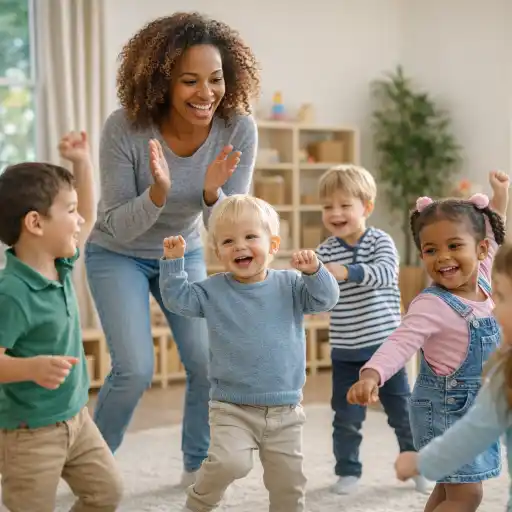
Leadership is a sequence of clear, short steps. Here’s a reproducible script plus common pitfalls and quick fixes inspired by ChildCareEd and practitioner resources.
- Before music
- 1) ✅ Set expectations: 2–3 rules (space, stop on cue, gentle hands).
- 2) ✅ Demonstrate: model moving, stopping, and safe use of props.
- During music
- 3) 🎵 Start with warm-up: march in place for 30–45 seconds.
- 4) 🎯 Use a predictable cue: 3-second countdown, then “Freeze!” plus raised hand or light cue.
- 5) 🔄 Offer choice: lead a round of teacher-led moves, then a child-led round to build ownership.
- After music
- 6) 🧘 Cool-down: deep breaths, stretches, or a quiet song to reset.
- 7) 📋 Reflect: quick 2-sentence feedback from a child or staff note on what worked.
Common mistakes and fixes:
- 🚫 Too-long sessions — Fix: split into 2–3 short rounds (5–8 minutes each).
- 🚫 One-size-fits-all cues — Fix: pair auditory cues with visual cues and choices.
- 🚫 Unsafe space or props — Fix: pre-check the area and practice a demo round with staff.
- 🚫 Overstimulating volume — Fix: use quieter tracks and reserve loud songs for outdoor play.
For concrete sequences and classroom scripts, see ChildCareEd’s practical tips (How to Lead Dance Parties) and Sing Play Create’s freeze-dance collections (Brain Breaks).
Conclusion
Freeze-dance parties are a scalable, research-aligned method to support physical, social, and cognitive growth while keeping the day joyful and manageable for staff. With careful planning, inclusive adaptations, and simple leadership scripts,s you can run repeatable, safe sessions that children love.
FAQ
- Q: How long should a freeze-dance party run? — A: For preschoolers, 5–15 minutes per session; several short rounds work best.
- Q: What if my room is small? — A: Use taped spots on the floor, seated freeze-dance options, or move the activity outdoors when possible.
- Q: How to include children with sensory sensitivities? — A: Offer quieter music, noise-dampening headphones, and lower-intensity movement roles (e.g., scarf waving).
- Q: Do I need special training? —Short-staff coaching and rehearsals are effective; ChildCareEd offers concise courses and lesson packs to build skills.
- Q: Where can I get music/lesson plans? — A: Start with ChildCareEd lesson plans and Sing Play Create playlists linked above; adapt them to your group.
Ready to try it? Draft a one-page plan, choose three songs, assign staff positions, and run a 7-minute pilot. Observe, tweak, and celebrate the smiles. For more templates and printable lesson supports, explore ChildCareEd’s resources (Free Resources). Remember: state requirements vary - check your state licensing agency.
- CDA Certification en Español: Recursos y Consejos para Educadores Bilingües
- 👶 ¿Cuáles son las proporciones y grupos requeridos en Dakota del Norte? 🏫
- Recursos en Español sobre el Sueño Seguro del Bebé
- Actividades de Motricidad Gruesa que Desarrollan el Equilibrio, la Coordinación y la Fuerza
- 10 Ejemplos de Cómo la Cultura Influye en el Desarrollo Infantil
- Capacitación en Salud y Seguridad Preventiva en Línea para Proveedores de Cuidado Infantil
- Cómo Iniciar el Proceso de Obtención de la Licencia de Cuidado Infantil
- Cómo Empezar una Guardería en Casa: Requisitos y Pasos
- ¿Cómo solicito la licencia para una guardería en California?
- Proporciones de Cuidado Infantil y Tamaños de Grupo por Edad en Maryland (Guía Rápida para Centros y Hogares)
- Proporciones de Cuidado Infantil y Tamaños de Grupo por Edad en Virginia (Guía Rápida para Centros y Hogares)
- Lista para Guardería en Casa en Illinois: Cómo Iniciar una Guardería en el Hogar
- Lista para Guardería en Casa en Texas: Cómo Iniciar una Guardería en el Hogar
- Cómo Trabajar en el Cuidado Infantil en California: Requisitos y Pasos
- Cómo Trabajar en el Cuidado Infantil en Wisconsin: Requisitos y Pasos
- Capacitación Previa al Servicio para Proveedores de Cuidado Infantil en Nevada
- Celebrando la amistad en el cuidado infantil durante el Día de los Mejores Amigos
- Canciones, juegos y preguntas de círculo para niños
- Cómo simplificar la capacitación para sus empleados de daycare
- How can I host a safe, engaging freeze-dance party in my daycare?
