Turn an ordinary movement break into a memorable, curriculum-rich experience with a Music-Video-Themed Movement Day. By combining short, intentional movement activities with child-friendly music videos, simple props, and interactive stations, children can strengthen motor skills, language, self-regulation, creativity, and social play while having fun. This article gives child care providers and directors practical planning steps, ready-to-use activities, inclusive adaptations, staff supports, and simple ways to observe the event’s impact. Educators can deepen this work through ChildCareEd’s self-paced online course Mind’s Medicine: Music in Early Childhood  Buy Now $16.00, which explores how music supports child development and helps educators plan developmentally appropriate musical activities. The online course Wellness in Action: Teaching Healthy Habits to Children Buy Now $55.00 can also help programs incorporate structured and unstructured physical activity into children’s daily routines. Together, these approaches can help providers plan timing, organize stations, adapt activities for diverse learners, and create an inclusive movement experience that supports learning across developmental areas. For additional lesson ideas, see ChildCareEd’s How Can Music and Movement Help New York Preschoolers? State requirements vary, so always check with your state licensing agency.
How do I design a Music‑Video Movement Day that fits a busy schedule?
Practical, enumerated plan:
- 📅 Prep (the day before): create 3–4 station tubs—video + props, instrument play, choreography practice, calm/stretch corner. Use simple playlists and printed cue cards.
- 🎬 Morning warm‑up (5–8 min): a high‑energy video (dance moves) to set tone and model moves.
- 🔁 Rotations (15–25 min total): 1) Dance‑along video station, 2) Prop & choreography station (scarves, shakers), 3) Rhythm/instrument station, 4) Calm/visual story with movement cues.
- 🏁 Closing (3–5 min): whole‑group mini performance or freeze dance and a goodbye song.
Keep groups small, reuse the same 3 songs/videos so children can master movements. For ready music & movement lessons and steady beat activity ideas, explore resources like Sing Play Create and the 12 Steady Beat Activities.
What specific activities bring the music‑video theme to life while building skills?
- 🎥 Video Dance‑Along: play a short, child‑friendly music video and teach 3 signature moves to repeat. Use simple visuals so children copy body parts and sequences. See action song ideas at Sing Play Create: Action Songs.
- 🥁 Rhythm & Instrument Station: steady‑beat games with drums, shakers, and body percussion to reinforce pulse and listening—ideas at Steady Beat Activities and ChildCareEd.
- 🧣 Choreography & Props: scarves, stretchy bands, bean bags—small groups invent short moves to a clip and perform. Props ideas are documented in creative movement posts like Connect‑A‑Stretchy Bands.
- 🧘 Calm Corner & Sensory Story: use a slow music video or audio story plus tactile props for regulation and language practice; sensory‑story techniques are recommended in ChildCareEd: Circle Time Ideas.
Adaptations for small spaces and inclusion: seated choreography, hand percussion, or a visual cue card so every child can participate; see practical inclusion guidance at ChildCareEd: inclusion tips and specialized ideas for children with visual differences at Teaching Visually Impaired.
Why does a music‑video movement theme matter for development and behavior?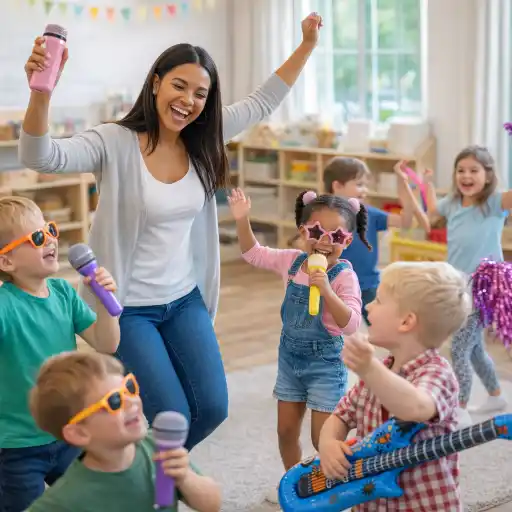
Concrete reasons it matters:
- 🧠 Cognitive support: pairing words with actions (vocabulary + gestures) strengthens memory and concept learning. See strategies in ChildCareEd.
- 💪 Physical & motor development: rotating obstacle‑style choreography and rhythm games build balance, coordination and bilateral integration—try gross motor ideas at Gross Motor Games.
- 🤝 Social & emotional: co‑created choreography and small performances build turn‑taking, confidence, and peer support.
Also follow public guidance for activity levels: the CDC recommends that 3–5-year-olds be physically active throughout the day and older children aim for accumulated active minutes—translate that into multiple short movement bursts across your day (CDC: Child Activity Guidelines).
What common mistakes happen, and how can I avoid pitfalls?
Anticipate issues and plan to prevent them. Here are common pitfalls and practical fixes you can apply instantly:
- 🚫 Mistake: Sessions are too long or too noisy. Fix: Keep video segments short (2–8 minutes) and alternate energetic and calm stations. Use quiet instruments and a calm corner for overstimulated children; see tips in ChildCareEd.
- 🚫 Mistake: One‑size‑fits‑all activities. Fix: Offer choice cards (sing, sign, play an instrument, or watch) so children select how they join. Inclusion resources and course suggestions are at ChildCareEd Free Resources.
- 🚫 Mistake: Poor transitions and safety gaps. Fix: Use clear visual and auditory cues (countdowns, bell, or familiar cue song) and mark activity zones with tape. For safety guidance and licenses, remember: state requirements vary - check your state licensing agency and related safety handouts at ChildCareEd Health & Safety.
- 🚫 Mistake: Staff uncertainty. Fix: rehearse one station routine before full rollout and use short coaching sessions (see staff PD below).
How can I prepare staff, sustain quality, and measure success?
Make professional learning short, practical, and classroom‑based. Use a combination of micro‑training, modeling, and simple tools so sstaff embedmovement without adding load.
Action steps (enumerated):
- 👩🏫 Train (2–3 short sessions): model one full rotation; share scripts for a starter 5‑minute video station and one calm corner routine. ChildCareEd courses like Mind's Medicine: Music in Early Childhood are targeted, short, and practical.
- 🔁 Coach: pair new teachers with a mentor for an observed session and quick feedback. Evidence supports modeling + coaching as high‑impact PD (ChildCareEd PD guidance).
- 📏 Measure: use a simple checklist—engagement (1–4), transitions (satisfied/needs work), inclusion adaptations used (yes/no), child responses (anecdotal). Track one class per week and adjust.
- 📦 Sustain: rotate playlists monthly, keep a prop box, and schedule one mini‑showcase for families so staseessee value and children practice performance skills.
Need supplies and low‑cost props? Explore ideas and equipment lists at No Time For Flash Cards and creative prop ideas at Sing Play Create.
Summary — Quick checklist to run your first Music‑Video Movement Day
Try these steps this week to pilot the theme with confidence:
- 📂 Choose 3 repeat videos and make 3 station tubs (video, instruments, props).
- 🕒 Schedule: 5–8 min warm‑up, 15–20 min rotations, 3–5 min whole‑group close.
- 🤝 Plan 2 adaptations per station (seated, tactile, visual cue).
- 👩🏫 Run a short staff rehearsal and use a 3‑item checklist to collect observations.
- 📣 Share results with families and note the child's success story to celebrate.
You’re creating joyful, developmentally powerful moments. Small, repeated, intentional movement experiences add up to big gains in attention, language, motor skills, and community. For more lesson plans, inclusion strategies, and course supports, start with ChildCareEd resources such as Gross Motor Games and training pages. Remember: state requirements vary - check your state licensing agency.
FAQ
- Q: How long should each rotation be? A: 5–12 minutes for preschoolers; 1–3 minutes for toddlers—short and repeated is best. See scheduling advice at ChildCareEd. For activity ideas tailored specifically to two-year-olds and practical caregiver strategies, see terrific activities for two-year-olds.
- Q: What if I don’t have video equipment? A: Use audio tracks plus choreography cards and a demonstration—video is helpful but not required. See steady beat and chant activities at Sing Play Create.
- Q: How do I include children with sensory needs? A: Offer quieter instruments, lower volume, a calm corner, and allow choices for participation; find inclusion ideas at ChildCareEd.
- Q: How to measure impact? A: Use a one‑page checklist for engagement, transitions, and two child‑level anecdotes each week.
- Q: Where to find ready plans? A: ChildCareEd lesson packs (Color Dance Parade), Sing Play Create resources, and printable game ideas on No Time For Flashcards.
Short, purposeful movement episodes embedded in routines support attention, executive function, language, and gross motor growth. Research‑informed summaries show that movement interventions improve attention and executive control in young children—movement is not just play; it scaffolds cognition and self‑regulation (ChildCareEd: Movement & Cognitive Growth).
- CDA Subject Area 2
- 45 Hour Preschool Methods and Materials
- 45 Hour Infant and Toddler Methods and Materials
- Pediatric RSV First Aid & CPR/AED
- 45 Hour School Age Methods and Materials
- Sensitive Periods in Montessori: Guiding Natural Learning
- Texas Director Credential
- Wellness in Action: Teaching Healthy Habits to Children
- Mind's Medicine: Music in Early Childhood
- Montessori Cultural Activities: Exploring the World Through Play and Learning
- ¿Cómo explicar los colores a un niño ciego? Actividades con tacto, sonido y emociones
- Recursos en Español sobre el Sueño Seguro del Bebé
- 10 Ejemplos de Cómo la Cultura Influye en el Desarrollo Infantil
- What Does the Latest Guidance Say About Screen Time for Toddlers and Preschoolers?
- How to Celebrate National Ice Cream Day in Your Center
- How can music and movement strengthen early childhood programs in North Dakota?
- Celebrando la amistad en el cuidado infantil durante el Día de los Mejores Amigos
- Canciones, juegos y preguntas de círculo para niños
- Summer Crafts and Activities for Preschool Classrooms
- How can North Dakota child care balance technology and play?
- How can music and movement help New York preschoolers?
- Be a Kid Again Day: Play-Based Learning Ideas for Teachers
- Can a Music‑Video‑Themed Movement Day Boost Learning and Inclusion in My Program?
- How can we host a Costume & Character Day that truly builds imagination and learning?
- How do singing, rhythm, movement and musical play support language, memory and social development in young children?
- Can Dance Support Young Children's Physical and Emotional Development?
- How Can Music and Movement Activities Boost Learning and Inclusion for Young Children?
- How Can Child Care Programs Celebrate Hispanic Heritage Month Meaningfully?
- ¿Todos los niños deben participar en el tiempo de círculo?
