Cold, icy days can keep children indoors, but they do not have to mean a day of restless bodies and disrupted routines. With a little planning, providers can make indoor movement safe, inclusive, and genuinely fun; Engaging Indoor Activities for Inclement Weather  Buy Now $24.00 offers a three-hour training focused on planning varied indoor experiences, while Balancing Active Play in Child Care Buy Now $16.00 explores how to balance movement, creative play, and quieter periods. These courses can help you turn winter’s space and scheduling challenges into practical classroom strategies—read on for activities you can adapt and use right away.
Why does indoor movement matter when outdoor play is limited?
Young children need regular opportunities to move, even when freezing temperatures, ice, or other conditions make outdoor play unsuitable. Active play engages large muscle groups and gives children practice with balance, coordination, body awareness, and moving safely around others. It also creates opportunities to cooperate, take turns, follow cues, and make choices.
Movement can be part of learning rather than a break from it. A child who hops to a color marker, copies an animal’s movement, or acts out a story is combining physical activity with listening, language, imagination, and problem-solving. Short, repeated bursts can fit naturally into transitions and classroom routines, helping children shift between energetic and focused experiences.
Public health guidance for early care settings recommends structured movement opportunities across the day, alongside adequate space for indoor and outdoor play. The CDC also identifies staff learning and written program policies as ways to support physical activity. Use these recommendations as planning context, and check applicable local rules and program guidance; state requirements vary - check your state licensing agency.
Which low-preparation activities can children try indoors?
Choose activities that match the room, group size, children’s abilities, and the materials available. Simple, familiar supplies—such as painter’s tape, scarves, soft balls, paper plates, and music—can support a wide range of movement without requiring a large equipment budget.
- 🟠 Tape paths and stepping stones: Make lines, shapes, or spots with painter’s tape. Invite children to walk, tiptoe, step, or hop along a path, offering choices rather than requiring every child to hop.
- Animal movement parade: Call out familiar animals and invite children to waddle, crawl, stretch, or flap. Let children suggest movements and model a clear stop cue.
- Freeze dance: Play music and invite children to dance in their own space. Pause the music for a freeze, then restart with a new movement idea.
- Soft “snowball” toss: Use crumpled paper or soft beanbags and large baskets as targets. Make the distance adjustable and keep throwing directed away from other children.
- Mini obstacle trail: Arrange floor markers, a crawl-under space, and a soft target toss. Keep the route simple, stable, and easy to supervise.
How can providers organize movement safely in limited space?
Before an active game begins, scan the area at children’s level. Move fragile or sharp objects, secure or remove loose rugs, and create visible boundaries. Check that furniture, props, and pathways do not create pinch points or blocked exits. Use only sturdy, age-appropriate materials and inspect them before play.
Supervision requires more than being in the room. Position adults to maintain clear sightlines, divide children into smaller groups when needed, and establish one consistent signal—such as a raised hand or a clap—for pausing movement. Demonstrate the activity and its boundaries before children begin; young children often learn expectations more readily when they can see them.
- Keep movement routes separate from quiet play and doorways.
- Use soft, lightweight materials and avoid slippery “skating” games on smooth floors.
- Reduce waiting by setting up more than one simple station or taking turns in small groups.
- Follow your program’s supervision, illness, cleaning, and emergency procedures.
Children benefit from clear expectations that protect participation, not from having movement removed as punishment. If a game becomes crowded or overly exciting, pause, simplify the route, and restart with a smaller group.
How can indoor movement include different ages and abilities?
Inclusive planning starts with the child, not the activity. Consider each child’s mobility, communication, sensory preferences, confidence, and current skills. Offer several ways to participate: standing or seated movements, walking or hopping, moving or giving directions, and joining immediately or watching first. A child’s choice to observe can be a meaningful first step toward participation.
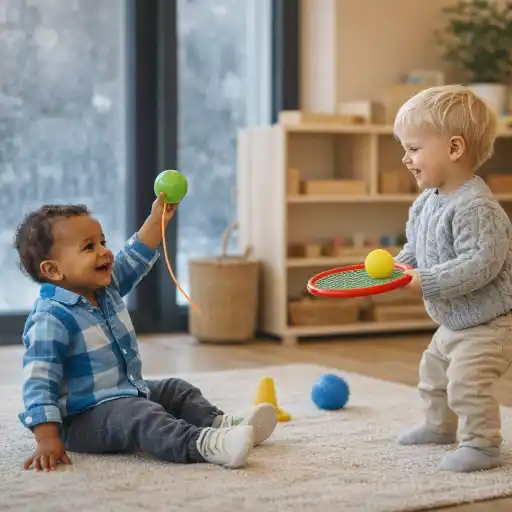
For infants, provide supervised awake floor time and gentle opportunities to reach, roll, and move in accordance with individual development and safe-sleep practices. Toddlers may enjoy short, repeated games with simple demonstrations. Preschoolers can often take on more complex sequences, invent movements, or help design a course—while still receiving appropriate supervision.
- Use picture cues, gestures, or a visual sequence to make directions easier to follow.
- Offer a seated alternative, such as arm movements, rolling a ball, or passing a scarf.
- Adapt equipment: choose larger, lighter, or easier-to-grip objects when helpful.
- Invite peer modeling without making one child responsible for another’s safety.
How can movement become a reliable part of the winter routine?
A predictable rhythm makes movement easier to plan and less likely to feel like an emergency response to pent-up energy. Rather than relying on one long indoor exercise period, build brief activity opportunities into the day and alternate them with quieter play, meals, rest, and focused experiences. Follow age-appropriate guidance and your program’s schedule; the right duration and frequency will depend on the children and setting.
A simple routine might include a short animal-walk warm-up after arrival, a freeze-dance transition before group time, and an obstacle trail during a planned active-play block. A movement-card jar can offer a quick choice when the group needs a reset. Keep a small kit of tape, scarves, soft balls, and visual movement cards ready so staff do not have to improvise from scratch.
Notice children’s responses. Are they engaged, waiting too long, becoming overstimulated, or needing a quieter option? Use those observations to adjust group size, music volume, activity length, or challenge level. Staff can also record brief examples of children’s emerging skills—such as balancing along a line or following a stop cue—to support reflection and communication with families.
Conclusion: What is the best way to keep children moving indoors?
When freezing weather limits outdoor play, young children can still have meaningful opportunities to move. Plan short, varied activities; make the space safe and easy to supervise; and offer adaptations so children can participate in ways that work for them. Tape paths, animal walks, dance, soft-target tosses, and simple obstacle trails can bring movement into ordinary classroom routines with modest preparation.
The central goal is not to recreate an outdoor playground indoors. It is to provide safe, welcoming chances to practice movement, connection, and choice throughout the day. Start with one activity, observe how children respond, and refine the plan with your team. Consistent, thoughtful indoor movement supports a lively classroom—even when winter weather keeps everyone inside.
Courses for further learning
- Engaging Indoor Activities for Inclement Weather Buy Now $24.00 — training on planning varied indoor experiences for inclement-weather days.
- Balancing Active Play in Child Care Buy Now $16.00 — strategies for balancing active, creative, and quieter experiences.
- Mind’s Medicine: Music in Early Childhood Buy Now $16.00 — developmentally appropriate ways to include music in classroom experiences.
- Inclusive Lessons for Preschoolers Buy Now $16.00 — practical approaches for adapting activities to support different learners.
- Effective Supervision in Child Care Buy Now $25.00 — supervision strategies for maintaining a safe environment during activities.
- 45 Hour Child Growth and Development
- 45 Hour Preschool Methods and Materials
- Engaging Indoor Activities for Inclement Weather
- 45 Hour School Age Methods and Materials
- CDA Bridge Bundle: Family Child Care without Portfolio Review
- CDA Bridge Bundle: Infant/Toddler without Portfolio Review
- CDA Bridge Bundle: Preschool without Portfolio Review
- Texas Director Credential
- Ice Cream and Asteroids!
- 🔍 ¿Qué ves cuando observas a un niño aprender?
- Recursos en Español sobre el Sueño Seguro del Bebé
- Proporciones de Cuidado Infantil y Tamaños de Grupo por Edad en Maryland (Guía Rápida para Centros y Hogares)
- Proporciones de Cuidado Infantil y Tamaños de Grupo por Edad en Virginia (Guía Rápida para Centros y Hogares)
- How to Celebrate National Ice Cream Day in Your Center
- Air Quality and Child Care in Maryland: Outdoor Play Safety Tips
- Air Quality and Child Care in Illinois: Outdoor Play Safety Tips
- How can North Dakota early childhood programs teach children about nature and wildlife?
- Canciones, juegos y preguntas de círculo para niños
- How can New York child care programs keep young children cool and hydrated during a heat wave?
- How can Minnesota child care programs keep infants and toddlers hydrated and safe in hot weather?
- Celebrate Ice Cream Day with Fun Activities for Children
- How can Oklahoma child care providers celebrate National Ice Cream Day safely and with learning fun?
- How can Florida child care providers celebrate National Ice Cream Day safely and with learning fun?
- How can Alabama child care providers celebrate National Ice Cream Day safely and with learning?
- How can New York child care providers safely celebrate National Ice Cream Day with fun activities?
- How can child care providers keep kids hydrated with simple daily habits?
- How Can Child Care Providers Help Young Children Feel Safe Around Costumes and Masks?
- How Can Child Care Providers Keep Young Children Active When It’s Freezing Outside?
