What if a child’s painting, movement, song, or pretend story could reveal important learning that words do not yet express? Intentional arts experiences help children build confidence, language, motor coordination, problem-solving, and emotional awareness; Open Heart, Open Art  Buy Now $16.00 offers focused professional learning on open-ended art and social-emotional development.
Why Does Art and Creative Expression Matter in Early Childhood?
Art is not an optional decoration added after “real” learning. For young children, drawing, painting, music, movement, drama, and construction are ways of thinking. Through the arts, children test ideas, represent experiences, communicate feelings, and make meaning from the world around them. Research identifies connections between music, drama, visual arts, and social-emotional development, while more recent studies continue to examine how creative experiences influence originality, flexible thinking, and problem-solving.
Creative experiences offer multiple entry points into participation. A child who is quiet during group discussion may communicate confidently through rhythm or collage. A child developing language may tell a story with puppets before telling it verbally. A child who struggles with fine-motor control can begin with large brushes, clay, or whole-body movement. These experiences honor different strengths rather than measuring every child through one narrow form of performance.
- Strengthening #creativity and flexible thinking.
- Supporting #selfexpression and emotional communication.
- Developing fine- and gross-motor coordination.
- Expanding vocabulary, narrative skills, and social interaction.
- Encouraging persistence, decision-making, and problem-solving.
What Is the Difference Between Process-Focused and Product-Focused Art?
Process-focused art prioritizes children’s exploration, decisions, and discoveries. Product-focused art begins with a predetermined result, often an adult-made model that children are expected to reproduce. Both may have a place in early learning, but when every child’s project looks the same, the activity may emphasize compliance and imitation more than creative thought.
NAEYC describes process-focused experiences as those without step-by-step instructions, sample products, or a single correct outcome. The child chooses materials, experiments with techniques, and determines when the work feels complete. The educator prepares a safe environment, observes closely, and extends thinking without taking ownership of the creation.
For example, instead of directing children to make identical paper flowers, place out paper, paint, natural materials, glue, and scissors. Invite children to explore: “What can these materials become?” Helpful language includes “I notice you used long, sweeping marks,” “What happened when the colors met?” and “What could you try next?” Avoid correcting children’s artistic choices or asking, “What is it?” as though representational accuracy determines value.
How Can Providers Design an Arts-Rich Classroom Environment?
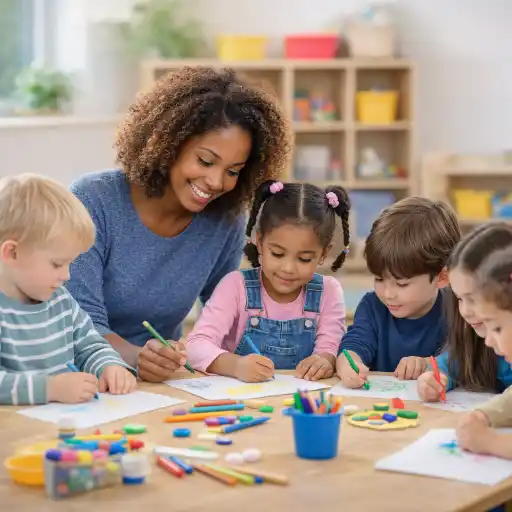
A thoughtfully arranged environment makes creative expression more accessible and less dependent on adult permission. Children should be able to see materials, make manageable choices, work for sustained periods, and participate in cleanup. Consider flexible areas for visual arts, music and movement, dramatic play, construction, sculpture, and reflection.
🖌️ Rotate one or two materials at a time so novelty invites investigation without overwhelming children. Recycled paper, boxes, fabric scraps, sticks, leaves, and cardboard can provide rich possibilities at low cost. ChildCareEd’s art exploration resource connects these experiences with fine-motor development, language, cognitive planning, and stress relief.
Accessibility should be built into the design. Offer larger handles, vertical surfaces, adaptive scissors, visual choices, tactile materials, quiet alternatives, and multiple ways to respond. Observe what creates a barrier, document the adaptation, and collaborate with families or specialists when needed. State requirements vary, so check your state licensing agency for material safety, supervision, and sanitation expectations.
How Can Art Be Integrated Across the Curriculum?
Arts integration is most effective when it is connected to meaningful questions rather than treated as an isolated craft. A story can become a movement sequence, a science observation can become a drawing, and a block challenge can become a dramatic scenario. Active arts experiences can deepen learning in literacy, mathematics, science, and engineering. For providers exploring music and movement, combining Montessori principles with music and rhythm offers another way to make these experiences intentional and engaging.
- Literacy: Invite children to illustrate a story, retell it with puppets, or create a new ending. Record their words beside the artwork.
- Science: Paint shadows, sketch plant changes, model animal habitats with clay, or use movement to represent weather.
- Mathematics: Explore rhythm patterns, sort collage materials, compare lengths, build structures, and describe shapes.
- Social studies: Invite families to share songs, images, stories, or artistic traditions without presenting one culture as a costume or stereotype.
- Social-emotional learning: Use color, music, dramatic roles, and movement to explore feelings, calming, cooperation, and conflict resolution.
Intentional questions extend learning: “How could we make this stronger?” “What might the character be feeling?” “How can we show that sound with our bodies?” and “What changed after you tried again?” These prompts preserve children’s ownership while making their reasoning visible.
How Can Providers Support Inclusion, Culture, and Emotional Expression?
Inclusive arts practice begins with the assumption that every child is an artist and communicator, even though participation may look different. Some children may prefer observation before joining, while others may need reduced noise, predictable routines, or a limited set of choices. Inclusion means adapting access without lowering expectations for meaningful participation.
- Observe the child’s interests, sensory preferences, communication style, and current strategies.
- Identify the barrier rather than labeling the child as unwilling or incapable.
- Offer an adaptation, such as a larger tool, visual cue, alternative material, or quieter workspace.
- Invite the child to choose how to participate and respect pauses or refusal.
- Document what supported engagement and share successful strategies with colleagues and families.
Cultural responsiveness requires more than displaying occasional holiday crafts. Select authentic books, music, artists, instruments, and images representing the children and families in the program. Invite family knowledge, credit sources, and avoid asking one child to represent an entire culture. Art can become a bridge for belonging when children see their identities respected and encounter perspectives beyond their own.
Creative expression can support emotional development, but classroom art is not clinical art therapy. Providers can offer predictable, open-ended opportunities to communicate feelings; persistent distress, repeated themes of harm, or significant behavioral changes require consultation with families and qualified mental-health professionals.
What Common Mistakes Should Educators Avoid?
- Providing a model to copy: Replace the sample with materials and an invitation.
- Rushing the process: Protect uninterrupted time and allow children to return to work.
- Praising only appearance: Describe choices, effort, strategies, and discoveries.
- Taking over difficult steps: Offer the smallest scaffold that preserves agency.
- Overloading the environment: Curate materials and introduce choices gradually.
- Ignoring accessibility: Adapt tools, space, sound, textures, and communication supports.
- Using cultural materials superficially: Choose respectful, accurate, and context-rich resources.
Documentation can make learning visible without turning art into a test. Capture one photograph, one child quotation, and one observation about a developing skill. For example: “Jordan tested three tools and explained that each created a different texture.” This communicates more than “Jordan made a picture.”
How Can Providers Begin Using Art and Creative Expression This Week?
Start small, make the change sustainable, and observe what children do. You do not need an expensive art studio or advanced artistic training. You need time, accessible materials, thoughtful language, and a willingness to let children’s ideas lead.
- Set up one open-ended invitation using paper, two colors of paint, and unusual tools.
- Add a short song, rhythm game, or movement prompt to one daily routine.
- Place puppets or simple props near a familiar story and invite children to retell it.
- Offer recycled materials for a collaborative construction challenge.
- Document one child’s process and share the learning with the family.
Review the experience with three questions: What choices did children make? What skills or theories did I observe? What adaptation or material might support deeper exploration next time? Additional professional learning includes Power of Art: Building Self-Esteem and Positive Behavior for All Abilities Buy Now $35.00, Mind’s Medicine: Music in Early Childhood Buy Now $16.00, and Art from the Heart for Preschoolers Buy Now $35.00.
Conclusion: How Can Art and Creative Expression Strengthen Early Learning?
Art and creative expression strengthen early learning when children have genuine choices, sufficient time, accessible materials, and responsive adults. Process-focused art supports experimentation and confidence; music, movement, and drama deepen language, social interaction, and problem-solving; culturally responsive and inclusive practices help every child experience belonging.
The central question is not whether every child can produce a beautiful finished project. It is whether the environment invites children to think, communicate, persist, connect, and see themselves as capable creators. By shifting from directing products to facilitating exploration, child care providers can make the arts a daily pathway for development, relationship-building, and joy.
- CDA Home Visitor Subject Area 3 Part 3 Birth to 5
- Many Colors, One Canvas: MD ECE Conference
- Open Heart, Open Art
- Power of Art: Bldg Self-Esteem & Positive Behavior for ALL Abilities
- CDA Bridge Bundle: Family Child Care without Portfolio Review
- Art from the Heart for Preschoolers: Open Ended Art Projects that Build Self-Esteem
- CDA Bridge Bundle: Infant/Toddler without Portfolio Review
- Texas Director Credential
- Montessori Cultural Activities: Exploring the World Through Play and Learning
- Terrible Two's Can Be Terribly Fun!
- Supporting Children's Self-Esteem
- Tiny Hands, Big Dreams: Fostering Creativity in Preschoolers
- Frosty Fun: Trauma-Informed Play for Resilient Young Learners
- CDA Certification en Español: Recursos y Consejos para Educadores Bilingües
- 🔍 ¿Qué ves cuando observas a un niño aprender?
- Proporciones de Cuidado Infantil y Tamaños de Grupo por Edad en Maryland (Guía Rápida para Centros y Hogares)
- Proporciones de Cuidado Infantil y Tamaños de Grupo por Edad en Nueva Jersey (Guía Rápida para Centros y Hogares)
- Proporciones de Cuidado Infantil y Tamaños de Grupo por Edad en Virginia (Guía Rápida para Centros y Hogares)
- How Do Art Activities Support Cognitive Growth in North Dakota Preschoolers?
- Canciones, juegos y preguntas de círculo para niños
- Do Toys Come Alive: How Can Pretend Play Spark Creativity in Your Daycare?
- What Should a School-Age Curriculum Include? A Guide for After-School Programs
- How Can Child Care Providers Use Art and Creative Expression to Support Young Children?
- How Can Art Become a Meaningful Part of the Early Childhood Curriculum?
- How Can Open-Ended Summer Art Encourage Planning and Creativity?
- How Can Flag Design Help Children Explore Symbols, Patterns, and Individual Expression?
- How Can Handmade Gifts Help Children Express Appreciation?
- How Can Art and Conversation Introduce Preschoolers to the Solar System?
- How Can Educators Respond When a Child Says Their Drawing Is “Nothing”?
