Bringing bilingual songs and musical routines into early learning environments is more than an enjoyable classroom activity—it is a research-informed strategy that can strengthen language development, cognitive growth, motor coordination, cultural awareness, and family engagement. Through repetition, rhythm, movement, and familiar words in more than one language, bilingual #music gives children meaningful opportunities to practice communication while building confidence and a sense of belonging. This guide provides child care providers and directors with classroom-ready strategies, thoughtful planning steps, one-week activity ideas, inclusion and safety considerations, and practical ways to partner with families so bilingual music becomes a consistent part of the curriculum rather than a one-time celebration.
To build your skills in this area, explore ChildCareEd’s self-paced online course Building Bridges for Dual Language Learners  Buy Now $16.00, which offers strategies for supporting language acquisition, creating culturally responsive environments, planning engaging activities, and collaborating with multilingual families. You can also take Mind’s Medicine: Music in Early Childhood Buy Now $16.00 to learn how music supports early development and how to design meaningful musical experiences for young children. Together, these trainings can help educators use bilingual songs intentionally to promote communication, inclusion, movement, and stronger home-school connections.
How does bilingual music support language, cognition, and classroom learning?
Why it matters: decades of work link music to stronger vocabulary, phonological awareness, and early literacy. For example, a preschool musical program produced measurable gains in receptive vocabulary as children practiced rhythmic and melodic discrimination (ECRP). A University at Buffalo study found music instruction delivered by trained teachers improved oral vocabulary and grammar understanding in preschoolers (University at Buffalo).
- Auditory scaffolding — melody and rhythm make new phrases memorable and repeatable (see MusicLingua and Cambridge School).
- Multisensory encoding — music + movement links sound to action, aiding retention.
- Reduced affective filter — music makes input lower-threat and more joyful, increasing uptake (ChildCareEd).
- Cognitive transfer — bilingual exposure with musical routines strengthens executive skills and attention (see Indiana ECC).
Bottom line: bilingual songs and chants are pedagogical tools that amplify language learning, not distractions. Use them intentionally and pair them with visuals and repetition to maximize gains.
What practical bilingual music activities can I add tomorrow?
Start small: integrate 2–3 musical moments into your daily flow. Numbered, ready-to-use ideas:
- 🎵 Welcome & goodbye routine — one short bilingual song to bookend the day (repeat daily to build predictability). See circle-time ideas at ChildCareEd music & movement.
- 🥁 Instrument play + vocabulary — give small groups egg shakers labeled in both languages; children say the word as they shake.
- 🕺 Freeze dance with target words — play a bilingual song and pause: children freeze and name an object or action.
- 📚 Story-song pairing — sing a refrain in the child’s home language, then read the same story in English (or vice versa) to build cross-language links (Supporting Dual Language Learners).
- 🎶 Call-and-response chants — teacher models a short phrase in the home language, children repeat and add one new English word.
Quick tips: 1) Keep song length under 60–90 seconds for preschool groups. 2) Repeat favorites across days. 3) Use visuals and gestures with every song. For ready lesson packs and teacher training, consider ChildCareEd course offerings.
How do I design inclusive bilingual music spaces and routines?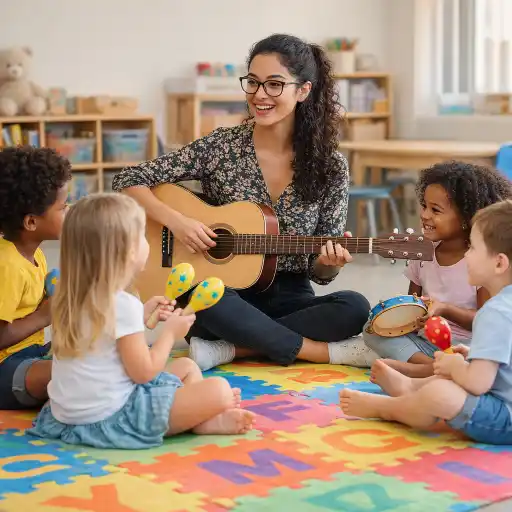
Inclusion and safety are non-negotiable. Use numbered planning steps to make music accessible to all learners:
- 🪑 Space & sound: create clear movement zones, offer seating or standing options, and provide soft instruments for children sensitive to loud sound.
- 🔉 Volume & pacing: lower music volume, shorten songs, and include calm musical choices for regulation moments (ChildCareEd).
- 🤝 Multiple access points: sing, sign, point to pictures, or let a child play an instrument — give at least 2–3 ways to participate. Consider children's different learning styles—visual, auditory, and kinesthetic—when selecting activities and adapt musical routines to match those strengths.
- 🧾 Label and visualize: display pictorial lyrics and bilingual word cards so children can follow along independently.
- ⚖️ Compliance: state requirements vary - check your state licensing agency for rules on group size, supervision, and musical materials.
Adaptation examples: seated body percussion for children with mobility needs; hand-held scarves for limited-movement participation; individual headphone options for children with sensory sensitivities. For program-level inclusion guidance, see ChildCareEd DLL supports and planning resources.
How can I partner with families and the community through bilingual music?
Families are the experts on language and culture. Use music to build trust and reciprocal learning in five concrete steps:
- 📩 Ask families for 3 favorite songs/phrases and request phonetic spellings or short audio clips so staff can model pronunciation accurately (ChildCareEd).
- 🎤 Invite family mini-sessions — a 5–10 minute song or story share during drop-off, in-person or recorded, honors culture and models home language for peers.
- 🔗 Community partnerships — collaborate with local bilingual musicians, university music students, or family groups to co-lead music events (ChildCareEd community ideas). Consider tying these activities to community celebrations such as Make Music Day to boost participation and create a predictable annual context for family engagement.
- 📘 Take-home playlists — send bilingual song recordings and simple activity cards so families can reinforce routines at home.
- 🤝 Celebrate and document — display family-supplied songs and short videos in the classroom and share learning notes at conferences.
Remember: even brief family contributions change the tone of the classroom. For guidance on family partnerships and DLLs, see ChildCareEd’s DLL resources and multilingual access materials (Indiana ECC).
What common mistakes happen, and how should we measure impact?
Common mistakes (and fixes):
- 🚫 One-off events only — Fix: build songs into daily routines so music becomes language-rich practice, not an isolated party.
- 🚫 Mixing two languages in the same short phrase — Fix: alternate whole-song exposures (sing fully in one language, then the other) so children can process phrases in context (EverythingESL).
- 🚫 Ignoring accessibility — Fix: pre-plan seating, volume control, and multiple entry points for participation.
- 🚫 Excluding family voice — Fix: proactively solicit and schedule family song contributions.
Measuring impact (simple, practical):
- 📈 Weekly checklist: note 1–2 language targets per child (new word use, imitation of a phrase, participation) and record with brief observations.
- 📷 Photo + quote evidence: capture a child singing or leading an action and add a transcribed quote from the child or family.
- 🔁 Family report: ask families which songs show up at home and which new words the child uses.
- 📊 Program-level review: after 6–8 weeks, summarize growth trends and adjust repertoire or routines.
For classroom assessment tools and DLL strategies, visit ChildCareEd and training options that pair music and language practice (Mind’s Medicine: Music).
Summary
Bilingual music is a low-cost, high-impact strategy when it is chosen and used intentionally. Start with short, repeatable songs; partner with families for authentic repertoire; make inclusion adjustments; and track small, observable language gains. Your classroom soundtrack can become a consistent scaffold for bilingual development, social belonging, and joyful learning.
FAQ (short):
- Q: Do I need to be fluent to use bilingual music? A: No — phonetic cues, short family recordings, and visuals let staff use songs confidently (ChildCareEd).
- Q: Should songs switch languages line-by-line? A: Avoid line-by-line mixing for young children; alternate whole-song exposures per language (EverythingESL).
- Q: How often? A: Daily micro-moments (2–4 short songs per day) are more powerful than occasional full lessons.
- Q: How do I keep it safe? A: Check group size, supervise active movement, and follow licensing rules — state requirements vary - check your state licensing agency.
Try this next-week checklist:
- Pick 3 bilingual songs (greeting, action, goodbye).
- Ask 2 families for short audio clips of a favorite song.
- Plan 1 short instrument activity and 1 story-song pairing.
- Start a weekly observation log: one line per child, one target.
Your efforts matter. Bilingual #music creates language-rich routines, builds bridges to #families, and helps #children feel seen in a classroom committed to #inclusion. Keep experimenting, document small gains, and share songs across your staff team.
- 45 Hour Child Growth and Development
- CDA Subject Area 2
- 45 Hour Preschool Methods and Materials
- 45 Hour School Age Methods and Materials
- 24 Hour Texas Pre-Service
- Early Childhood Education
- Creating Safe & Healthy Child Care Environments
- Mind's Medicine: Music in Early Childhood
- Montessori Cultural Activities: Exploring the World Through Play and Learning
- CDA Certification en Español: Recursos y Consejos para Educadores Bilingües
- 💛🧩 ¿Cómo puedo hacer que mi enseñanza sea inclusiva para los niños con autismo?
- 👶 ¿Cuáles son las proporciones y grupos requeridos en Dakota del Norte? 🏫
- Recursos en Español sobre el Sueño Seguro del Bebé
- 10 Ejemplos de Cómo la Cultura Influye en el Desarrollo Infantil
- Retraso del Habla en la Guardería: Cómo Pueden Ayudar los Proveedores
- Cómo Trabajar en el Cuidado Infantil en Carolina del Norte: Requisitos y Pasos
- Mexican-Themed Activities That Teach Culture and Creativity
- Canciones, juegos y preguntas de círculo para niños
- Cómo simplificar la capacitación para sus empleados de daycare
- How can North Dakota child care programs lay reading foundations the right way?
- How can child care programs celebrate Latin rhythms and culture with young children?
- How can bilingual music transform your early childhood classroom?
- What Does Ms. Rachel Get Right About Talking to Babies and Toddlers?
- Why Do Bilingual Classroom Activities Matter for Dual Language Learners?
- How Can Child Care Programs Celebrate Hispanic Heritage Month Meaningfully?
- How Can Early Childhood Teachers Distinguish Typical from Atypical Development?
- How Can Preschools Celebrate Hispanic Heritage Month Meaningfully?
- What Are Age-Appropriate Ways to Honor Latino Cultures in the Classroom?
