When children become the sound detectives, a quick guessing game can turn early literacy into lively, meaningful play. Use Task Cards – Beginning Sounds Buy Now $2.49 as picture prompts, inviting children to choose a card, offer a beginning-sound clue, and take turns guiding their peers’ guesses. Explore Language and Literacy Foundations in Pre-K  Buy Now $16.00 to build practical strategies for strengthening listening, speaking, and early literacy through everyday classroom experiences. Read on for ways to give children meaningful choices while you observe, encourage participation, and extend their thinking.
Why is correcting a number-sequence mistake a valuable learning opportunity?
Number-sequence errors are not simply wrong answers to erase. They can show what a child currently understands about number order, memory, and the relationship between spoken number words and written numerals. When a child identifies a missing, repeated, misplaced, or incorrect number, they must compare the sequence with what they expect and decide what to change. This makes the task more demanding—and potentially more revealing—than reciting numbers from memory.
For providers, the key is to treat the mistake as useful information rather than evidence of failure. A child may know the sequence aloud but have difficulty recognizing numerals, holding several numbers in mind, or checking left to right. Giving time to notice and repair an error can nurture #confidence and a habit of self-monitoring. The goal is not to catch children out; it is to help them feel capable of investigating their own ideas.
Research on metacognition and self-regulation emphasizes teaching learners to plan, monitor, and reflect, with adults modeling this process and offering appropriate scaffolds. In early math, that can sound simple: “Let’s check the numbers together. What do you notice?” The Eastern Connecticut State University study of teacher-child math interactions also highlights the value of math talk and questions that encourage children to explain how they reason.
What kinds of sequence mistakes can children learn to spot?
Start with short, familiar sequences and one clear error. For example, show 1, 2, 3, 5, 6 and invite children to figure out what seems different. Common errors include a missing number, a repeated number, a number in the wrong position, or an incorrect number replacing the expected one. Keep early examples within a range the children can count confidently; the intended challenge is noticing and repairing, not struggling with an unfamiliar number set.
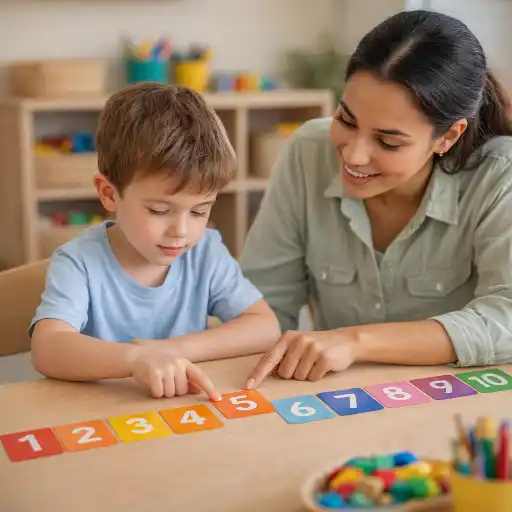
Choose representations to suit the children’s current skills. Numeral cards, a floor number path, blocks labeled with numbers, or a short spoken sequence can all work. A child who is still learning numeral recognition may be more successful with objects or number cards paired with quantities. The topic of moving from counting practice to number-pattern reasoning provides useful ideas for extending basic counting into prediction and explanation.
- Missing number: 1, 2, 3, 5 — “Which number could fill the gap?”
- Repeated number: 2, 3, 4, 4, 5 — “Do we need both fours?”
- Out of order: 1, 3, 2, 4 — “Where could these cards go?”
- Incorrect number: 5, 6, 8, 8 — “What would make this sequence match our count?”
Use a light tone: “A puppet made a counting mix-up. Can we help?” This makes the task collaborative and lowers the pressure to be instantly right.
How can providers guide children without giving away the answer?
Offer enough support to make the sequence accessible, then allow the child time to do the thinking. First, ask the child to read or count the sequence aloud. Invite them to point to, move, or touch each number as they say it. If the spoken count and printed sequence diverge, that difference can help them locate the error. You might ask, “What number did you expect to see next?” or “How could we check?” rather than immediately naming the correction.
If the child is unsure, reduce the cognitive load. Use a shorter sequence, provide number cards to arrange, or count forward together while tracking on fingers. The source worksheet on finding and fixing a counting sequence describes using fingers or separate number cards to make a mismatch concrete. Offer a visual number line or counters when it helps, and gradually step back as the child gains confidence.
Model self-talk naturally: “I see 1, 2, 3, 5. I’m going to count slowly and check what comes after 3.” Then pause and let the child contribute. Helpful prompts include:
- “What do you notice?”
- “Can we count it together and check?”
- “Which number would make the sequence work?”
- “How could we show your idea with cards or blocks?”
Respond to the process as well as the answer: “You checked each number and noticed where the count changed.” This recognizes thoughtful #reasoning without making speed the measure of success.
Which playful activities help children practice self-correction?
Self-correction can be part of everyday play rather than a separate worksheet lesson. Make a short number path with cards and leave one space empty. Invite children to choose the card that belongs there, then check by counting along the path. Or arrange numbered blocks in a tower with one number misplaced and ask children to help a toy character fix the “counting tower.” Keep sessions brief and return to the idea in different settings so children can practice with objects, movement, and spoken numbers.
- 🎵 Sing a familiar counting song and pause before one number so children can supply it.
- Use a floor number line; walk along it and pause where a number is missing.
- Place numeral cards in order, then invite a child to choose and explain one deliberate mix-up.
- Count snack items or blocks, then compare the spoken count with number cards.
- Ask a puppet to count incorrectly and let children explain how they know.
Children can also create sequences for peers to solve. This invites them to think about what makes a sequence correct and how to provide an understandable clue. Keep materials appropriate to children’s ages and abilities, and supervise small manipulatives according to program safety practices. For practical ways to build a playful math environment, No Such Thing as Boring Math Buy Now $24.00 explores how intentional play can support mathematical exploration.
How can teams observe progress and avoid common pitfalls?
Notice how children approach the task, not only whether they identify the intended error. Do they count aloud, use a number path, compare cards, ask for help, or explain their choice? A brief note can capture a useful next step: “Ari spotted the missing 4 in a sequence to 6 after counting with finger movements; next, offer cards without the number path.” Such observations help teams adjust the range, visual support, and complexity instead of repeating the same task for everyone.
Common pitfalls include using sequences that are too long, adding several errors at once, correcting immediately, or treating a wrong guess as carelessness. A child may need more practice with number-word order, numeral recognition, attention, or the language used in the activity. Provide a manageable challenge and revisit it through different materials. Avoid rewarding speed; a child’s explanation or thoughtful checking may be a stronger sign of learning than a quick response.
Invite children to represent a correction by moving cards, drawing a number, pointing, or explaining orally. These approaches provide more than one way to participate and can be especially helpful for children developing language or fine-motor skills. Directors can support consistent practice by sharing open-ended prompts and discussing brief observations during team planning. For broader activity-planning support, consider Math Foundations in Early Childhood Buy Now $16.00. State requirements vary - check your state licensing agency when aligning professional development or documentation with local expectations.
Conclusion: How can children become confident sequence checkers?
Helping children correct their own number-sequence mistakes begins with a welcoming invitation to notice, check, and explain. Use short, familiar sequences; make errors visible with cards, objects, movement, or spoken counting; and offer prompts before supplying a correction. Treat each response as information about the child’s developing number knowledge, not a judgment of ability.
Most of all, make checking part of playful math. When educators model their own thinking and praise careful observation, children learn that mistakes are manageable clues. With repeated, supportive practice, children can strengthen their understanding of number order and begin to approach their own work with greater independence and #curiosity.
- 45 Hour Child Growth and Development
- CDA Home Visitor Subject Area 3 Part 3 Birth to 5
- Safe and Sound: Creating Healthy Environments for Every Child
- Children at the Wheel: Emergent Curriculum
- Emergent Learning & Development
- Creating Environments that Nurture Growth and Community
- Texas Director Credential
- 45 hour Growth and Development Birth-age 12 ONLINE
- Scaffolding Instruction
- CDA Certification en Español: Recursos y Consejos para Educadores Bilingües
- ¿Cómo empiezo mi certificación CDA en Florida en línea?
- Regulaciones de Licenciamiento de Cuidado Infantil en California para Centros y Hogares de Cuidado Infantil Familiar
- Proporciones de Cuidado Infantil y Tamaños de Grupo por Edad en Maryland (Guía Rápida para Centros y Hogares)
- Proporciones de Cuidado Infantil y Tamaños de Grupo por Edad en Nueva Jersey (Guía Rápida para Centros y Hogares)
- Proporciones de Cuidado Infantil y Tamaños de Grupo por Edad en Virginia (Guía Rápida para Centros y Hogares)
- Cómo Trabajar en el Cuidado Infantil en Carolina del Norte: Requisitos y Pasos
- How can child care programs reliably track and document their training hours?
- Do You Need a Family Day Care Registration or Group Family Day Care License in New York?
- What Certifications Do I Need to Open a Daycare? License, Training, and Credentials Explained
- How Can Open-Ended Summer Art Encourage Planning and Creativity?
- How Can Familiar Objects Make Addition Concrete for Young Children?
- How Can Seasonal Picture Sorting Build Phonemic Awareness in Early Childhood?
- How Can You Plan Patriotic Crafts Without Limiting Children’s Creativity?
- How Can Concrete Models Help Children Understand Subtraction Before Worksheets?
- How Can Child Care Programs Update Emergency Contacts While Protecting Family Privacy?
- How Can You Adapt Number Activities for Children with Cerebral Palsy?
- Why Does a Child Think Odd Numbers Are Always Smaller—and How Can Providers Help?
- How Can Child Care Providers Help Children Correct Their Own Number-Sequence Mistakes?
