A simple board game can turn a rainy afternoon into a lively practice ground for number sense, visual attention, rule-following, and flexible problem-solving. Explore ChildCareEd’s Early Mathematics Through Play Buy Now $24.00 to build practical strategies for making math meaningful through games, routines, and hands-on exploration. For a wider foundation in using play to nurture learning and cooperation, consider The Best Promotion is Play  Buy Now $24.00 as another professional learning option.
Imagine children moving colorful pieces along a path, counting each space, noticing a special instruction, and deciding how to reach the finish. In a maze, they trace a route, meet a dead end, and reconsider. These moments are more than entertainment: they give educators a window into how young children think, communicate, and persist.
Why do preschool board games offer learning beyond turn-taking?
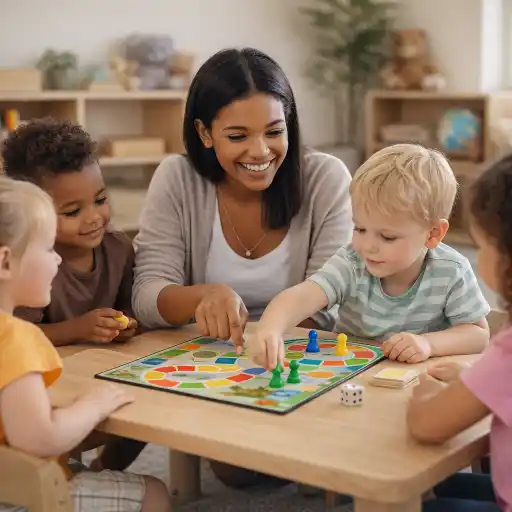
Turn-taking is a valuable social skill, but a board game also brings several learning demands together in a concrete, motivating way. A child may need to listen to a direction, remember a rule, count moves, keep track of a game piece, and tolerate waiting. The activity can integrate cognitive, language, social-emotional, and motor practice without feeling like a formal lesson.
That integration matters because children do not develop skills in separate compartments. When a player pauses before moving, they are practicing attention and self-control. When they explain why they chose a route, they use language to make thinking visible. When a plan does not work, they can try a different one. The OECD describes self-regulation as including inhibition, mental flexibility, and working memory—capacities that games can invite children to practice in a playful context.
Games also provide a shared structure. Rules are visible and consistent, which can help children understand what happens next and participate with confidence. The goal is not to test children or demand perfect performance. Instead, notice their strategies, make the game accessible, and let curiosity lead the conversation.
- Choose a clear learning intention, such as counting spaces or describing a route.
- Keep the group small enough for each child to act and contribute.
- Notice effort, reasoning, and collaboration—not only who reaches the finish first.
How can a path game build early math understanding?
A numbered or spaced game path gives number words a practical purpose. When children roll a die or draw a number card, they connect a quantity to movement: “I counted four, so I move four spaces.” As they move one space for each number word, they practice one-to-one correspondence. They may also notice numerals, compare positions, and describe who is ahead, behind, or closer to the goal.
Research supports using appropriate number games as one part of early math learning. A classroom study of a preschool number-game intervention reported positive effects on numeral identification, while a systematic review found math gains in some of the tasks examined across board-game studies. These findings do not mean every game automatically teaches math; educator prompts and a well-matched level of challenge help make the mathematical ideas explicit.
Try a brief “math talk” pause during play. Ask children to count the spaces aloud, touch each space as they count, or compare two quantities. For a cooperative variation, have the group move one shared piece and work toward a common destination. This reduces the emphasis on winning and creates natural opportunities to combine contributions.
- “How many spaces did you move? Let’s count them together.”
- “Which number is larger? How can you tell?”
- “How many more spaces might your piece need to reach the cabin?”
- 🎲 Let children count dots, move a token, and then recount its path to connect symbols with quantities.
Keep numbers within reach and offer counters or a number line as support. A child can participate meaningfully by pointing, moving a piece, or counting with a partner.
What do game rules teach about attention and self-regulation?
Following game rules involves more than remembering instructions. Children practice waiting while another player acts, inhibiting an impulse to move out of turn, and holding a simple rule in mind. If a special space changes what happens next, they may also need to shift their plan. These small, repeated demands make games a natural setting for practicing components of self-regulation.
Expect variation. One child may wait comfortably but forget a rule; another may remember every instruction but need help managing the pause between turns. Neither moment should be treated as a character flaw. Preschoolers are still developing these capacities and benefit from predictable cues, modeling, and supportive repetition. At five years, following rules or taking turns during games is among the social-emotional milestones listed by the CDC, but milestones are not a scorecard for individual play sessions.
Make expectations simple and visible. Explain one or two rules before starting, demonstrate what a turn looks like, and use a visual reminder or turn marker if helpful. Short games can be easier to sustain than a long round. If frustration rises, acknowledge it calmly and offer a reset, a simpler version, or a cooperative goal.
- Use a consistent cue: “First Maya, then Leo.”
- Let a child hold a “my turn” card or move a shared marker to show whose turn is next.
- Offer specific feedback: “You waited while your friend moved, then remembered the rule.”
- Keep rule changes intentional; changing several rules at once can make the game confusing.
How do mazes strengthen visual tracking and problem-solving?
A maze invites children to follow a line visually from a starting point, notice turns and intersections, and guide a finger or tool along a route. This combines visual tracking, spatial awareness, attention, and fine-motor coordination. When children encounter a dead end, they can use that information to backtrack and test another route. The process—notice, plan, try, and revise—is a child-sized version of problem-solving.
Offer maze levels that grow gradually in complexity. The Rainy Day Puddle Jump – Board Game & Maze Activity Pack Buy Now $2.00 includes a board game and three mazes at easy, intermediate, and advanced levels. That progression can help educators adjust the challenge without assuming all children are ready for the same path.
Let children choose how to engage. Finger-tracing can precede pencil use; a small token can travel through the route; or a child can describe where the raindrop should go while an adult traces. Ask questions that invite reasoning rather than supplying the answer: “What do you notice at this turn?” or “Where could you go after this path ends?” Praise the strategy change, not just completion.
- Start with a broad, simple path and add intersections when the child is ready.
- Use larger printing, high contrast, or a finger-tracing option when access needs call for it.
- Invite children to invent a route or create a maze for a peer to solve.
How can educators make games inclusive and developmentally responsive?
One game format will not suit every child in every moment. Consider language, vision, motor control, attention, prior experience, and comfort with competition. Adapt the materials or participation method while preserving the central learning opportunity. A child can show understanding by pointing, moving a token, using gestures, speaking in a home language, or collaborating with a peer.
Make the game approachable before adding complexity. Demonstrate one turn, use picture cues, reduce the number of spaces, or replace a die with a spinner that has fewer options. For a child who becomes distressed by winning and losing, choose a shared team goal or agree that the group will count how far everyone travels together. These adjustments support agency and belonging without removing challenge.
Providers can also use brief observations to guide next steps. Record what the child actually did: “Ari counted each space while moving the boot token, then retraced the maze after a dead end.” Such notes are more useful than broad labels like “good at math.” They help staff plan whether to repeat the activity, add a new rule, or offer a different tool. For preschool programs, the Math Foundations in Early Childhood Buy Now $16.00 course offers additional approaches to playful, hands-on math instruction.
- Offer a cooperative version, shorter turns, or a quiet space if the group needs a calmer pace.
- Use familiar themes and invite children’s ideas for game characters or destinations.
- Observe progress over several experiences rather than drawing conclusions from one round.
What common pitfalls can educators avoid during game play?
A game can lose its learning value if the adult focuses only on speed, winning, or reaching the finish. For preschoolers, the worthwhile learning often happens in the middle: a child recounts, asks for clarification, waits, negotiates a rule, or tries a new route. Treat mistakes and dead ends as information, not failure.
Another common pitfall is expecting one activity to teach everything. A board game may offer opportunities to count, follow a rule, and interact with peers, but educators should identify a primary focus and observe what emerges. Avoid turning playful questions into a rapid quiz. Give children time to think, and accept a response through movement, gesture, or home-language words as meaningful participation.
Plan for safety and readiness as well. Use age-appropriate pieces, supervise small materials, and ensure that children can see and reach the board. If attention fades, shorten the round rather than insisting everyone finish. State requirements vary - check your state licensing agency for any program-specific expectations related to curriculum or training.
- Too much adult direction: Pause, observe, and ask an open-ended question before intervening.
- Rules that are too complex: Begin with a few consistent rules, then add one new feature at a time.
- Competition that overwhelms: Try cooperative play and recognize shared problem-solving.
- Only praising the winner: Notice counting, persistence, careful observation, and kind communication.
Conclusion: What can preschool board games teach beyond taking turns?
Preschool board games and mazes can help children practice early math, rule-following, visual tracking, self-regulation, language, and problem-solving—all within a playful shared experience. Their value depends not on finishing quickly, but on how children engage with the path, use the rules, communicate ideas, and respond when a first attempt does not work.
Choose an achievable challenge, model the rules, offer flexible ways to participate, and use thoughtful prompts to make children’s thinking visible. Observe specific strategies so you can plan a useful next step. A short game can be both joyful play and purposeful learning when educators make room for children to explore, make choices, and try again.
To deepen your classroom practice, explore ChildCareEd’s Early Mathematics Through Play Buy Now $24.00, Math Foundations in Early Childhood Buy Now $16.00, No Such Thing as Boring Math Buy Now $24.00, The Best Promotion is Play Buy Now $24.00, and Role of Play in Learning Buy Now $16.00. Each offers a different lens on designing engaging, developmentally responsive experiences for young children.
- 45 Hour Child Growth and Development
- Turning Behavior Around for Toddlers and Preschoolers
- CDA Preschool Credential
- Early Mathematics Through Play
- Power of Art: Bldg Self-Esteem & Positive Behavior for ALL Abilities
- The ABCs of Behavior: Turning Challenges into Learning Opportunities
- Teach with Respect!
- CDA Bridge Bundle: Preschool
- Pediatric RSV First Aid & CPR/AED
- Proporciones de Cuidado Infantil y Tamaños de Grupo por Edad en Virginia (Guía Rápida para Centros y Hogares)
- Cómo Trabajar en el Cuidado Infantil en Carolina del Norte: Requisitos y Pasos
- Cómo Ser Maestra de Preescolar en Wisconsin
- How can rainy day indoor activities help preschoolers learn kindness and cooperation in Georgia?
- Celebrando la amistad en el cuidado infantil durante el Día de los Mejores Amigos
- Canciones, juegos y preguntas de círculo para niños
- Define Cooperative Play: Examples for Preschool and Child Care
- Can Screen-Free Board and Movement Games Help Young Children Learn and Stay Calm?
- How can we effectively teach children to wait, share, and take turns?
- How can we help children learn to wait, take turns, and manage frustration?
- Is My Preschooler Ready for Kindergarten? Milestones Beyond ABCs and 123s
- How Can Teachers Encourage Sharing Without Forcing It?
- How Can Bingo Games Make Learning Feel Like Play?
- How Can Child Care Providers Teach Young Children to Take Turns?
- How Can Child Care Providers Support Children Who Always Want to Be First?
- How Can Cooperative Sight-Word Games Help Early Readers Learn Together?
- How Much Correction Is Too Much During a Preschool Literacy Game?
- How Can Teachers Support Children Who Become Upset When They Lose a Game?
- What Can Preschool Board Games Teach Beyond Taking Turns?
- Why Do Some Preschoolers Struggle to Listen and Follow Directions During Group Games?
