When a child can recite numbers but struggles to explain what “take away” means, more worksheet practice may not be the answer. Start with objects children can touch, move, and count, then connect those actions to drawings and symbols; for a deeper foundation in playful, hands-on early operations, explore ChildCareEd’s Early Mathematics Through Play Buy Now $24.00, which offers practical strategies for making math meaningful across the Pre-K day.
Concrete learning does not mean avoiding print forever: it means making sure the symbol represents an idea children have experienced. The progression below can help providers and directors plan purposeful subtraction experiences, use worksheets as a later tool, and notice what each child understands.
Why should children experience subtraction before worksheets?
Subtraction is more than recognizing a minus sign or producing a correct answer. Young children need to make sense of the action and relationships represented: removing objects from a group, comparing two groups, or figuring out a missing part. A concrete model makes those relationships visible. If a child begins with six counters and moves two away, the child can see, touch, and count what remains.
This matters because a worksheet can show whether a child selected or wrote an answer, but may not reveal the strategy behind it. The child might be guessing, memorizing a sequence, or misunderstanding which number represents the starting group. The research on teacher growth in guiding preschool mathematical understanding emphasizes recognizing children’s demonstrated thinking, using mathematical language, and assessing systematically—not simply recording right or wrong responses (Bhargava, “Learning to Guide Preschool Children’s Mathematical Understanding”).
Concrete models also help educators respond to different developmental pathways. One child may remove objects and count each remaining item; another may count backward or use a familiar number relationship. Both strategies can be discussed and extended.
- Make the quantity and the action visible before introducing an equation.
- Invite children to explain, demonstrate, or draw their reasoning.
- Use practice materials to reinforce understanding—not as a substitute for it.
A strengths-based approach treats a child’s strategy as useful information. When we begin with objects, #children can build meaning and confidence before moving toward abstract notation.
Which concrete models make subtraction understandable?
Choose simple, safe materials that children can manipulate independently. Counters, linking cubes, toy animals, large buttons, blocks, or classroom objects can all represent quantities. Use the same materials for repeated problems so children can focus on the mathematical idea rather than learning new directions each time.
Model the action slowly and narrate it: “There are five bears. Two bears walk away. Let’s count how many are still here.” Encourage children to move each object as they count. This supports one-to-one correspondence and makes the change in quantity visible. The subtraction strategy guidance in the reference set likewise recommends concrete models such as counters and cubes, with children continuing to use them as long as they are helpful.
- Take-away model: Place five counters in a row, remove two, and count what remains: 5 − 2 = 3.
- Comparison model: Make a group of five and a group of three; match objects one-to-one to see which group has more and how many more.
- Missing-part model: Show five spaces with three counters and ask how many spaces are empty.
- Story model: Act out a familiar event, such as “Four ducks are in the pond; one swims away. How many are still there?”
Offer choices when possible. Some children reason best with cubes, while others prefer pictures, fingers, or acting out a story. Keep materials appropriately sized and follow supervision and safety practices for the age group. A clear, accessible set of #manipulatives gives learners an inviting way to test an idea, revise it, and explain what happened.
How can educators move from objects to drawings and numerals?
Use a gradual, connected progression: children first act out subtraction with objects, then represent the action with a drawing or picture, and finally connect the representation to numerals and an equation. This sequence is sometimes described as moving from concrete to pictorial to symbolic. It is not a one-way staircase: children may return to counters when a new problem feels challenging, and that is a sensible learning choice.
For example, after a child solves 6 − 2 with counters, invite the child to draw six circles and cross out two. Then show “6 − 2 = 4” and explain how each part matches the model: six is the starting amount, two is removed, and four remain. Ask the child to point to the part of the drawing that represents each number.
Keep the first tasks small and language-rich. Use phrases such as “start with,” “take away,” “how many remain?” and “difference.” Avoid presenting a vocabulary list without a meaningful situation. Questions that prompt children to explain their thinking help adults distinguish conceptual understanding from copying.
- Represent the same story with objects, a drawing, and an equation.
- Ask, “What changed?” and “How can you show that another way?”
- Offer a #worksheet only after children have had a chance to model the idea, and allow them to draw or use counters to solve it.
Print practice, including a subtraction worksheet, can provide brief follow-up or a record of a child’s representation. Keep it purposeful and manageable rather than making completion the goal. The instructional priority is a meaningful #progression between concrete action and mathematical symbols.
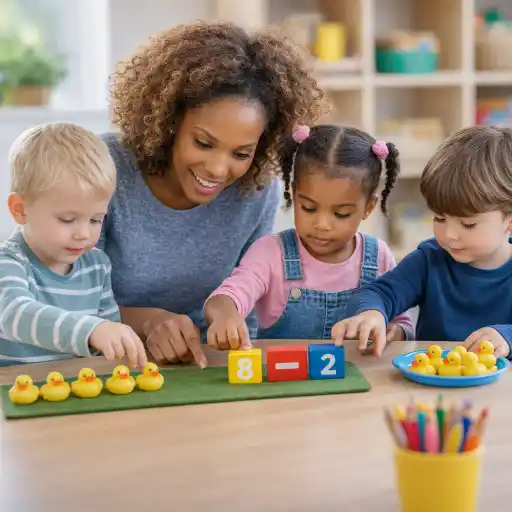
How can play and stories make subtraction meaningful?
Play gives subtraction a reason to happen. Instead of presenting a bare equation, create a small problem using a familiar classroom context: blocks are put away, snack portions are eaten, toy cars leave a garage, or animals return to a barn. Children can move figures or objects as the story unfolds, then describe what changed. The activity can be brief, but conversation makes the mathematics richer.
Try a “puppet picnic.” Put six pretend apples on a plate. The puppet eats two. Ask children to act out the scene, count what remains, and tell the puppet how they know. Repeat with different quantities or let children invent a new story. For children ready for more challenge, hide some objects and ask what number is missing: “There were six apples. Now I see four. How many did the puppet eat?”
Play also makes room for multiple forms of subtraction. Children may take away, compare sets, or find a missing part. Keep the goal clear while adjusting the number size, materials, prompts, or adult support. These are practical applications of play-based math guidance in ChildCareEd’s Teaching Math to Young Children, which describes using manipulatives, open-ended questions, and adaptations to support early numeracy.
- Use familiar toys and situations so children can focus on quantity.
- Invite children to take turns as storyteller, problem-solver, and checker.
- Connect classroom experiences to home routines, such as sharing fruit or putting toys away.
- 🧸 Celebrate a clear explanation or a thoughtful strategy—not speed alone.
Purposeful #play helps subtraction feel like a useful way to describe change, rather than a set of unfamiliar marks on a page.
How can providers assess understanding and avoid common pitfalls?
Assessment can happen while children play. Observe what a child does with a small group of objects, listen to the explanation, and note whether the child counts each object once, understands what remains, and can connect the action to a drawing or numeral. A short anecdotal note can guide the next experience more effectively than a worksheet score alone.
For example, record: “Ari started with five counters, removed two, and counted the remaining three; next, invite Ari to draw the model and explain the equation.” This describes evidence and a next step without labeling the child. If a child is unsure, reduce the number of objects, model one example, or let the child act out a story. If the child is ready, introduce comparison or missing-part problems.
Common pitfalls are easy to understand in a busy classroom, but small adjustments keep instruction focused:
- Moving to symbols too quickly: return to objects or drawings and connect each symbol to the model.
- Relying on worksheets as the main lesson: use them selectively after hands-on exploration.
- Equating speed with understanding: value accurate modeling, explanation, and strategy choice.
- Requiring one method: accept different developmentally appropriate approaches and ask children to show how they know.
- Keeping manipulatives from children who need them: treat tools as legitimate supports, not rewards.
When planning activities or documenting training, state requirements vary - check your state licensing agency. For broader professional learning in early operations, the Early Mathematics Through Play course Buy Now $24.00 addresses number sense, early operations, and hands-on strategies providers can incorporate into the Pre-K day.
Conclusion: What is the best way to teach subtraction before worksheets?
To teach subtraction meaningfully before worksheets, begin with concrete models, make the action visible, and invite children to explain what happens to a quantity. Then connect the objects to drawings and numerals, returning to a model whenever it helps. Playful stories and familiar routines give children a reason to remove, compare, and find missing parts.
Use worksheets as one limited practice or documentation tool after children have explored the underlying idea—not as the first or only way to teach it. Observe strategies, adjust quantities and supports, and celebrate reasoning as much as correct answers. Small, consistent experiences can help children approach early operations with curiosity and confidence.
For more structured professional learning, explore Early Mathematics Through Play Buy Now $24.00. The course covers early operations alongside counting, number sense, and other math concepts, helping providers develop a wider repertoire of hands-on, developmentally appropriate classroom strategies.
- Lesson Planning for Preschoolers
- 45 Hour Preschool Methods and Materials
- Birth to Five CDA Credential with Portfolio Review
- CDA Bridge Bundle: Preschool
- Pediatric RSV First Aid & CPR/AED
- 45 Hour School Age Methods and Materials
- CDA Bridge Bundle: Family Child Care
- CDA Bridge Bundle: Infant/Toddler
- Texas Director Credential
- Preschool Arithmetic Activity
- CDA Certification en Español: Recursos y Consejos para Educadores Bilingües
- 💛🧩 ¿Cómo puedo hacer que mi enseñanza sea inclusiva para los niños con autismo?
- ¿Cómo pueden los equipos de cuidado infantil practicar habilidades rápidas de primeros auxilios en situaciones reales?
- 10 Ejemplos de Cómo la Cultura Influye en el Desarrollo Infantil
- Proporciones de Cuidado Infantil y Tamaños de Grupo por Edad en Maryland (Guía Rápida para Centros y Hogares)
- Proporciones de Cuidado Infantil y Tamaños de Grupo por Edad en Nueva Jersey (Guía Rápida para Centros y Hogares)
- Proporciones de Cuidado Infantil y Tamaños de Grupo por Edad en Virginia (Guía Rápida para Centros y Hogares)
- Lista para Guardería en Casa en Illinois: Cómo Iniciar una Guardería en el Hogar
- Cómo Trabajar en el Cuidado Infantil en Carolina del Norte: Requisitos y Pasos
- Celebrando la amistad en el cuidado infantil durante el Día de los Mejores Amigos
- Canciones, juegos y preguntas de círculo para niños
- Cómo simplificar la capacitación para sus empleados de daycare
- Count It, Sort It, Find It! Fall Math Games for Preschoolers
- How Can Color-Coded Practice Reinforce Early Division Skills?
- How Can Short, Focused Practice Build Subtraction Fluency Within 10?
- How Can Child Care Providers Make Counting and Simple Operations Playful?
- How Can Concrete Models Help Children Understand Subtraction Before Worksheets?
- How Can Patterned Practice Help Young Children Master Subtraction Facts?
- How Can After-School Programs Support Math Learning for Children with IEPs?
