Outdoor classrooms and nature-based child care are practical, research-informed approaches that expand meaningful learning beyond four walls. For directors and providers, the goal is not only to show families and staff why outdoor experiences matter, but also to design safe, equitable, curriculum-aligned environments that educators can use consistently throughout the year. This article provides concrete planning steps, adaptable routines, and strategies for avoiding common challenges so programs can build sustainable outdoor practices that support #children, #learning, and #safety. Providers can strengthen their skills through ChildCareEd’s self-paced online course Creating the Natural Outdoor Classroom  Buy Now $16.00, which explores sensory experiences, outdoor learning, and the development of natural spaces where children can investigate, discover, and connect with nature. Key themes include #outdoors, #nature, #children, #learning, and #safety.
Why does a nature-based outdoor classroom matter — and why should programs prioritize it?
Why it matters: 1) Developmental gains — outdoor learning supports gross and fine motor skills, self-regulation, social skills and creativity; see ChildCareEd’s summary of the Benefits of Outdoor Classrooms. 2) Mental health — time outside lowers stress and boosts attention and mood (Minnesota Dept. of Health). 3) Academic relevance — nature settings provide authentic contexts for hands-on science, math, language and project-based learning (creative ways to use nature).
Evidence snapshot (why it matters):
- Systematic reviews show positive associations with self-regulation, social skills and nature connection (mixed-methods review: nature-based early childhood education).
- Public health guidance links outdoor play with physical activity and reduced obesity risk (research summaries).
- Practical programs report improved transitions, engagement, and family support when outdoor routines are consistent (The Outdoor Classroom).
How do I design an outdoor classroom that balances curriculum, inclusion, and safety?
Design begins with purpose. Use a simple planning loop: 1) identify learning goals, 2) audit your site, 3) select zones, 4) set supervision & maintenance routines. For practical training, ChildCareEd’s Creating the Natural Outdoor Classroom Buy Now $16.00 course gives design, sensory, and routine strategies you can adapt to any footprint.
Checklist (site design & safety):
- 🔎 Site audit: sight lines, shade, drainage, trip hazards, and gate security.
- 🪵 Zones: 1) active gross-motor, 2) loose-parts & building, 3) sensory/garden, 4) quiet/reflection.
- 🧯 Surfacing & equipment: age-appropriate equipment and fall surfacing; follow local licensing guidance and CDC outdoor safety recommendations (CDC outdoor play & safety).
- 🧾 Routines & documentation: daily hazard scan, weather/air-quality plan, grab-and-go kits, and maintenance logs. Remember: state requirements vary - check your state licensing agency.
Accessibility & inclusion tips:
- ♿ Use wide paths and mixed-level play features for varied abilities.
- 🌱 Plant low-allergen species; offer sensory options that don’t depend on fine motor precision.
- 🤝 Involve families and local partners in design decisions to reflect community needs.
What practical activities, routines, and curricula can work year-round — even with limited space?
Adaptability is the program’s superpower. Use micro-blocks of outdoor time (15–30 minutes) and rotate stations so even small yards feel fresh. Programs interested in child-centered, experiential approaches can draw on Montessori principles that emphasize nature and real-world experiences to structure outdoor materials, work cycles, and discovery-based activities. For activity ideas, see ChildCareEd’s lists in What Are Creative Ways to Use Nature as Your Classroom? and the New York-focused implementation guide (How can I build a nature-based curriculum for my New York program?).
Year-round starter plan (enumerated):
- 🌞 Spring: seed starting & observation journals; sensory mud kitchen rotations.
- 💧 Summer: shade storytime, water-evaporation experiments, nature-based gross-motor circuits.
- 🍂 Fall: leaf sorting & measurement, seed counts, habitat-build projects.
- ❄️ Winter: short observation walks, ice experiments, cozy outdoor story nooks with warm-up routines indoors.
Small-space strategies (3 steps):
- Container gardens and vertical planters.
- Take learning to nearby green spaces or partner with parks.
- Bring nature indoors with a rotating nature table and plant-care jobs.
How do I train staff, engage families, find funding, and measure program impact?
Build capacity in four parallel streams:
- Staff training: use short, focused professional development such as ChildCareEd’s free Creating the Natural Outdoor Classroom modules and resources for everyday safety (free resources).
- Family engagement: invite families to planting days, share photos and weekly learning notes, and co-create gear-lending solutions (see WaNPA guidance on gear & partnerships: Outdoor Care & Learning).
- Funding & partnerships: pursue local grants and seed funds (e.g., Minnesota DNR outdoor school grants No Child Left Inside, US Play Coalition action & research grants Action & Research Grants), and connect with extension offices or environmental centers for volunteers and materials.
- Measuring outcomes (simple, practical):
- 📷 Weekly photo artifacts + quick child quotes (1–2 per week).
- ✅ Track three program indicators: increased outdoor minutes, observed self-regulation behaviors, and family engagement events.
- 📈 Use short pre/post snapshots for specific projects (e.g., plant growth measures, vocabulary growth).
What common mistakes should programs avoid and how do I prevent them?
Common pitfalls derail even committed teams. Below are frequent mistakes and fixes drawn from practice and the ChildCareEd resources.
- ❌ Mistake: Too many loose materials out at once. ✅ Fix: Offer 2–3 focused choices and rotate weekly to preserve novelty.
- ❌ Mistake: No weather or air-quality plan. ✅ Fix: Establish a three-level weather plan (go outside / shorten session / stay indoors); reference the CDC for heat, sun, and air-quality guidance (CDC).
- ❌ Mistake: Skipping staff training. ✅ Fix: Schedule brief team learning huddles and enroll staff in modular courses (ChildCareEd CEU options: course page Buy Now $16.00).
- ❌ Mistake: Assuming families have gear. ✅ Fix: Create a program gear library, swap events, or request gently used donations (see WaNPA gear strategies Outdoor Care & Learning).
Remember: consistent routines, clear communication, and small, testable changes create sustainable success. Also, state requirements vary - check your state licensing agency.
Conclusion — Where to begin and quick FAQs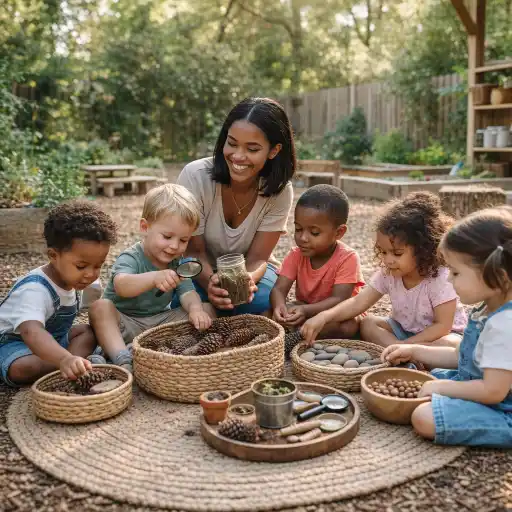
Start with one small, measurable change: a daily 15–20 minute outdoor block, a planter box, or a weekly nature walk. Use a simple audit, a staff training session, and one family engagement event to build momentum. ChildCareEd has ready-made trainings and free resources to help you launch (resources and course guidance).
FAQ
- Q: How long should outdoor time be? A: Start 15–30 minutes and build to longer blocks as staff and children adapt; evidence suggests more outdoor minutes boost physical and developmental outcomes.
- Q: What if space is tiny? A: Use containers, vertical planters, take short walks to nearby green spaces, or convert hallways into sensory paths for rainy days.
- Q: How do we document learning for licensing and families? A: Weekly photos + 1–2 child quotes + a quick outcomes tracker (three indicators) provides practical documentation.
- Q: Who decides safety rules? A: Program leadership aligns daily procedures with local licensing, Caring for Our Children standards, and CDC guidance — state requirements vary - check your state licensing agency.
Further reading and training links: ChildCareEd’s benefits overview, Creating the Natural Outdoor Classroom course Buy Now $16.00, and CDC safety guidance (Outdoor Play & Safety). You’re not alone: build step-by-step, celebrate small wins, and use community partners to grow your program confidently.
- 45 Hour Child Growth and Development
- Creating the Natural Outdoor Classroom
- 45 Hour Preschool Methods and Materials
- Family Voices Matter: Tools for Meaningful Collaboration
- 45 Hour Infant and Toddler Methods and Materials
- 45 Hour School Age Methods and Materials
- CDA Bridge Bundle: Family Child Care
- CDA: Creating the Outdoor Classroom
- Texas Director Credential
- Get Ready for Summer!
- How Can Childcare Educators Thrive in the Big Apple?
- CDA Certification en Español: Recursos y Consejos para Educadores Bilingües
- How can Washington early childhood educators support outdoor play, safety, and learning in daycare?
- How can New York early childhood programs use garden-based learning?
- How can Washington classrooms be more inclusive using nature, play, and community?
- How can New York childcare programs help children in the concrete jungle fall in love with nature?
- Canciones, juegos y preguntas de círculo para niños
- How can Minnesota child care programs keep kids learning and engaged over the summer?
- Why Should Early Childhood Programs Prioritize Outdoor Play?
- How can childcare programs create high-quality outdoor classrooms and nature-based care?
- Can forest preschool activities be integrated into traditional programs?
- How can I bring a Forest Preschool (nature-based learning) to my program?
- How Can Early Childhood Programs Implement Practical Sustainability Practices?
- Childcare Weather and Air Quality Chart: Keeping Outdoor Play Safe
- What Makes a Great Home Daycare? 10 Things Parents Notice First
- Common After School Activities Kids Get Bored With—and What to Try Instead
- How Can Child Care Programs Make Nature-Based Learning Meaningful, Inclusive, and Safe?
