Cold weather and shorter days can challenge every #provider team as playground access becomes limited and young children still need frequent opportunities to move. Indoor physical activity supports gross motor development, physical health, self-regulation, attention, and more predictable classroom routines. This article offers child care directors and teachers practical, low-preparation movement games, daily scheduling strategies, adaptations for varied abilities, safety considerations, and reusable routines to sustain engagement throughout the week. Options include movement stations, obstacle courses, action songs, animal walks, stretching, dance breaks, and games that develop balance, coordination, listening, and spatial awareness.
To strengthen your program’s approach to active indoor play, explore ChildCareEd’s self-paced online course Wellness in Action: Teaching Healthy Habits to Children  Buy Now $55.00. The training provides practical strategies for encouraging active play, limiting sedentary time, adapting experiences for children with special needs, and helping children build lifelong healthy habits. Providers can apply these ideas by planning several short movement opportunities throughout the day instead of relying on one long activity period. For additional planning strategies, explore Engaging Indoor Activities for Inclement Weather Buy Now $24.00 and Balancing Physically Active Play in Child Care Buy Now $25.00. These courses offer professional development; verify with your licensing agency or employer whether a course applies to your requirements. State requirements vary, so always check with your state licensing agency.
What quick, low‑prep activities can I use right away?
Brief, repeatable games can be implemented in classrooms with limited space. Select from these eight low-preparation activities, adapting each experience to children’s developmental capabilities, interests, and the physical environment. Many draw on practical ideas from ChildCareEd’s gross motor ideas and related resources.
- 🟠 Tape Stepping Stones — lay painter’s tape shapes on the floor for hopping, tiptoeing, or letter/number calls (indoor gross motor activities).
- ⚽ Soft Ball Toss & Targets — baskets or hula hoops at different distances build aiming and turn‑taking (gross motor games).
- 🎈 Balloon Keep‑Up — one balloon per small group for cooperative movement and gentle bursts (10 gross motor games).
- 🟣 Indoor Obstacle Course — crawl under tables, step over cushions, balance on tape beams; rotate stations to reduce waiting.
- 🔵 Movement Jar — cards with 2–3 minute actions (star jumps, animal walks) for quick brain breaks (rainy day activities Buy Now $0.00).
- 🐾 Animal Walks & Music — mix action songs or Frozen‑style dance breaks to refresh attention (music & movement).
- 🟢 Seated Gross Motor — mitten match runs, seated marches, and hand/arm actions when space is tiny or for children who need it (adaptation tips).
- 🟡 Sensory‑active corners — indoor "snow" bins (fake snow, scoops) or playdough stations tied to fine motor practice (winter sensory ideas).
How can I structure the day to balance active and calm moments?
Intentional scheduling makes brief movement opportunities a sustainable part of the daily routine. Follow the CDC’s age guidance and distribute activity across the day so movement supports—rather than disrupts—learning (CDC guidance).
- 🕒 Sample rhythm to borrow:
- Morning warm‑up (5–8 min): tape stepping stones or animal walks.
- Pre‑circle reset (2–3 min): freeze dance or stretch song.
- Transition bursts (1–3 min): a single Movement Jar card between centers.
- Main active block (15–30 min): indoor obstacle course or gross motor stations.
- Calm‑down (3–5 min): breathing, gentle yoga, or quiet story.
- Brief movement breaks can replace sedentary transitions and may support children’s re-engagement with learning. Adjust their frequency and duration in response to children’s engagement and the program’s schedule.
- Use stations and small groups to keep lines short—rotate every 4–6 minutes.
- Keep choice in mind: always offer an easier and a harder option (hop OR step; seated OR standing).
- Documentation & family connection: note observed gains and share short wins with families; include safe photo permission rules.
How do I adapt activities for different ages and abilities?
Inclusive practice requires intentional planning. When selecting adaptations for infants, toddlers, and preschoolers, begin with each child’s demonstrated skills and provide graduated options (messy play & infant strategies Buy Now $0.00).
- Offer graduated options, such as walking along a tape path or balancing with support. Select challenges that are safe and appropriate to each child’s current abilities.
- Seated alternatives: convert standing moves to seated arm actions, beanbag passes, or chair yoga for children with mobility limits.
- Peer buddies: pair children for modeling and social support; rotate leaders to build confidence.
- Visual supports: picture cards, taped paths, or a Movement Jar reduce language load and increase independence.
- Proprioceptive input can be incorporated through appropriately scaled heavy-work tasks, such as pushing a box or carrying books, to support self-regulation and attention.
- Sensory‑friendly choices: have quieter, tactile stations (texture books, sensory bins) for children who need low‑stimulus options.
- Age tweaks: infants benefit from floor tummy time and rolling games; toddlers from obstacle crawls and ball rolls; preschoolers from relays and alphabet action cards (gross motor games).
- If you have concerns about a child’s motor development, document observations, discuss them with the family, and follow your program’s referral procedures; qualified professionals can determine whether further evaluation is appropriate.
How do I keep safety, supervision, and space management effective indoors?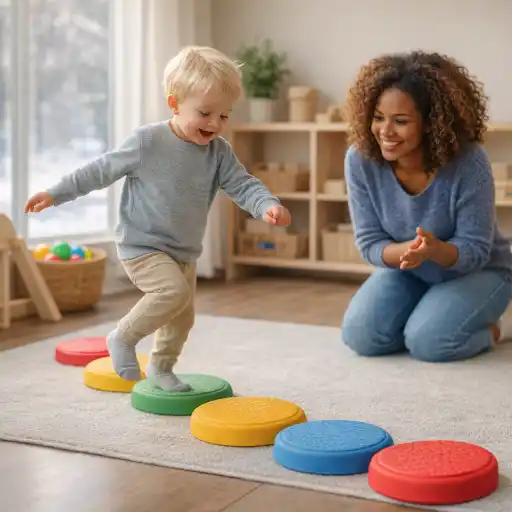
Safety is foundational. Use deliberate planning, clearly communicated expectations, and strategic adult positioning to support active play while reducing preventable risks. Many practical tips come from ChildCareEd activity and supervision guidance (indoor gross motor guidance).
- Clear the zone: remove hard, sharp, or fragile items; mark the play area with tape.
- Teach one stop signal: choose a clap, bell, or word so children stop immediately.
- Adult placement: station adults where they can see all children (corners of the play zone) rather than clustered together.
- Station rotation: set 3–6 stations and limit group size to reduce waiting and collisions.
- Equipment rules: use soft balls, lightweight props, and secure loose rugs; check for tripping hazards.
- Hygiene & illness policy: clean frequently touched materials and follow your center’s sick‑child policy (state requirements vary - check your state licensing agency). For practical winter illness‑prevention strategies, simple nutrition guidance, and activity ideas that support children’s health during cold months, see Keeping kids healthy! Tips and tricks.
Common mistakes — and how to avoid them
- ❌ Too hard too fast — fix: simplify and offer two levels of challenge.
- ❌ Long waits — fix: create stations and stagger start times.
- ❌ Weak supervision — fix: assign clear adult roles and sightlines.
- ❌ One‑size rules — fix: adapt for ability and celebrate effort, not comparison.
What materials and routines help sustain movement all winter long?
A small collection of versatile materials and predictable routines can establish a consistent movement culture. Rotating these materials sustains children’s interest while keeping preparation manageable.
- Core, low‑cost materials:
- Painter’s tape, paper plates, cones/hula hoops, soft balls/beanbags.
- Balloons, scarves, music player/tablet for action songs.
- Sensory supplies: fake snow, playdough, scoops, textured fabrics (winter classroom activities).
- Weekly rotation template:
- Monday: balance & tape games
- Wednesday: obstacle course + proprioceptive heavy work
- Friday: music & movement + sensory table
- Embed movement into routines: greet with a movement (march in), use music for transitions, and build short gross motor goals into lesson plans (10 gross motor games).
- Document incremental progress with brief observational checklists—for example, balance on one foot, completion of five consecutive hops, or successful beanbag catches—and share relevant observations with families.
Conclusion — Why this matters + FAQs
Why it matters: Indoor movement on cold days supports physical development, social skills, and attention—key ingredients for school readiness and healthy growth. Short, frequent, inclusive activities are more powerful than one long indoor session. Prioritize safety, variety, and adaptation so every child experiences success.
Quick FAQs (for busy directors)
- Q: How long should movement breaks be? A: 1–10 minutes several times a day; multiple brief breaks beat one long session (CDC).
- Q: What if space is tiny? A: Use tape lines, seated marches, balloons, and Movement Jar cards (rainy day ideas Buy Now $0.00).
- Q: How do I include children with mobility or sensory needs? A: Offer seated options, visual supports, tactile stations, and peer buddies; consult your inclusion trainings (inclusion & infant/toddler tips Buy Now $0.00).
- Q: When should I be concerned about development? A: Note persistent large‑motor delays (balance, hopping, catching) and follow your referral steps for assessment.
- Q: Where to find ready plans? A: Start with ChildCareEd lesson pages on gross motor and winter activities (gross motor, winter classroom).
Keeping your #children moving indoors on cold days is doable, low‑cost, and high‑impact. With simple materials, short routines, and thoughtful adaptation, you’ll protect health, learning, and #play through the winter months. Use these ideas tomorrow and adjust as your group shows progress. Your #providers team already understands play’s power—bring it inside and keep the #movement going all season.
- Moving About the Classroom: Effective Transitions for Everyday
- CDA Home Visitor Subject Area 3 Part 3 Birth to 5
- CDA Home Visitor Subject Area 2 Part 3 Birth to 5
- Balancing Physically Active Play in Child Care
- CDA Infants/Toddlers: Lesson Planning Made Easy
- Engaging Indoor Activities for Inclement Weather
- 24 Hour Texas Pre-Service
- Texas Director Credential
- Preventative Health and Safety
- Technology as a Classroom Tool
- Mental Health for Tiny Elves: Supporting Kids Through Winter Blues
- Child Care Weather Guidelines: Using the 2026 Weather Watch Chart
- Air Quality and Child Care in Georgia: Outdoor Play Safety Tips
- Air Quality and Child Care in Illinois: Outdoor Play Safety Tips
- Safe Temperature Regulations in Daycare: North Carolina Rules for Child Care Providers
- Safe Temperature Regulations in Daycare: Nevada Rules for Child Care Providers
- Canciones, juegos y preguntas de círculo para niños
- How can Washington providers keep children safe and learning when wildfire smoke forces us indoors?
- What are Oklahoma's safe temperature rules for daycares and how do we follow them?
- What are Minnesota's safe temperature rules for daycare and how do we follow them?
- Daycare Temperature Regulations in Alaska: How Cold Is Too Cold?
- Daycare Temperature Regulations in Hawaii: Keeping Children Safe Indoors and Outdoors
- How Can Child Care Programs Keep Young Children Safe in Cold Weather?
- How can I keep Children Active Indoors On Cold Days?
- How can child care programs prevent seasonal safety hazards like heat, cold, allergies, holiday risks, and outdoor play dangers?
- How Child Care Programs Can Keep Children Safe During Extreme Weather
- How to Plan Safe Outdoor Activities During Hot Weather and Poor Air Quality
- Daycare Outdoor Weather Safety: Temperature, Heat Index, and Playtime
- How Can Child Care Programs Balance Indoor and Outdoor Learning Across the Week?
- How Can Child Care Providers Explain Weather-Related Changes to Outdoor Play Plans?
