Fruit words can turn an everyday topic into a lively first reading experience: children already know, see, and talk about foods such as bananas and peaches. Pairing that familiar vocabulary with simple print activities helps preschoolers connect spoken language, pictures, and written words; Understanding Print Knowledge in Preschool  Buy Now $16.00 offers focused professional learning to strengthen those classroom practices. Read on for practical ways to build healthy-food language and early reading together, and consider the course if you want a deeper guide to print-focused instruction.
Building Vocabulary Buy Now $16.00 and Reading Aloud and Storytelling Buy Now $16.00 are also relevant training options for extending children’s word learning and shared reading experiences.
Why combine food words and beginning reading?
Food is part of children’s daily lives, so it offers an accessible starting point for purposeful language and literacy. A child may have seen a pear at snack, helped select apples at a market, or heard a family member name a favorite fruit. When educators connect those experiences to conversation and print, new words have meaningful context rather than feeling like isolated vocabulary drills.
Food themes also naturally invite description, comparison, questions, and storytelling. “The lemon is yellow and bumpy” gives children descriptive vocabulary; “Which fruit is round?” invites careful listening and reasoning. Keep the focus on curiosity, enjoyment, and respectful food exploration—not on judging what children eat or pressuring them to taste.
- Use familiar foods to introduce and revisit useful words.
- Connect spoken words, illustrations, and printed words during shared reading.
- Let children participate through talking, pointing, drawing, gestures, or home-language words.
Which food words are most useful for preschool readers?
Choose a small group of words that children can encounter repeatedly across books, play, meals, and conversation. Begin with the names of familiar fruits—such as banana, pear, lemon, peach, and cherry—and add words that help children describe what they observe. Depending on the group’s interests, useful words might include color, shape, texture, taste, seed, peel, sweet, sour, smooth, or bumpy.
Effective vocabulary instruction includes more than naming an object once. Say the word clearly, connect it to a real object or image, explain it in child-friendly language, and use it again in meaningful contexts. For instance: “This is a peach.
Children’s languages and experiences will differ. Invite families to share the names of familiar foods in home languages and pronounce those words respectfully. Make space for children to compare words across languages without treating one language as more valuable than another.
- Pick three to five target words for a short activity.
- Use concrete objects, photographs, gestures, and descriptive sentences.
- Return to the words throughout the week instead of introducing a long list at once.
How can a simple fruit reader teach print knowledge?
A short, repetitive reader can make the relationship among spoken words, pictures, and print easier for beginning readers to notice. ChildCareEd’s Emergent Readers - Fruits Buy Now $1.75 introduces banana, pear, lemon, peach, and cherry through brief, repeated sentences and fruit illustrations. Its coloring pages also give children a chance to revisit the images and vocabulary through fine-motor activity.
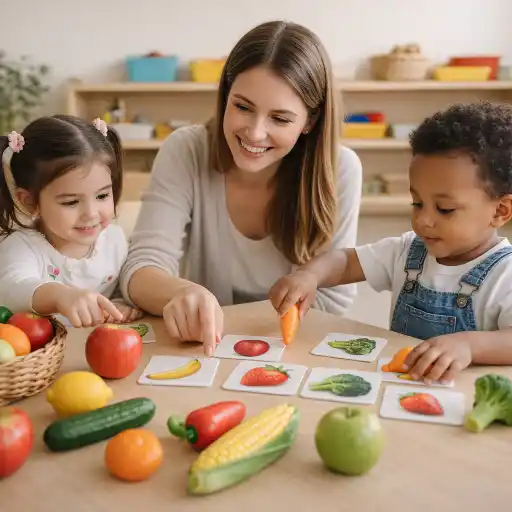
Keep the interaction conversational. Pause so children can complete a familiar phrase, find a matching picture, or point to a word they recognize. Avoid turning every page into a quiz: the aim is shared meaning and active participation, not perfect answers. Repeated readings let children become more familiar with the language and structure over time.
- Before reading: name the cover, invite predictions, and introduce a few fruit words.
- During reading: point out a repeated phrase, a picture, and a printed word.
- After reading: invite children to name, draw, sort, or pretend-play with a fruit from the story.
How can educators extend fruit vocabulary into everyday routines?
Children learn words through repeated, responsive interactions, so a reading activity can become a thread woven through the day. After sharing a fruit reader, add fruit pictures and labels to the dramatic-play market, place matching play foods in a basket, or invite children to help make a picture menu. During snack, describe the fruit that is being served without requiring children to eat or even touch it. These connections give children multiple, low-pressure opportunities to hear and use the same vocabulary.
Extend the theme with playful sorting and language prompts. Children might group fruit pictures by color, compare which images look round, or match an illustration to a word card. Ask open questions such as “What do you notice about this fruit?” and “How is this one different from the pear?” Then repeat or expand children’s responses: if a child says “red,” you might answer, “Yes, the cherry is red, and it has a small stem.”
Food-themed games can also support exploration away from mealtimes. The Healthy Eating Advisory Service activity guide describes creative ways to explore fruit and vegetables without pressuring children to eat them. Adapt activities for children’s ages, abilities, sensory preferences, and family practices.
- 📚 Set up a pretend fruit market with picture labels, baskets, and simple lists.
- Invite children to draw a favorite fruit and dictate a caption for an adult to write.
- Use a fruit song or rhyme to play with sounds and repetition.
- For group activities involving actual food, follow program food-safety and allergy procedures.
How can providers make the experience inclusive and observe progress?
Children do not all show emerging literacy in the same way. One child may say the fruit’s name, while another points to the matching image, signs, selects a communication symbol, or watches closely. Treat these as meaningful forms of participation and provide several ways to join. For children who use more than one language, include familiar home-language words when possible and welcome family contributions.
Observe a few specific behaviors during regular activities rather than relying on a one-time test. Does a child anticipate a repeated phrase, connect a fruit picture with its name, show interest in the printed word, or handle a book with growing independence? Note the context and the support provided; these details help educators plan a useful next step and share concrete observations with families.
Common pitfalls include introducing too many unfamiliar words, expecting every child to answer aloud, or treating a memorized refrain as proof that a child can decode new text. Instead, repeat a manageable set of words, make participation flexible, and distinguish joyful familiarity with a book from independent word reading. If you are selecting curriculum or documenting literacy instruction, state requirements vary - check your state licensing agency.
- Record one brief observation, such as “matched the pear picture to the spoken word.”
- Offer visual, spoken, tactile, and movement-based ways to explore the topic.
- Use observations to choose whether to repeat, extend, or adapt the next activity.
Conclusion: What should providers take away?
Combining healthy-food vocabulary with beginning reading turns familiar experiences into meaningful opportunities for language, print awareness, and joyful participation. Start with a few fruit words, read a short illustrated reader more than once, point out that printed words carry meaning, and revisit the vocabulary in play and conversation. The aim is not to make preschoolers read independently ahead of their development; it is to build the knowledge and confidence that support later literacy.
ChildCareEd’s Emergent Readers - Fruits Buy Now $1.75 can provide a ready-to-use starting point for a fruit-themed shared reading, while Understanding Print Knowledge in Preschool Buy Now $16.00 offers a focused training option for providers who want to deepen their understanding of print instruction. Keep activities welcoming, responsive, and connected to children’s lives. A thoughtful conversation about a pear can be both a healthy-food discussion and a first step toward understanding how reading works.
- Understanding Print Knowledge in Preschool
- 45 Hour Child Growth and Development
- Science of Reading Foundations in the Pre-K Classroom
- Language and Literacy Foundations in Pre-K
- Setting the Stage: Story Time
- Pediatric RSV First Aid & CPR/AED
- CDA Bridge Bundle: Preschool without Portfolio Review
- Texas Director Credential
- Building Vocabulary
- Classroom Tools for Emergent Literacy
- Healthy Cooking for Picky Kids
- Creating Your Own Galaxies
- Kickstart a Healthy Routine for Kids That Actually Sticks Past January
- How to Celebrate National Ice Cream Day in Your Center
- Which Oklahoma Farms and Ranches Offer Preschool Field Trips That Teach About Animals and Community?
- How does the brain develop in early childhood?
- Celebrando la amistad en el cuidado infantil durante el Día de los Mejores Amigos
- Mexican-Themed Activities That Teach Culture and Creativity
- How Does the Brain Develop During the First Five Years?
- Can simple kitchen activities teach valuable skills to young children in child care settings?
- How Can Child Care Programs Use Easy Nature‑Based Activities for Every Season?
- Why Do Predictable Books Help Preschoolers Feel Like Readers?
- How Do Fruits vs. Vegetables Sorting Mats Build Healthy Eating Habits?
- How Can Child Care Providers Build Phonological Awareness in Preschool?
- How Can Preschool Teachers Introduce Inclusive, Culturally Responsive Books?
- How Can Themed Vocabulary Strengthen Beginning-Sound Awareness in Preschool?
- How Can Familiar Real-Life Processes Help Preschoolers Learn Sequence Words?
- How Can Food and Kitchen Words Build Early Reading Skills?
- How Can Healthy-Food Vocabulary Help Preschoolers Begin Reading?
- Teaching Syllables Through Play: What Should Preschoolers Notice?
