Books can help preschoolers feel recognized, develop empathy, and explore experiences beyond their own. To strengthen your selection and read-aloud practice, explore Diversity, Equity, and Inclusion in Education  Buy Now $16.00 and Building Bridges for Dual Language Learners Buy Now $16.00; these courses can deepen your professional knowledge, support culturally responsive classroom practices, and may contribute to required training hours depending on your setting.
Why Do Inclusive Books Matter in Preschool?
For young children, books are not merely literacy tools. They are also social messages about whose families, languages, bodies, communities, and experiences are valued. A book may function as a mirror, allowing a child to recognize meaningful aspects of home life, or as a window, inviting children to encounter experiences different from their own.
Thoughtful representation supports belonging and engagement, while intentional conversations help children develop language for noticing difference without attaching negative judgments. A color-blind approach—avoiding all discussion of race or culture—can unintentionally communicate that these parts of identity are uncomfortable or unimportant. Preschoolers already notice differences; respectful adults can help them interpret what they observe with accuracy, warmth, and fairness.
Books also provide a manageable starting point for directors and providers who are developing anti-bias practice. A read-aloud creates shared attention, makes complex ideas concrete, and gives teachers opportunities to model curiosity, empathy, and advocacy.
How Should You Select Books That Represent Children Responsibly?
Begin with an intentional collection review rather than purchasing titles solely because they appear multicultural. Strong collections include books about everyday life, imaginative stories, informational texts, poetry, wordless books, and stories that address fairness in developmentally appropriate ways. Representation should appear across the entire library—not only during a designated cultural celebration.
Use a brief evaluation process before introducing a book:
- Who wrote and illustrated the book, and what relationship do they have to the culture portrayed?
- Are cultural details specific, accurate, and integrated into the story rather than used as decoration?
- Do characters have agency, humor, relationships, and varied interests beyond their identity?
- Are people of color, multilingual families, disabled people, LGBTQ+ families, rural families, and varied socioeconomic experiences visible without tokenism?
- Who solves problems, makes decisions, and takes action?
- Do illustrations avoid caricature, exoticism, stereotypes, or a single story about a community?
How Can You Prepare Preschoolers Before Reading?
Preparation helps children participate thoughtfully instead of treating a book as a cultural performance. Preview the text privately, identify potentially confusing or harmful language, and decide which ideas require clarification. Consider the developmental goal: vocabulary, family diversity, emotional understanding, racial identity, home language, or fairness.
Before reading, activate children’s knowledge without asking one child to speak for a whole group. You might say, “This story shows a family getting ready for school. Families may have different routines. What helps your family get ready?” For a book featuring a language unfamiliar to some children, pronounce names and words carefully and explain that languages can sound and look different.
Use neutral, respectful language:
- “People have many skin tones, and every skin tone is worthy of care and respect.”
- “Families can be organized in many ways. What makes a family is caring for one another.”
- “This character speaks two languages. Knowing more than one language is a strength.”
Invite, but do not require, personal sharing. Some children may not want to discuss family practices publicly. Protect privacy, avoid assumptions, and remember that a classroom’s responsibility is to represent children accurately without placing them on display.
What Questions Make Inclusive Read-Alouds Meaningful?
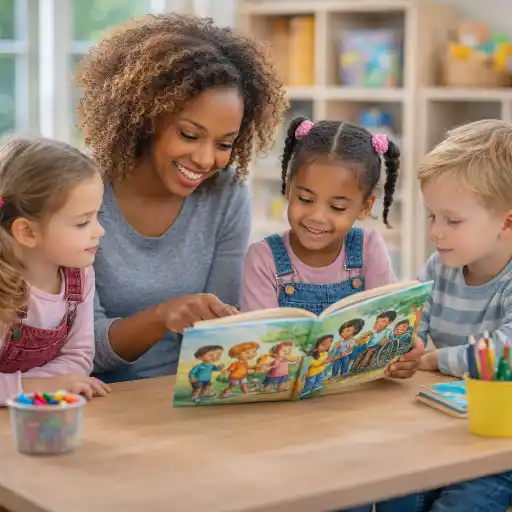
High-quality discussion is more important than simply having diverse books on the shelf. During the read-aloud, use open-ended prompts that encourage observation, interpretation, and connection. Pause briefly so children have time to process and respond.
- Notice: “What do you see in this picture? What details help you know what is happening?”
- Connect: “Have you ever done something similar? What might be different for another family?”
- Perspective-take: “How do you think the character feels? What makes you think that?”
- Challenge bias: “The character said that food was weird. How might that make someone feel? What could we say instead?”
- Practice fairness: “What could the children do to make sure everyone can join?”
Respond directly to children’s comments about race, disability, clothing, language, or family structure. Avoid shushing or changing the subject. A concise response can be both honest and reassuring: “Yes, her skin is darker than yours. People have different amounts of melanin, and all skin colors are beautiful.” If a child makes an unkind statement, address the impact and guide repair: “That word can hurt people. In our classroom, we describe differences respectfully.”
After reading, extend the conversation through drawing, dramatic play, sequencing, dictation, or a second related book. Eastern Connecticut State University’s resource on inclusive classrooms emphasizes that discussion around books helps children develop vocabulary, empathy, and the ability to respond to unfairness.
How Can You Support Home Languages and Family Partnerships?
Culturally responsive book use is strongest when families are treated as knowledge holders rather than occasional guests. Ask caregivers about preferred names, home languages, favorite stories, and words that comfort or delight their child. Provide multiple ways to contribute: lending a book, recording a story, suggesting a title, or sharing a translation. Participation should always be voluntary.
Include dual-language editions, books written originally in languages represented in the program, and audio recordings when available. Do not treat English acquisition as a replacement for the home language. Children’s first languages support identity, relationships, conceptual development, and family communication.
Practical strategies include:
- Label a small number of book categories in English and children’s home languages.
- Invite families to review books for cultural accuracy without making them responsible for educating the entire staff.
- Use correct pronunciation for names and ask families for guidance when uncertain.
- Offer picture supports, gestures, and repeated phrases so multilingual children can participate fully.
- Send home book-related prompts that families can answer in any language.
Directors can support consistency by creating a written book-selection policy, budgeting for multilingual materials, and scheduling staff reflection. State requirements vary - check your state licensing agency, especially when planning visitors, lending libraries, food activities, or documentation practices.
What Common Mistakes Should Providers Avoid?
Good intentions do not automatically produce culturally responsive practice. The most common mistake is tokenism: adding one book about a group and treating it as sufficient representation. A second is restricting diverse books to holidays or special events, which can make cultures seem unusual rather than part of ordinary classroom life.
Other pitfalls include choosing books because of attractive artwork without examining the storyline, asking a child to explain an entire culture, using costumes or props without context, and presenting poverty, disability, immigration, or racial injustice only through sadness or rescue. Avoiding difficult topics entirely can also limit children’s ability to recognize unfairness and act with compassion.
Use a monthly or quarterly audit:
- Which children see their families, languages, and identities reflected?
- Which groups appear only once or only in stories about hardship?
- Who is missing from books, illustrations, and classroom extensions?
- Do characters with diverse identities participate in ordinary joy, leadership, play, and problem-solving?
- Are books accessible to children with different sensory, physical, and language needs?
Keep brief notes about children’s responses, family feedback, and titles that generate meaningful discussion. Replace books that rely on stereotypes rather than using them as teaching tools unless the staff has the expertise and purpose to critically frame them. Professional learning such as Strength in Differences: Cultural Diversity Buy Now $24.00, Cultures in the Classroom Buy Now $24.00, and Reading Aloud and Storytelling Buy Now $16.00 can help providers connect selection decisions with daily instruction.
Conclusion: How Can You Begin This Week?
Introducing inclusive, culturally responsive books is an ongoing practice of selection, conversation, reflection, and partnership. Begin by auditing the books children use most often, selecting several authentic titles that reflect both familiar and unfamiliar experiences, and planning two or three questions before each read-aloud. Then invite families to recommend stories and observe how children respond.
The central question—how can preschool teachers introduce inclusive, culturally responsive books?—is answered through intentional action: choose books critically, read them in ways that welcome honest questions, support home languages, challenge stereotypes, and connect stories to children’s everyday lives. When books become part of a consistent culture of belonging, children learn that their own experiences matter and that other people’s experiences deserve curiosity, dignity, and care.
- Diversity, Equity, and Inclusion in Education: For Workforce Solutions
- Building Equity: Inclusionary Practices in Preschool
- Art from the Heart for Preschoolers: Open Ended Art Projects that Build Self-Esteem
- CDA Bridge Bundle: Preschool without Portfolio Review
- 45-Hour Infant and Toddler Curriculum
- Diversity, Equity, and Inclusion in Education
- Texas Director Credential
- Leveling the Playing Field: ERSEA for Head Start
- Bridging Cultures: Family Communication & Collaboration
- Celebrate Juneteenth in Baltimore
- 10 Ejemplos de Cómo la Cultura Influye en el Desarrollo Infantil
- Celebrando la amistad en el cuidado infantil durante el Día de los Mejores Amigos
- Canciones, juegos y preguntas de círculo para niños
- How can child care programs celebrate Latin rhythms and culture with young children?
- How can I introduce the Festival of Lights to young children in respectful, developmentally appropriate ways?
- Building a Better Head Start Lesson Plan: 7 Things Every Teacher Should Include
- Types of Curriculum in Early Childhood Education: Which Approach Fits Your Classroom Best?
- Getting to Know You Activities for Preschoolers When a New Child Joins the Class
- How Can Child Care Providers Support Language Development in Young Children?
- How Can Child Care Providers Use Project-Based Learning to Deepen Young Children’s Learning?
- How Can Classroom Environment and Arrangement Support Young Children’s Learning?
- How Can Child Care Providers Design Learning Centers That Support Play and Development?
- What Is Developmentally Appropriate Practice—and What Does It Look Like?
- How Can Themed Activity Bundles Simplify Weekly Planning?
- How Can Providers Create an Inclusive Classroom for Every Child?
- How Can Puppets Support Communication and Literacy in Early Childhood?
- How Can Preschool Teachers Introduce Inclusive, Culturally Responsive Books?
- What Makes a Preschool Curriculum Meaningful, Inclusive, and Effective?
- How Can Child Care Programs Celebrate Juneteenth Through Respectful, Child-Centered Art?
