When preschoolers describe how lemonade is made, they are doing more than recalling a snack—they are organizing ideas, practicing language, and building early literacy. Pair the printable How to Make Lemonade: A Sequencing Activity Buy Now $1.49 with Science of Reading Foundations in the Pre-K Classroom Buy Now $16.00 to strengthen sequencing, oral language, and foundational literacy while adding a practical professional-learning option for your teaching team.
For additional classroom application, directors and providers may also explore Reading Aloud and Storytelling  Buy Now $16.00, Assessment of Language and Literacy Skills Buy Now $24.00, and Basic Science in Early Childhood Buy Now $25.00. These English-language courses can help staff connect sequencing with conversation, observation, literacy, and inquiry. State requirements vary - check your state licensing agency.
Why do familiar processes make sequence words easier to learn?
Sequence words—such as first, next, then, before, after, and last—help children organize events in time and communicate procedures clearly. For young children, however, these concepts are initially abstract. A familiar process gives the language a concrete anchor: children can remember squeezing lemons, adding water, stirring, and tasting because they can connect the words to actions and sensory experiences.
Real-life processes also support oral language and comprehension. Research on preschool conversation emphasizes the value of open-ended questions, sophisticated vocabulary, and multi-turn exchanges during centers and everyday routines. A teacher might ask, “What happened after we added the sugar?” rather than requesting a one-word response. That small shift invites children to explain, reason, and listen to peers.
Sequencing is also connected to narrative development. When children explain how something happened, they practice organizing information with a beginning, middle, and end. These skills later support story retelling, comprehension, procedural writing, and classroom participation. The goal is not to make preschoolers memorize terminology. It is to give them repeated, meaningful opportunities to use language while doing something understandable.
- Builds #vocabulary through meaningful action words and materials.
- Strengthens #comprehension by connecting order with cause and effect.
- Supports #literacy through oral explanations, print, and retelling.
How can providers introduce sequencing through lemonade?
Begin with an authentic conversation. Display a lemon, cup, spoon, water, and sugar, or show photographs if food preparation is not possible. Invite children to predict what will happen. Use clear language: “First we prepare the ingredients. Next we squeeze the lemon. Then we add water. Last we taste the lemonade.” Repeat the words naturally rather than presenting them as a vocabulary quiz.
Next, complete the activity with children. The How to Make Lemonade resource Buy Now $1.49 asks children to color, cut, and glue illustrated steps in order. This format combines sequencing with fine-motor practice, attention to detail, and visual discrimination. Before children begin, model how to look for clues: Which picture shows the beginning? What must happen before the lemonade can be tasted?
Keep the first sequence short. Three or four steps may be enough for children who are new to the concept. Older preschoolers can work with a longer sequence or create their own picture recipe. Children do not need to produce identical work; the teacher’s questions and observations matter more than a perfectly assembled page.
Use inclusive examples. Some children may not drink lemonade or may have family routines involving different ingredients. Invite them to compare the process with making another familiar drink or snack. This preserves the instructional goal while respecting family practices, allergies, dietary needs, and cultural experiences.
Which teaching moves help children use sequence words?
Intentional adult language makes a significant difference. Narrate the process as it unfolds, then pause so children can contribute. Use gestures, photographs, and objects alongside speech, especially for children who are learning English or benefit from visual communication.
- Model: “First, I cut the lemon.”
- Prompt: “What comes next?”
- Expand: If a child says, “Sugar,” respond, “Yes, next we add the sugar to the water.”
- Recast: If a child says, “We drink it first,” respond, “We drink it last, after we mix everything.”
- Invite explanation: “How do you know this picture belongs before that one?”
Open-ended questions are particularly useful during centers and meals, when children are already engaged in meaningful activity. Teachers can encourage longer conversations by following children’s interests, introducing precise verbs such as squeeze, pour, and stir, and asking children to explain their choices.
Pair spoken language with print. Write the words first, next, then, and last on cards. Place them beside the corresponding pictures and point to each word while speaking. This links oral language to print knowledge without requiring children to read conventionally. Children can also dictate a class recipe while the teacher records their words.
How can sequencing become a playful, integrated learning experience?
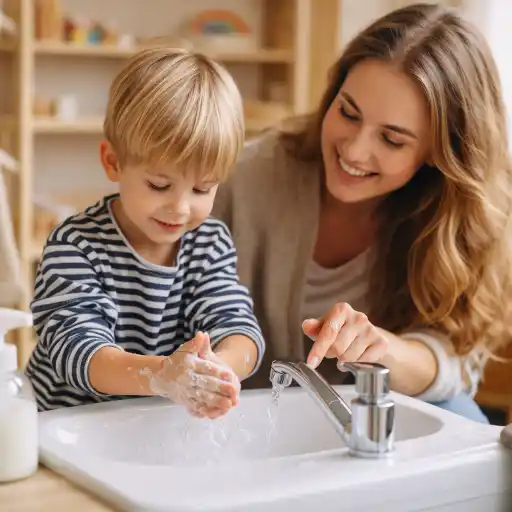 Sequencing works best when it extends beyond a single worksheet. After children assemble the lemonade cards, invite them to act out the procedure using pretend ingredients. One child may be the “pourer,” another the “stirrer,” and another the narrator. Role-play gives children a reason to repeat sequence words while strengthening cooperation and expressive language.
Children can also create a classroom photo sequence. Photograph handwashing, setting the table, planting seeds, or cleaning a center. Ask children to arrange the images and explain what happens first and why. Familiar routines are especially powerful because children can verify the order through experience.
- 📸 Create a photo recipe with real classroom pictures.
- Use blocks or dramatic-play materials to represent each step.
- Invite children to draw a three-part “how-to” book.
- Compare two processes: making lemonade and washing hands.
- Sing a transition song that includes “first,” “next,” and “last.”
Cooking-related activities can also integrate math and science. Children may count lemons, compare full and empty cups, observe how sugar dissolves, or describe changes in smell and taste. Keep food preparation safe and developmentally appropriate: adults should manage knives, monitor allergies, follow sanitation procedures, and provide alternatives for children who cannot participate in tasting.
For children who prefer construction or dramatic play, add recipe cards, menus, cups, pitchers, and order forms to a pretend café. Research on sociodramatic play suggests that props and adult modeling can encourage more complex language, story structure, and cooperative interaction.
How can providers differentiate and assess sequencing skills?
Children will not all demonstrate sequencing in the same way or at the same time. Some may point to the correct picture, while others may explain the full process verbally. Accept gestures, home-language responses, drawing, acting, communication devices, and partial verbal phrases as meaningful participation.
Adjust the task without lowering the learning goal. Offer two choices instead of six, use real objects before abstract pictures, provide a “first-then” strip, or invite a peer to model the process. Children developing fine-motor control may use larger cards, adhesive pieces, or pre-cut materials. Children who are ready for more challenge can add a reason: “We squeeze the lemon before adding water because the juice needs to go into the cup.”
Observe and document specific behaviors:
- Identifies the beginning and ending of a process.
- Orders two or more steps with support.
- Uses sequence words spontaneously or after modeling.
- Explains why one step must occur before another.
- Retells a process to a peer or family member.
Use observations to plan the next experience. A child who orders pictures but uses few words may need more conversation and modeling. A child who uses “next” for every step may benefit from repeated contrasts among first, then, and last. Brief notes, photographs, and work samples can show growth over time without turning a playful activity into a formal test.
Staff teams can strengthen consistency by agreeing on shared prompts and recording examples during ordinary routines. The goal is not to rank children; it is to identify the support that helps each child communicate more effectively.
What common mistakes should be avoided?
One common mistake is treating sequencing as a paper-and-pencil task only. If children arrange pictures without discussing the process, they may practice visual matching but miss the language objective. Always pair the resource with real objects, demonstration, conversation, or dramatic play.
Another mistake is asking too many closed questions: “Is this first?” “Is this next?” These questions can produce guessing. Instead, ask children to explain their reasoning and invite more than one possible connection. A child’s unexpected answer may reflect a real family experience or a misunderstanding that deserves thoughtful clarification.
Providers may also introduce too many sequence words at once. Begin with a small set and repeat it across the day. Use the same terms during cleanup, transitions, handwashing, snack, and storytelling. Consistency helps children transfer the language from one activity to another.
A final pitfall is rushing children. Sequencing requires attention, memory, language processing, and sometimes fine-motor coordination. Give children time to inspect pictures, handle materials, and revise their arrangement. Celebrate the process: “You looked carefully, noticed the spoon, and changed the order.”
Conclusion: How can real-life processes build strong sequence language?
Familiar real-life processes help preschoolers learn sequence words because they make time, order, and cause visible. When providers connect a lemonade-making activity with modeling, open-ended conversation, print, dramatic play, science, and observation, children practice much more than arranging pictures. They develop #sequence awareness, oral language, comprehension, reasoning, fine-motor skills, and confidence.
The practical answer is simple: choose a process children recognize, name each step, invite them to act and explain, represent the steps with pictures or print, and revisit the sequence in another routine. The How to Make Lemonade: A Sequencing Activity Buy Now $1.49 is a manageable starting point, while professional learning such as Science of Reading Foundations in the Pre-K Classroom Buy Now $16.00 can deepen staff understanding of vocabulary, comprehension, emergent writing, and language-rich practice.
Small, repeated conversations turn everyday routines into powerful literacy experiences. When children can explain what happened first, what came next, and what happened last, they are gaining tools for storytelling, problem-solving, and future reading success.
- CDA Preschool Credential with Portfolio Review
- Language and Literacy Foundations in Pre-K
- CDA Bridge Bundle: Preschool
- Art from the Heart for Preschoolers: Open Ended Art Projects that Build Self-Esteem
- CDA Bridge Bundle: Preschool without Portfolio Review
- Potty Training Made Simple
- Staff Supervision, Observation & Feedback
- Texas Director Credential
- Building Vocabulary
- Supporting Families and Caregivers in Language and Literacy
- CDA Certification en Español: Recursos y Consejos para Educadores Bilingües
- Actividades de Otoño Fáciles para Preescolares esta Temporada
- Cómo Trabajar en el Cuidado Infantil en Carolina del Norte: Requisitos y Pasos
- Celebrando la amistad en el cuidado infantil durante el Día de los Mejores Amigos
- First Week of Preschool Lesson Plans: 5 Days of Easy Activities and Routines
- Circle Time Topics Beyond Weather, Days of the Week, and the Calendar
- How Can Child Care Providers Support Memory Development in Young Children?
- How Can Sound Bingo Sharpen Listening Skills in Preschoolers?
- Why Do Predictable Books Help Preschoolers Feel Like Readers?
- How Can Child Care Providers Help Children Develop Self-Control?
- How Can Child Care Providers Teach Feelings to Preschoolers Through Simple Activities?
- How Can Printable Books Help Preschoolers Fall in Love With Reading?
- How Can Child Care Providers Document Learning During Ordinary Routines?
- How Can Familiar Real-Life Processes Help Preschoolers Learn Sequence Words?
- What Should Effective Beginning-Sound Practice Include?
- How Can Child Care Providers Make Transitions Easier for Children With Different Needs?
- How Can You Create a Visual Schedule Preschoolers Will Actually Use?
- How Can Educators Invite Children to Revise a Story They Told Earlier?
- What Are Simple Ways to Build Listening Skills During Everyday Classroom Routines?
- Teaching Syllables Through Play: What Should Preschoolers Notice?
