Why teach help-seeking during fall art and classroom projects?
Fall projects naturally invite children to cut, twist, paint, glue, sort, and assemble materials. Some steps are challenging by design, and children may encounter a real barrier: a lid is too tight, a tool is hard to manage, or they are unsure what to do next. Those moments let educators teach that asking for assistance is a capable strategy—not a sign of failure.
Help-seeking supports communication, persistence, self-advocacy, and participation. It also helps adults understand what a child needs. As ChildCareEd explains in teaching children to ask for the help they need, a child's request may take the form of words, gestures, signs, eye gaze, pictures, or a communication device. A responsive adult notices the message and answers it.
Art can also make the learning memorable. A child who asks, “Can you hold this paper?” experiences the immediate benefit of clear communication and can return to creating. The aim is not to eliminate every difficulty. It is to help children recognize when they can continue independently, when a small cue would help, and when they need someone’s support.
- Normalize help-seeking: everyone needs assistance sometimes.
- Build communication alongside fine-motor, creative, and social learning.
- Strengthen trust by responding warmly to children’s attempts to communicate.
How can educators recognize when a child needs support?
Not every child will say “help.” During an autumn collage, a child might hand over a closed marker, point toward scissors, repeat a step without success, pause and watch a peer, or begin to look upset. Treat these actions as useful information rather than evidence that a child is being uncooperative. Notice what the child has tried and what part of the task appears difficult.
Offer a brief pause when the child is safe and still engaged. This gives them a chance to try a manageable next step or communicate their need. Avoid making children struggle for the sake of independence: if distress increases, a safety concern arises, or the child signals for assistance, respond promptly. In an urgent or unsafe situation, intervene immediately.
Describe what you observe without judgment: “The tape is sticking to your fingers, and you’re trying to attach the leaf.” Then offer a simple, genuine choice: “Would you like a hint, a demonstration, or help holding the paper?” This helps children connect a problem with possible forms of support. When practical, make tools and materials accessible so that the activity invites agency rather than creating unnecessary barriers.
- Watch actions, facial expressions, gestures, and changes in participation.
- Name the challenge specifically and calmly.
- Give processing time, then offer an accessible prompt or choice.
What words, gestures, and visuals can children use to ask?
Teach a few short phrases during calm moments, then use them naturally during projects: “Help, please,” “Can you show me?” “Please hold this,” or “I need a break.” Keep phrases concrete and connected to real classroom tasks. Model rather than quiz: “This jar is tight. You can ask, ‘Will you help me open it?’” Children do not need to repeat a phrase perfectly for the request to count.
Communication is broader than speech. A child may point, sign, use a picture, look toward a familiar adult, or use an augmentative communication system. Accept these methods as meaningful. Head Start’s guidance on engaging children in conversations emphasizes attending and responding to verbal and nonverbal communication, individualizing support, and including children’s home languages.
Make a small visual help menu available at the art area. Pictures might represent “show me,” “open this,” “hold it,” “get a tool,” or “break.” Introduce the visuals before a child is frustrated, demonstrate how to point to or hand over a card, and pair images with speech, signs, or the child’s communication system when appropriate. Visuals should be accessible to everyone and never become the only acceptable way to request help.
- Place clear picture choices at child height near frequently used materials.
- Use familiar words and honor children’s home languages and communication preferences.
- Coordinate with families and relevant specialists when a child uses individualized supports.
How can adults help without taking over the project?
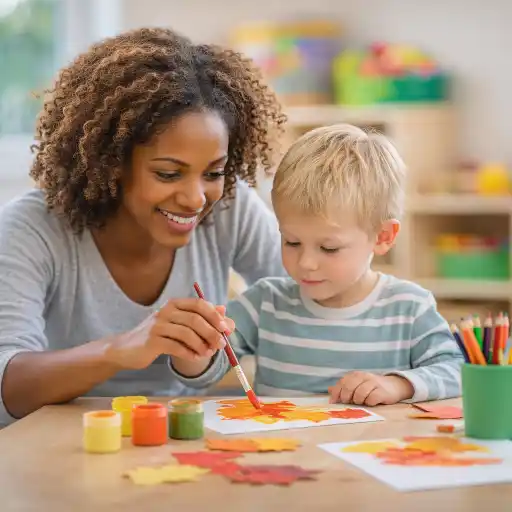
First acknowledge the request: “You let me know the paper is hard to cut. I’m here.” Then decide what support will help the child continue while preserving their role as the creator. Depending on the task, an adult might steady the paper, move a tool within reach, offer a hint, demonstrate one step, or complete a step together.
A useful sequence is to observe, offer a small cue, model if needed, and return the activity to the child when possible. For example: “The leaf keeps sliding. I can hold the corner while you add the glue.” This lets the child make the decisions about color, placement, and design. It also reflects the principle in fall crafts in child care: seasonal art can support creativity, fine-motor practice, problem-solving, and collaboration when educators adapt the process thoughtfully.
Respond to communication attempts, not just polished requests. If a child points or hands you a container, you can say, “You’re asking me to open it,” and help. When the child is distressed, connect and support regulation first; a language lesson can wait. After an urgent safety intervention, explain briefly what happened and practice a help signal later when the child is settled.
- Offer the least intrusive support that is safe and useful.
- Give children time to act after a hint or demonstration.
- Recognize the strategy: “You noticed it was stuck and asked for help.”
How can teams practice the skill and avoid common pitfalls?
Practice help-seeking before children become frustrated. A puppet might struggle to open a box of paper leaves; invite children to suggest a phrase, gesture, or picture the puppet could use. During the project, model requests for materials and collaboration: “Could you pass me the green paper?” or “Would you hold the branch while I tie it?” Children hear that asking is part of working together, not something reserved for emergencies.
Teams can agree on a few shared prompts, keep visual supports in consistent places, and discuss which tasks or routines seem to trigger frustration. Share strengths-based observations with families—for example, “Mina pointed to the help card when her glue stick was stuck”—and ask what communication approaches are familiar at home. Use observations to adjust materials, task steps, group size, or adult support.
A common pitfall is jumping in too quickly and doing the task for the child. Another is saying only “Use your words,” which may exclude children who are not speaking or who need more time. Avoid treating a picture card as a requirement, withholding adult assistance to force independence, or praising only a finished product. Art is about process, and communication attempts are progress. As you plan projects and staff training, state requirements vary - check your state licensing agency.
- 🧩 Try a brief puppet role-play, then practice the same phrases at the art table.
- Make asking optional and keep adult support dependable.
- Offer different ways to participate, including watching, pointing, signing, and speaking.
Conclusion: What should providers remember about teaching help-seeking?
Fall art offers authentic, low-stakes moments for children to notice a challenge, communicate a need, and return to their ideas with support. Teach simple phrases and signals, provide visuals when useful, and accept each child’s communication style. Pause when it is safe, respond promptly when help is needed, and give only as much assistance as supports continued participation.
Most of all, let children know that asking for help is a strength and that their communication matters. When educators model and respond consistently, classroom projects become practice in language, agency, collaboration, and confidence—not just seasonal crafts. For more structured professional learning, [Language Development in Early Childhood](https://www.childcareed.com/courses-language-development-4008.html) explores ways to foster verbal and nonverbal communication. Use these strategies to help every child feel capable of saying, showing, or signaling: “I can ask for help.”
Further ChildCareEd learning:

- CDA: Special Needs: Understanding the Whole Child
- CDA Home Visitor Subject Area 3 Part 3 Birth to 5
- CDA Home Visitor Subject Area 2 Part 3 Birth to 5
- Power of Art: Bldg Self-Esteem & Positive Behavior for ALL Abilities
- Art from the Heart for Preschoolers: Open Ended Art Projects that Build Self-Esteem
- Texas Director Credential
- Access for All: Inclusion and the ADA
- Wellness in Action: Teaching Healthy Habits to Children
- Technology as a Classroom Tool
- Today Is Earth Day!
- Boo-tiful Science: Glow-in-the-Dark STEAM Experiments for Mini Mad Scientists
- Nature’s Classroom: Why Fall Is the Best Season for Sensory Learning Outdoors
- Pumpkins, Pinecones, and Leaves: Autumn-themed STEM Projects
- CDA Certification en Español: Recursos y Consejos para Educadores Bilingües
- Apoyo en Español para Capacitaciones Grupales Presenciales y por Zoom en Cursos Selectos
- Proporciones de Cuidado Infantil y Tamaños de Grupo por Edad en Nueva Jersey (Guía Rápida para Centros y Hogares)
- Cómo Trabajar en el Cuidado Infantil en Carolina del Norte: Requisitos y Pasos
- Celebrando la amistad en el cuidado infantil durante el Día de los Mejores Amigos
- Canciones, juegos y preguntas de círculo para niños
- How can leaf-themed art and science activities deepen learning in my child care program?
- Fall Detectives: 10 Questions Pre-K Kids Can Investigate This Season
- How Can Loose Parts Play Turn Everyday Objects Into Powerful Learning Opportunities?
- How Can Fall Classroom Activities Teach Positive Behavior?
- How Can Fall Classroom Projects Build Stronger Family Partnerships?
- How Can Fall Art Leave Room for Children’s Ideas Beyond Matching Pumpkins?
- How Can Child Care Programs Plan a Halloween Celebration Where Food Is Optional?
- How Can You Build a Fall Giving Project That Protects Every Family’s Dignity?
- How Can Fall Art Projects Teach Children to Ask for Help?
