Why is weaving a worthwhile fine-motor experience?
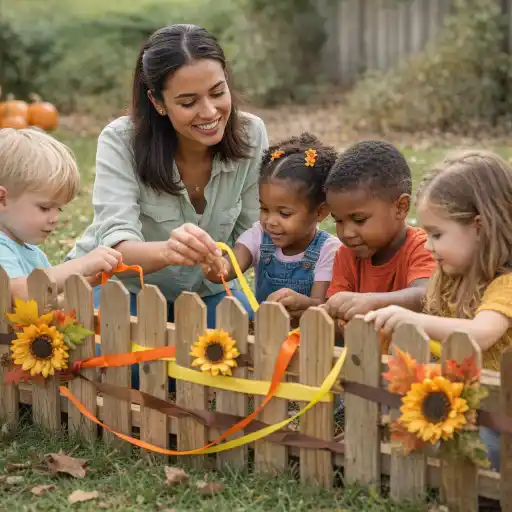
Paper weaving asks children to coordinate small, deliberate actions: hold a paper base steady, guide a strip through an opening, alternate over and under, and adjust when the paper catches or bends. These movements engage finger dexterity, visual-motor coordination, and the two hands working together for different purposes. One hand may stabilize the fence while the other threads a strip—a practical example of bilateral coordination.
The activity also supports learning beyond hand control. Children can compare strip widths, notice repeating sequences, name autumn colors, and describe how they solved a problem. Repetition gives them a chance to build persistence, but the open-ended design keeps the experience creative rather than turning it into a test of neatness. As the Montessori Room’s discussion of weaving activities notes, weaving can connect fine-motor practice with hand-eye coordination, pattern exploration, and creative expression.
For providers, the value lies in observing the process. Notice whether a child uses both hands, follows a simple sequence, changes strategy, or asks for help. A finished fence is a cheerful display; the meaningful learning is in the child’s decisions and attempts along the way.
How can you prepare a safe, inviting paper-weaving station?
Keep the setup simple, organized, and ready for children to explore. You will need a sturdy paper fence or loom with wide, pre-cut openings; colorful paper strips; child-safe scissors if children will cut; and glue or tape for securing the completed work. Cardstock or heavier construction paper is often easier to manage than thin paper, which can tear during threading.
- Offer a small selection of fall colors and different strip widths.
- Place strips in shallow trays so children can see and reach them easily.
- Prepare slits in advance when children are not ready to use scissors safely.
- Show a sample or demonstrate the first pass, then leave room for children’s ideas.
- Check materials for torn edges and supervise tool use throughout the activity.
How do you teach the over-and-under pattern without taking over?
Begin by inviting children to examine the fence and the strips. Model one slow movement: thread the strip through an opening, then bring it across the next section in the opposite direction. Use simple language such as “over, under, through” and point to each step as you demonstrate. A short verbal pattern can help children remember the sequence without requiring them to follow a lengthy set of instructions.
After one demonstration, let children try. Resist the urge to correct every uneven strip or finish the task for them. If a child pauses, offer a prompt: “Where could the strip go next?” or “Would it help to hold the fence with your other hand?” A small hint can support independent problem-solving while respecting the child’s effort.
Children’s woven patterns do not need to match an adult’s sample. Some may repeat colors; others may choose randomly or leave spaces. Invite them to explain their decisions: “Tell me about the colors you chose,” or “What did you notice when you changed direction?” These questions connect language and reasoning to creative work. The goal is meaningful participation and practice, not a perfectly uniform fence.
How can you adapt the activity for different learners?
Children arrive with different levels of experience, motor control, attention, and confidence. Adapt the materials and the amount of support so everyone can participate in a way that is challenging but manageable. For a first attempt, use a fence with only a few wide slots and large, firm strips. For children who are ready for more complexity, offer narrower strips, more openings, or a simple repeating color pattern to explore.
- Pre-cut strips and openings for children who need to focus on threading rather than scissor use.
- Use a larger fence format to make openings easier to see and reach.
- Tape or hold the base steady if coordinating two hands is difficult.
- Offer a choice of pointing, placing, or verbally directing a partner when that best supports participation.
- Allow additional time and short breaks; attention and stamina vary.
How can you connect weaving to intentional lesson planning?
A seasonal craft becomes a stronger learning experience when its purpose is clear and the activity connects to children’s interests. Before the session, choose one or two observable goals. For example: “Children will practice threading a strip through openings using both hands,” or “Children will create or describe a repeating color pattern.” Keep goals focused enough to notice during the activity.
Plan a brief opening, exploration time, and a simple closing. You might begin by looking at photographs of fences, fields, or autumn colors; invite children to predict how strips can cross; then provide ample time for weaving. As children work, make concise notes about the strategies they use, the support they choose, and the ideas they express. A photo or child’s comment can document learning more effectively than judging the finished piece alone.
Fall fence weaving is more than a seasonal craft. With thoughtful setup and responsive guidance, it gives preschoolers an engaging chance to practice finger control, hand-eye coordination, bilateral use, pattern exploration, and persistence. The learning is not measured by whether every strip lies perfectly flat; it is seen in each child’s effort, experimentation, and growing independence.
Keep the first version simple, adapt materials to children’s needs, and offer prompts that support rather than replace their thinking. Set one or two clear goals, observe the process, and use what you notice to shape the next experience. For a practical starting point, explore the Harvest Fence Paper-Weaving Activity Pack, then build on the activity with intentional planning and opportunities for children to create in their own way.
References
- Paper Weaving Fall Printables - Fine Motor Activity
- Weaving Projects for Kids
- Weaving Activities
- Easy Paper Weaving Animals for Preschoolers to Make
- Autumn Cutting & Sorting: Fall Mazes, Color Activities & Paper Weaving Prep Buy Now $1.49
- Paper Weaving Owl Craft
- Art: Fall Leaf Weaving
- Fall Fine Motor Activities
- Big Collection of Fall Fine Motor Activities for Preschoolers
- Thankful Tree Activity. All Ages. Art. Buy Now $0.00
- How Do You Create Effective Lesson Plans for Preschoolers?
- How Can Connect-the-Dots Activities Reinforce Number Sequence and Motor Planning?
- From Rags to Riches: Junk Art
- Lesson Planning for Preschoolers
 Buy Now $24.00
- Curriculum Planning Buy Now $24.00
- Paper Weaving Craft Instruction Cards
- 20+ FREE Fine Motor Activities, Lesson Plan Ideas, and Resources
- Art Activities Preschool Lesson Plans
- Fine Motor Skills Stations Planning Template
- CDA Preschool Credential with Portfolio Review
- What Makes Me Special: An Overview of Autism and ADHD
- 45-Hour School Age Curriculum
- CDA Bridge Bundle: Preschool
- 45 Hour School Age Methods and Materials
- CDA Bridge Bundle: Family Child Care without Portfolio Review
- Art from the Heart for Preschoolers: Open Ended Art Projects that Build Self-Esteem
- CDA Bridge Bundle: Infant/Toddler without Portfolio Review
- CDA Bridge Bundle: Preschool without Portfolio Review
- Thanksgiving Booklet Activity
- Helping children develop Fine Motor Skills
- Developing Skills Through Fall Crafts in Childcare
- Pumpkin Spice and Sensory Delight: Easy Autumn Sensory Bins for Early Learners
- How to boost fine motor skills: Holiday Edition
- DIY Snow Globes: The Fine Motor Craft That’ll Keep Kids (and Adults) Busy for Hours
- Increasing Fine Motor Skills in the Early Childhood Education Classroom
- 👶 ¿Cuáles son las proporciones y grupos requeridos en Dakota del Norte? 🏫
- Actividades de Motricidad Gruesa que Desarrollan el Equilibrio, la Coordinación y la Fuerza
- Actividades de Otoño Fáciles para Preescolares esta Temporada
- Calabazas, hojas y manzanas: actividades de otoño para preescolares
- Celebrando la amistad en el cuidado infantil durante el Día de los Mejores Amigos
- Canciones, juegos y preguntas de círculo para niños
- How can childcare providers support fine motor development with simple activities?
- Can doodling and drawing build fine motor skills and creativity?
- How Can Child Care Providers Strengthen Fine Motor Development Through Play and Daily Routines?
- What Are Simple Ways to Strengthen Hand-Eye Coordination Through Classroom Activities?
- How Can Fall Collage Activities Support Children Still Learning to Use Scissors?
- How Can a Fall Fence-Weaving Activity Build Preschoolers’ Fine-Motor Coordination?
