Fall projects can turn children’s everyday discoveries into welcoming invitations for families to share their knowledge, stories, and creativity. Explore practical ways to make seasonal learning collaborative and inclusive, and consider Building a Community of Families  Buy Now $16.00 to deepen your relationship-building strategies and strengthen your classroom’s family connections.
Why do fall projects create meaningful opportunities for partnership?
Autumn offers young children vivid, familiar experiences: changing leaves, cooler weather, harvest foods, and new routines. These interests provide natural starting points for projects that connect classroom exploration with family knowledge. A child who brings up a favorite walk, seasonal song, or family tradition can help shape the group’s questions and discoveries.
Partnership is more than inviting caregivers to attend an event. Families have expertise about children’s interests, languages, routines, and ways of making sense of the world. When educators invite that expertise into project planning, children experience continuity between home and the classroom.
Projects also give families a concrete window into children’s thinking. A leaf collection, class story, or display of children’s observations can prompt conversations that go beyond “What did you do today?” The aim is not a polished product; it is shared inquiry and connection. Keep participation flexible so families can contribute in ways that work for their time, language, and comfort.
How can you choose a fall project families can help shape?
Begin with children’s questions and observations rather than selecting a predetermined craft. Invite them to notice what is changing outdoors, compare leaves, or wonder where pumpkins grow. Ask families for related ideas, objects, words, stories, or experiences—while making clear that sharing is optional and no purchase is expected.
Choose a topic broad enough to welcome different experiences. A “Signs of Fall” inquiry can include weather, trees, neighborhood walks, clothing, sounds, and seasonal routines. Minnesota DNR’s Project Learning Tree early childhood activities include seasonal investigations such as collecting, counting, and sorting leaves, and connecting outdoor exploration with art, movement, and family participation.
- Ask an open prompt: “What changes do you notice outside this time of year?”
- Invite family contributions such as a drawing, photograph, favorite seasonal word, or short voice message.
- Offer several response formats: a conversation, paper note, digital message, or in-class contribution.
- Use the children’s responses to decide what to investigate next.
Make the invitation specific and low-pressure. “Would your family like to share a favorite fall sound?” is easier to answer than a general request to volunteer. For additional relationship-centered learning, providers may explore Project-Based Learning for Children Buy Now $16.00, which focuses on hands-on projects and inquiry in early childhood settings.
What classroom projects connect autumn learning with family knowledge?
A successful fall project gives children many ways to participate and lets family contributions influence the direction of learning. Consider projects that use accessible materials and connect naturally to classroom objectives. The process can build language, observation, early mathematics, creative expression, and a sense of community.
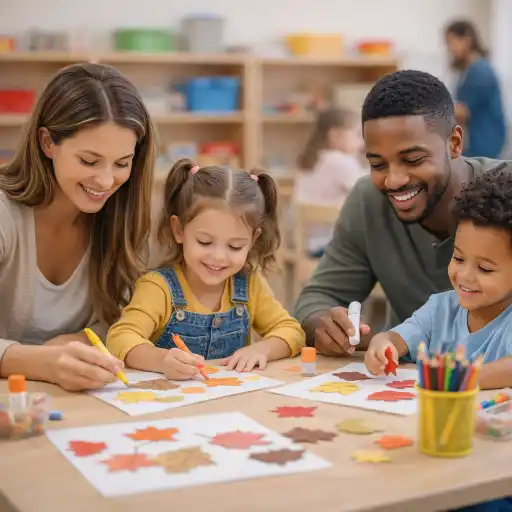
- Class leaf inquiry: Children observe, sort, draw, and describe leaves. Families may share a leaf photograph or a place they enjoy walking.
- Autumn sounds and stories: Collect children’s descriptions of wind, rain, or rustling leaves; invite optional family recordings of a seasonal story or song.
- Community harvest map: Children draw places where they see trees, gardens, markets, or seasonal displays. Families can suggest local places without needing to visit them.
- Family traditions and everyday routines: Invite a short story about a seasonal activity, a favorite book, or a family way of noticing changes in nature. Participation and disclosure remain voluntary.
- 🍂 Collaborative class mural: Children and families contribute drawings, words, or paper leaves that represent what they notice, value, or wonder about in autumn.
As described in ChildCareEd’s autumn activities for toddlers and preschoolers, simple seasonal materials can support sensory exploration, language, counting, and scientific thinking. Use family ideas to extend these experiences rather than asking caregivers to produce a finished assignment at home.
How can you make participation inclusive and manageable?
Families have different work schedules, access to technology, languages, transportation, and comfort with classroom visits. A thoughtful project does not treat physical attendance as the only sign of engagement. Offer options that can happen asynchronously and let caregivers choose whether and how to contribute. Children should never be made responsible for persuading adults to participate.
Use inclusive language such as “family,” “caregiver,” or “important grown-up,” and ask families how they describe themselves. Never expect one child or caregiver to speak for an entire culture. If a family shares a language, tradition, photo, or story, present it accurately and with permission. ChildCareEd’s article on making family participation visible emphasizes voluntary contributions, varied ways to take part, and respectful representation.
- Keep requests brief, plain-language, and clear about how a contribution will be used.
- Provide translated or interpreted information when possible; offer paper and digital options.
- Use classroom materials and natural items that are safe, accessible, and appropriate for children’s ages.
- Obtain permission before displaying names, photographs, recordings, or other identifying information.
- Thank families in a way that feels comfortable to them, and avoid comparing participation levels.
Ask for feedback in more than one way and use it to adjust the project. State requirements vary - check your state licensing agency for applicable rules on photographs, records, communication, and privacy.
How can educators document learning and keep communication reciprocal?
Documentation makes children’s thinking visible and helps families join the project conversation. Capture more than the final artwork: include children’s questions, their predictions, the strategies they tried, and the words they used to describe discoveries. A short caption beside a photograph or work sample can explain the learning without relying on technical jargon.
Share concise updates through the communication channels families prefer. For example: “We compared three leaves and noticed differences in shape. What kinds of leaves has your child noticed near home?” This gives families a clear opening to respond and helps educators learn about children’s experiences outside the program. NAEYC’s Five Rs for Promoting Positive Family Engagement highlights respect, responsiveness, relationships, reciprocity, and reflection as useful principles for partnership.
Close the loop by telling families how their ideas influenced classroom plans. If a caregiver shares a favorite nature walk, children might map the kinds of trees they encounter in the neighborhood. If a family sends a word in a home language, children can learn its meaning and use it in a class display—with permission and care.
- Share observations and questions, not only announcements or finished products.
- Invite a reply without making it a homework requirement.
- Reflect with staff: Whose perspectives informed the project, and what could make participation easier?
Conclusion: What helps fall projects strengthen family partnerships?
Fall projects build stronger family partnerships when they begin with children’s curiosity, welcome family knowledge, and offer flexible ways to participate. Seasonal inquiries—such as exploring leaves, autumn sounds, neighborhood changes, or family stories—can connect children’s learning across home and classroom while supporting language, observation, creativity, and community.
Keep invitations specific, voluntary, inclusive, and manageable. Represent contributions respectfully, protect privacy, document children’s thinking, and share how family input shapes the next steps. The central question is not how many caregivers attend a special event, but whether families feel heard and see their knowledge valued. Start with one simple autumn question, listen carefully, and let the children’s ideas—and their families’ perspectives—guide what your classroom discovers next.
Explore five relevant ChildCareEd courses
- CDA Home Visitor Subject Area 3 Part 3 Birth to 5
- CDA Home Visitor Subject Area 2 Part 3 Birth to 5
- Bienvenido! Welcoming All Families
- Engaging Parents in the Montessori Toddler Classroom
- Art from the Heart for Preschoolers: Open Ended Art Projects that Build Self-Esteem
- Effective Approaches for Autism and Inclusion
- Culture, Communication, and Collaboration in Assessment
- Bridging Cultures: Family Communication & Collaboration
- Supporting Families and Caregivers in Language and Literacy
- Today Is Earth Day!
- Nature’s Classroom: Why Fall Is the Best Season for Sensory Learning Outdoors
- DIY Snow Globes: The Fine Motor Craft That’ll Keep Kids (and Adults) Busy for Hours
- 👶 ¿Cuáles son las proporciones y grupos requeridos en Dakota del Norte? 🏫
- Curso de Comunicación de 9 Horas de Maryland
- Apoyo en Español para Capacitaciones Grupales Presenciales y por Zoom en Cursos Selectos
- How can we use nature-based learning through Minnesota's outdoor seasons?
- How Can Michigan Providers Prevent Summer Learning Loss in Young Children?
- Can California’s Universal TK Expansion Make the Early Learning Pipeline Stronger?
- How Can Child Care Programs Build Strong Family Engagement?
- How can childcare programs create high-quality outdoor classrooms and nature-based care?
- How Can Intergenerational Learning Between Children and Older Adults Improve Early Childhood Practice and Community Well‑Being?
- How Can Early Childhood Programs Implement Practical Sustainability Practices?
- Talk, Listen, Connect: Build Stronger Child Care Relationships in 9 Hours
- Fall Detectives: 10 Questions Pre-K Kids Can Investigate This Season
- Grants for In-Home Daycare Providers: Do You Have to Be a Nonprofit to Qualify?
- How Can Preschool Teachers Use Fall Activities to Strengthen Family Engagement?
- How Can Fall Classroom Activities Teach Positive Behavior?
- How Can Teachers Use Fall Classroom Experiences to Document Children’s Development?
- How Can Fall Classroom Projects Build Stronger Family Partnerships?
