When children sort mail, care for a pretend patient, or design a safer neighborhood, they are doing more than playing—they are building language, problem-solving, empathy, and early ideas about work. Strengthen your planning with ChildCareEd’s Curriculum Planning course  Buy Now $24.00, which can help you connect community-helper experiences to developmentally appropriate goals and professional training needs.
Why does career awareness belong in early childhood?
Career awareness in the early years is not about asking children to choose an occupation. It is about helping them notice how people contribute, solve problems, use tools, collaborate, and care for others. Community-helper activities make these abstract ideas visible through familiar places and relationships.
Children often recognize doctors, teachers, firefighters, or mail carriers, but a thoughtful unit can broaden that picture to include sanitation workers, farmers, librarians, cooks, mechanics, artists, translators, delivery workers, and many others. The goal is to represent work accurately and respectfully while showing that communities depend on many forms of knowledge and labor.
ChildCareEd’s preschool social science guidance emphasizes that community experiences can strengthen belonging, communication, empathy, and early civic understanding. These outcomes make career exploration a natural part of social studies rather than an isolated theme.
How can educators introduce community helpers meaningfully?
Begin with children’s lived experiences. Ask, “Who helps our classroom work?” or “Who helps your family?” Invite children to share observations without requiring personal disclosure. A short photograph, book excerpt, object, or neighborhood sound can serve as an anchor for discussion.
- Introduce one or two helpers at a time instead of presenting a long list.
- Teach functional vocabulary such as workplace, tool, repair, deliver, protect, grow, and care.
- Use open-ended questions: “How does this person help?” “What might happen without that service?”
- Include helpers children may not immediately see, such as custodians, farmers, cooks, caregivers, and utility workers.
Pair each introduction with an experience. After discussing a librarian, create a lending station. After reading about a baker, measure pretend ingredients. Following a conversation about builders, provide blocks and blueprints. The ChildCareEd community-helper guide recommends connecting whole-group anchors with hands-on centers so children revisit ideas in increasingly complex ways.
How can Community Helpers Match support learning?
Community Helpers Match is a practical resource for connecting occupations with tools, workplaces, vehicles, or responsibilities. Used thoughtfully, matching is not merely a recognition task. It invites children to explain relationships and justify their thinking.
Begin with picture-to-picture matches for younger children or children who benefit from visual support. For example, match a nurse with a clinic, a gardener with a watering can, or a mail carrier with envelopes. Then extend the activity by asking children to describe what the helper does and whom the helper supports.
- 🧩 Beginning level: Match identical pictures or familiar helper-and-tool pairs.
- Developing level: Match a helper to a workplace, vehicle, or action.
- Extending level: Sort several possible tools, explain a choice, or create a new match.
- Language extension: Invite children to complete sentences such as “A veterinarian helps…”
Use the cards in small groups, learning centers, or transition games. Avoid treating an incorrect response as failure; instead ask, “Tell me what you noticed,” and offer another clue. Matching can support classification, vocabulary, visual discrimination, and early reasoning while remaining accessible and engaging.
How can dramatic play turn career ideas into deeper understanding?
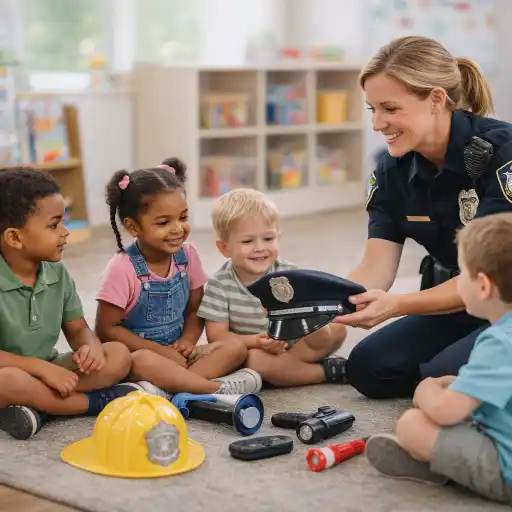
Dramatic play allows children to practice the social purposes of work. A pretend clinic can include greeting a patient, recording information, offering comfort, and explaining next steps. A post office can include sorting, labeling, delivering, and asking for clarification. These scenarios build communication and perspective-taking alongside career vocabulary.
Prepare environments with authentic, safe, and open-ended materials: clipboards, recycled boxes, fabric, envelopes, menus, maps, measuring tools, and picture labels. Everyday clothing is generally preferable to stereotyped costumes because it leaves room for many identities and interpretations.
Adults should model briefly and then step back. Offer scripts when needed—“How can I help?” “What do you need?” “Thank you for coming”—but allow children to direct the narrative. Rotate roles so children experience being helpers, customers, coworkers, and observers.
Connect play to purposeful play training Buy Now $35.00 by observing how children negotiate, solve problems, and revise their ideas. A child who changes a hospital sign, creates a delivery route, or invents a new tool is demonstrating meaningful conceptual growth. Document these moments as evidence of language, social-emotional, and cognitive development.
How can activities remain inclusive and culturally responsive?
Career awareness should expand children’s possibilities, not narrow them through stereotypes. Show people of varied genders, races, ages, languages, body types, and abilities performing many kinds of work. Include local occupations and invite families to contribute photographs, stories, audio recordings, or objects when participation is comfortable and voluntary.
Do not ask one child or family to represent an entire culture or profession. Instead, use multiple books, images, and perspectives. Be especially careful with emergency-service themes, uniforms, and medical play; some children may have experienced frightening events or may feel anxious around particular helpers. Offer observation roles, gradual participation, and alternative scenarios.
Planning for access means providing picture directions, tactile materials, multilingual labels, adapted tools, and different ways to respond. ChildCareEd’s Planning for Every Child Buy Now $55.00 course offers related professional learning on responsive curriculum, differentiation, and accessibility.
When involving guests or visiting a community site, clarify supervision, consent, transportation, allergies, privacy, and emergency procedures. State requirements vary - check your state licensing agency.
How can providers assess learning and avoid common pitfalls?
Assessment can be brief and observational. During matching and play, record whether children identify a helper, use target vocabulary, explain a connection, cooperate with peers, or revise an idea after new information. Collect drawings, dictated statements, photographs of constructions, and short quotes.
- Overloading the unit: Focus on a few helpers and revisit them repeatedly.
- Relying on worksheets: Balance paper tasks with conversation, movement, construction, and play.
- Using stereotypes: Include diverse workers and describe responsibilities accurately.
- Making play too adult-directed: Model, ask a question, and allow children to lead.
- Confusing recognition with understanding: Ask children to explain why a match makes sense.
After each experience, reflect: Which children participated? What language emerged? Which materials supported independence? What should change tomorrow? A simple checklist can include participation, vocabulary, reasoning, cooperation, and role flexibility.
Families can receive a short update with one child quote and one suggested home prompt, such as noticing helpers on a walk or discussing how a family member contributes to the household.
Conclusion: What makes community-helper activities effective?
Effective community-helper activities connect children’s real-world observations with purposeful play, conversation, and reflection. They build #career awareness while also supporting #vocabulary, empathy, classification, cooperation, and confidence.
Use Community Helpers Match as a flexible starting point: introduce a small set of cards, invite children to explain relationships, and extend the ideas into dramatic play, art, maps, construction, and family conversations. Plan for representation, access, and emotional safety, then document what children demonstrate.
For educators who want a stronger bridge between engaging themes and intentional instruction, explore these ChildCareEd options:
- Curriculum Planning Buy Now $24.00 — connects standards, curriculum, and developmentally appropriate lesson plans.
- Lesson Planning for Preschoolers Buy Now $24.00 — supports purposeful planning for preschool development.
- From Play to Planning Buy Now $55.00 — explores child-centered, culturally responsive curriculum.
- Community and Family Engagement in Childcare Buy Now $24.00 — strengthens partnerships around children’s learning.
- Children at the Wheel Buy Now $25.00 — supports inquiry-based planning from children’s interests.
The central question is not simply, “Can children name a community helper?” It is, “Can children understand how people contribute, imagine themselves as capable participants, and connect learning to the communities they know?”
- 45 Hour Child Growth and Development
- Basic Health & Safety and Breastfeeding Awareness
- TEAM: Together Everyone Achieves More
- 24 Hour Texas Pre-Service
- CDA Bridge Bundle: Family Child Care without Portfolio Review
- CDA Bridge Bundle: Infant/Toddler without Portfolio Review
- CDA Bridge Bundle: Preschool without Portfolio Review
- Play, Learn, Grow
- Texas Director Credential
- Labor Day Activities
- CDA Certification en Español: Recursos y Consejos para Educadores Bilingües
- 👶 ¿Cuáles son las proporciones y grupos requeridos en Dakota del Norte? 🏫
- Cómo Trabajar en el Cuidado Infantil en Carolina del Norte: Requisitos y Pasos
- Capacitación CDA gratuita en Illinois
- Superhero Activities for Preschoolers: Play, Create, and Learn
- Superhero Theme Activities for Preschool and Child Care
- How can Michigan providers teach community and citizenship for the 250th anniversary?
- What Do Superheroes Teach Kids About Kindness and Courage?
- Can Superhero Day Capes and Pretend Play Teach Children to Help Others?
- How can child care programs build strong readers before kindergarten?
- How can child care programs use culturally responsive activities to support young children?
- How Can We Teach Young Children to Care for the Environment?
- Get to Know You Activities for Preschool: 12 Easy First-Week Ideas
- Snip, Stick, Celebrate! What Easy Labor Day Crafts Can Toddlers Make?
- Social Studies Activities for Toddlers: Start With Home, Helpers, and Their Little World
- How Can Child Care Providers Teach Friendship Skills Through Everyday Classroom Activities?
- How Can Simple Music and Movement Activities Build Early Literacy Skills?
- How Can Simple Sorting Activities Build Sustainable Habits in Early Childhood?
- How Can Community Helper Activities Build Career Awareness in Early Childhood?
