What if a two-minute song could strengthen children’s listening, vocabulary, and sound awareness during an ordinary transition? Intentional music and movement make early literacy active, memorable, and inclusive; for deeper professional learning, explore Mind's Medicine: Music in Early Childhood  Buy Now $16.00 to build confidence planning developmentally appropriate musical experiences. Providers who want a broader literacy foundation can also explore Science of Reading Foundations in the Pre-K Classroom Buy Now $16.00, which connects phonological awareness, vocabulary, print knowledge, and storytelling to everyday practice.
Why do music and movement matter for early literacy?
Young children learn language through repeated, social, multisensory experiences. Singing organizes speech through rhythm, melody, rhyme, and predictable phrasing, while movement gives children a physical way to represent meaning. A child who claps syllables, freezes when a song stops, or fills in the final word is practicing important foundations for later reading.
Research and professional guidance connect active music participation with phonological awareness, oral language, vocabulary, memory, attention, and self-regulation. Music is not a replacement for explicit literacy instruction; it is a powerful context for making oral language visible and enjoyable.
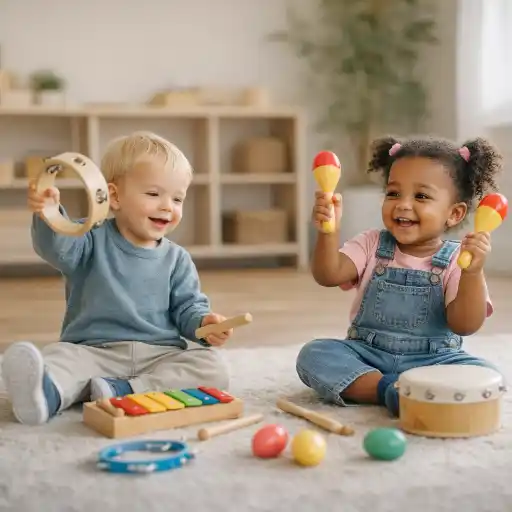
For child care providers, the practical advantage is substantial: music requires little preparation and can be embedded across the day. A welcome song can build names and social connection; a cleanup chant can reinforce sequencing; and a rhyme during handwashing can support sound awareness. These brief moments accumulate into a language-rich environment. For more playful ways to build early reading into daily routines, explore everyday literacy activities for toddlers and preschoolers.
How can providers use songs to build vocabulary and oral language?
Choose songs with clear words, repetition, and opportunities for children to respond. Before singing, identify one or two target words rather than trying to teach every word in the lyrics. Show an object or picture, demonstrate a gesture, and repeat the word naturally throughout the activity.
- Action vocabulary: Use songs about walking, jumping, stretching, opening, closing, or hiding. Pair each verb with a movement.
- Descriptive language: Contrast fast and slow, loud and soft, high and low, or smooth and bumpy.
- Social language: Use greeting and turn-taking songs with children’s names, greetings, and simple questions.
- Narrative language: Sing a story-based song and ask what happened first, next, and last.
Use the interactive sequence “model, invite, pause, expand, repeat.” Sing or chant the line, invite children to join through voice or movement, pause before a predictable word, and expand their responses. If a child says “bus,” respond, “Yes, the big yellow bus is moving.” This transforms a song into reciprocal communication rather than passive listening.
Accept many forms of participation. Humming, pointing, signing, eye gaze, tapping, and using a communication device are meaningful responses. The goal is communication and comprehension, not polished performance. Resources such as songs and rhymes for language development also emphasize repetition, gestures, and responsive interaction.
Which activities strengthen rhyme, syllables, and phonological awareness?
Phonological awareness is children’s ability to notice and manipulate the sound structure of spoken language. It includes rhyming, alliteration, sentence segmentation, syllabification, onset-rime blending, and phonemic awareness. Music creates a playful setting for these skills because children hear and physically experience sound patterns before they are expected to read print.
- 🎵 Syllable claps: Clap or stomp the parts of names, animals, classroom objects, and theme words.
- Rhyme pauses: Sing a familiar line and stop before the final word so children can complete it.
- Rhyme choices: Show two pictures and ask which word rhymes with the song’s target word.
- Alliteration names: Create playful phrases such as “Mia marches” or “sleepy snakes.”
- Sound sorting: Invite children to move toward pictures that begin with a selected sound.
- Sentence beats: Tap once for each word in a short familiar sentence or classroom direction.
The NAEYC guidance on phonological awareness recommends embedding sound play in authentic, play-based experiences. Begin with rhythm, rhyme, and syllables, then introduce more complex sound manipulation as children demonstrate readiness. Avoid turning the activity into a test or requiring every child to answer aloud.
For toddlers, focus on imitation, gestures, and predictable endings. Preschoolers may enjoy inventing verses, substituting rhyming words, or matching sounds to picture cards. Repetition matters: use a small repertoire of songs throughout the week so children can anticipate patterns and experience success.
How can movement make literacy concepts concrete?
Movement helps children connect spoken language with action, space, and memory. Instead of asking children only to listen for a concept, invite them to demonstrate it with their bodies. This is particularly helpful for children who communicate or learn more effectively through sensory and motor experiences.
- Alphabet action song: Assign an action to selected letters, then invite children to say the letter name, sound, or a familiar word.
- Phonics freeze dance: Play music while children move. When it stops, call a sound or word and invite children to freeze, point, or repeat it.
- Story dance: Children move like characters or objects in a story and then retell the sequence.
- Letter pathway: Place large letter cards on the floor. Children step or jump to letters while spelling a simple word.
- Scarf vocabulary: Move scarves high, low, quickly, slowly, above, below, around, and through.
- Echo patterns: Clap, tap, or stomp a short pattern for children to reproduce.
Keep instructions concise and model the movement before asking children to respond. Offer seated alternatives, such as tapping knees or moving a scarf with one hand. Movement should clarify the language goal rather than overwhelm it. For example, if the target is the word “under,” children might move a scarf under a chair; if the target is syllables, each clap should correspond to one spoken syllable.
Music can also support transitions. A consistent cleanup chant gives children a sequence to follow, reduces verbal overload, and makes routine language memorable. The ChildCareEd overview of music and movement offers practical examples of welcome songs, steady-beat stations, action rhymes, and calming music moments.
How can directors make music activities inclusive and culturally responsive?
Inclusion begins by recognizing that participation looks different across children. One child may sing enthusiastically, while another watches, taps, signs, uses a switch, or joins only during a familiar refrain. Each response can demonstrate attention, communication, or connection.
- Offer two or three response options: sing, point, sign, tap, move, or observe.
- Provide standing, seated, and low-movement versions of the same activity.
- Use picture cards, objects, gestures, and visual schedules alongside spoken directions.
- Adjust volume and tempo; provide soft instruments or a quiet re-entry space when needed.
- Assign meaningful roles, such as beat leader, picture-card holder, instrument helper, or song chooser.
- Invite families to share songs, rhymes, and movement traditions in home languages.
Home languages are assets rather than obstacles. A bilingual song can strengthen belonging, pronunciation, vocabulary, and family partnership. Invite caregivers to contribute a favorite lullaby, fingerplay, or greeting. Display important words in children’s languages and accept responses in any language.
Directors can support consistent practice by creating one-page song cards that identify the literacy goal, target vocabulary, materials, adaptations, and observation prompt. Ensure instruments are age-appropriate, intact, and actively supervised. State requirements vary - check your state licensing agency, especially when documenting training, using equipment, or planning activities that involve noise and movement.
How can programs plan and measure progress without losing the joy?
Effective implementation is brief, intentional, and repeatable. Begin with three anchor songs: a welcome song, a movement or literacy song, and a calming or goodbye song. Repeat them for several days before introducing new material. Familiarity lowers cognitive demands and allows children to participate more independently.
- Set one goal: For example, children will clap two-syllable words or use the word “under.”
- Select a song: Choose a predictable song that naturally supports the goal.
- Plan access: Decide how children can respond through speech, movement, signs, pictures, or instruments.
- Observe: Note one indicator, such as joining the refrain, echoing a pattern, identifying a rhyme, or using target vocabulary.
- Adjust: Shorten the activity, repeat it, simplify the target, or add a visual cue.
Common mistakes include using music only as background, choosing songs without a clear purpose, making group times too long, introducing too many new words, correcting every error, and forcing participation. Replace these habits with short bursts, wait time, responsive expansion, and flexible entry points.
Directors may use a simple weekly reflection: What did children notice? Who participated and how? Which supports helped? What should we repeat or change? Training such as Language Development in Early Childhood Buy Now $16.00, Classroom Tools for Emergent Literacy Buy Now $25.00, and Balancing Active Play in Child Care Buy Now $16.00 can help staff connect musical experiences with language goals, classroom materials, and daily scheduling.
Conclusion: How can simple music and movement activities build early literacy skills?
Simple music and movement activities build early literacy by making language audible, physical, social, and memorable. Songs support vocabulary, listening, rhyme, syllables, sequencing, and expressive communication; movement helps children demonstrate meaning and participate through multiple pathways.
Start with one familiar rhyme, one syllable-clapping game, and one action song. Keep each experience brief, repeat it across the week, include home languages and varied response modes, and observe one small indicator of growth. When music is used intentionally rather than as background noise, ordinary routines become joyful opportunities for children to listen, communicate, and develop the foundations for reading.
- CDA Subject Area 2
- CDA Home Visitor Subject Area 2 Part 3 Birth to 5
- Language and Literacy Foundations in Pre-K
- 24 Hour Texas Pre-Service
- Mind's Medicine: Music in Early Childhood
- Texas Director Credential
- Montessori Cultural Activities: Exploring the World Through Play and Learning
- Building Vocabulary
- CDA Infants/Toddlers: Stages of Development
- Language Development in School Age
- Phonological Awareness
- Cultivating Literacy, Language, and Cultural Awareness: The Hanukkah Minibook in Early Childhood Education
- Best Songs for Circle Time
- CDA Certification en Español: Recursos y Consejos para Educadores Bilingües
- 👶 ¿Cuáles son las proporciones y grupos requeridos en Dakota del Norte? 🏫
- Actividades de Fiesta para Niños de Preescolar y Primaria
- Can simple indoor movement games teach listening and cooperation to preschoolers in Oklahoma?
- Celebrando la amistad en el cuidado infantil durante el Día de los Mejores Amigos
- Canciones, juegos y preguntas de círculo para niños
- Cómo simplificar la capacitación para sus empleados de daycare
- How can North Dakota child care programs lay reading foundations the right way?
- How can child care programs celebrate Latin rhythms and culture with young children?
- How and Why Does Music Boost Brain Development in the First Five Years?
- How Does Singing Together Build Community in the Classroom?
- How Can Music and Movement Activities Boost Learning and Inclusion for Young Children?
- Why Do Bilingual Classroom Activities Matter for Dual Language Learners?
- How Can Simple Music and Movement Activities Build Early Literacy Skills?
