Superhero Day—complete with capes, masks, imaginative missions, and dramatic play—is more than a celebration. When planned thoughtfully, it can become a purposeful, play-based strategy for teaching young children about helping others, personal safety, cooperation, and community responsibility. A one-day theme or week-long series can transform pretend play into meaningful practice for prosocial behavior, positive #superhero identity-building, and classroom routines that help every child feel capable and included. This guide gives directors and providers practical ideas for using capes, scripts, learning centers, and reflective questions as teaching tools, while also addressing safety, inclusion, and family involvement. Educators can strengthen their planning through ChildCareEd’s From Play to Planning: Building Culturally Competent, Child-Centered Curriculum  Buy Now $55.00, which explores intentional play, problem-solving, and inclusive curriculum design, and Creating Environments that Nurture Growth and Community Buy Now $55.00, which supports the development of learning spaces that encourage belonging, cooperation, and positive relationships. Providers can also use the linked Superhero Activities for Preschoolers and Fun Superhero-Themed Lessons resources for ready-made activity and safety ideas.
1) Why should we plan a Superhero Day to teach helping and cooperation?
Why it matters: pretend play offers kids a low-stakes arena to rehearse social roles, language, and helping behaviors. Research and practical guides show dramatic play builds empathy, turn-taking, perspective-taking, and problem-solving — all key to stronger peer relationships and calmer classrooms (see The Power of Play). A themed day makes these goals visible to children and families: when you call a child a "helper" or "rescuer" and give them simple missions, you are naming and reinforcing prosocial identity. Use the superhero frame to teach real-world helpers (mail carriers, nurses, firefighters) and small acts of service—delivering a message, helping a friend tie a shoe—that scale into daily habits (Superhero Theme Activities).
- Builds social-emotional skills: empathy, asking for consent, and conflict repair.
- Strengthens language and narrative skills through mission scripts and "mission reports."
- Integrates gross and fine motor practice via obstacle courses and crafts.
Keep these goals front-and-center when you plan props, prompts, and staff coaching. State the learning aim aloud: "Today we're learning how helpers look and sound." That clarity helps staff coach intentionally and helps families see the learning behind the capes.
2) How do capes and pretend roles actually teach helping, empathy, and safety?
Pretend roles let children try on behaviors before they are required in real life. When a child plays "rescuer," they practice steps like noticing a need, asking permission, calling an adult, and offering comforting words. This sequence—observe, ask, act, report—maps to basic first-aid and helper routines and is easily taught through short role-play prompts (First Aid Role Play Scenarios).
- 👑 Role rehearsal: children repeat scripts ("Do you want help?") until the phrases feel natural.
- 🛟 Guided reflection: after a mission,n say, "Who needed help? What did we do?" which reinforces perspective-taking and vocabulary.
- 🎭 Scaffolding: adults model consent language ("May I pick that up for you?") and coach small repairs when conflicts arise.
Evidence shows pretend play links to social competence and body awareness; using superhero narratives to practice safe choices helps children label feelings and bodily limits (body awareness & safety lessons; see also research summaries at ECRP and pretend-play literature on social outcomes).
Embed safety teaching gently: show that not all stunts are safe, model "safe rescue" alternatives, and rehearse when to get an adult. (Reminder: state requirements vary - check your state licensing agency.)
3) What practical Superhero Day activities and centers teach helping across domains?
Design 3–4 rotating centers so children practice different skills. Each center has a clear learning aim and a short adult script to launch play. Keep sessions 12–20 minutes for preschool attention spans and rotate.
- 🛡️ Movement: "Hero Training Course" — gross motor + planning.
- Set stations: balance line, tunnel crawl, jump-to-target, and "rescue" a stuffed animal. Focus on cheering effort, not speed. (See movement ideas at Play With a Purpose.)
- 🎭 Dramatic Play: "Helper HQ" — social skills & language.
- Props: capes, clipboards, first-aid kit, phone, community helper photos. Provide role cards: medic, dispatcher, sidekick. Use scripts: "I see you fall—May I help?" and ask kids to write or dictate a short mission report.
- 🎨 Craft & Literacy: mask/cuff station — fine motor + identity work.
- Offer templates and choices (felt, foam, stickers). Invite children to design a "helping badge" and practice writing their hero's name—tie to literacy objectives (mask & cuff craft ideas). You can also adapt these simple crafts into keepsakes—for example, turning a helping badge or decorated cuff into a Mother's Day gift—see ready-to-use Mother's Day crafts for kids for center-appropriate templates and variations.
- 📚 Calm Corner: "Mission Planning" — reflection & inclusion.
- Quiet books about helpers, picture prompts for empathy, and a visual mission board where kids add stickers when they complete a helping task. Use this space for children who prefer quieter roles (planner, medic's notebook keeper).
Tips for success: rotate props weekly, prep an adult to model each center for the first five minutes, and celebrate effort with specific praise or small tokens. For craft inspiration, see curated collections like 30+ Superhero Crafts and Superhero School.
4) How do I keep Superhero play safe, inclusive, and licensing-friendly?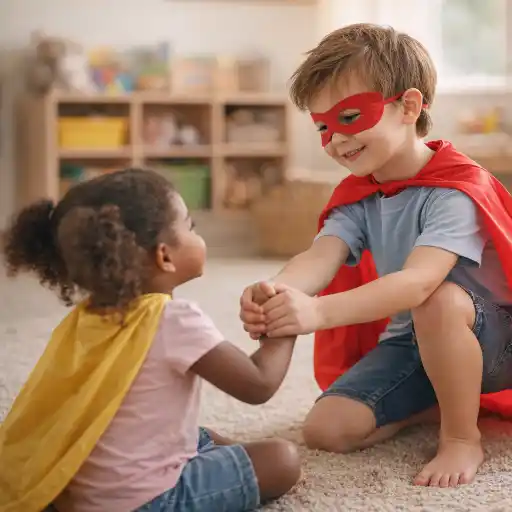
Safety, inclusion, and licensing are non-negotiable. Superhero themes are flexible—plan to prevent risky imitation, honor sensory needs, and follow licensing rules. State requirements vary - check your state licensing agency.
Checklist (enumerated):
- 👀 Supervision & layout: position staff where active areas are visible; use a single stop signal (bell, clap) so children can pause play immediately (movement guidance).
- 🩺 Staff training: keep at least one staff member certified in pediatric First Aid & CPR and practice short role-play calling drills. ChildCareEd's blended First Aid & CPR courses are commonly used by programs (first aid role-play).
- ♿ Inclusion & adaptations: provide quiet capes (soft fabrics), weighted options for regulation, visual scripts, and alternative roles (planner, reporter) so children with different needs can lead. See inclusion guidance at Developmental Disabilities Awareness Month Activities.
Common mistakes and how to avoid them:
- 🚫 Letting play escalate into unsafe stunts — set clear physical rules, demo safe alternatives, and have mats or soft landing zones.
- 🚫 Over-reliance on violent storylines — choose helper-focused narratives and homemade heroes (simple hero examples).
- 🚫 One-size-fits-all roles — rotate responsibilities and offer quiet leadership jobs so all children succeed.
5) How do I assess learning, involve families, and make the learning stick?
Assessment should be simple, practical, and shareable. Use quick teach-backs, checklists, and family notes so learning transfers home.
- ✅ Quick checks: Use 1–2 minute teach-backs—"Show me how you would ask to help a friend"—or a 3-step poster: Notice → Ask → Help. Short, repeated practice every 2–4 weeks cements skills (first aid role-play).
- 📣 Family engagement: send a two-sentence family note with a photo and a take-home prompt: "Ask your hero to show you their mission report." Share safe at-home alternatives so parents can reinforce safe play (link to resources like Superhero Activities for Preschoolers). You might also offer simple, child-friendly gift projects—like handprint flowers or sock monkeys—that families can make together; see our Mother's Day weekend activities for ready-made, center-friendly craft ideas.
- 📊 Simple documentation: keep a one-page log of observed helping incidents and skills practiced. Use this for staff reflection and licensing records if needed.
FAQ (quick answers):
- Q: Is superhero fighting ever OK? A: No hitting—if pretend antagonists appear, use sound effects or puppets and coach conflict repair scripts. Emphasize helpers over fighting (theme guidance).
- Q: How long should centers run? A: 12–20 minutes per center for preschoolers; repeat favorite centers across days.
- Q: What if a child imitates a dangerous stunt at home? A: Communicate with families, show safer alternatives practiced in class, and offer simple take-home activities.
Finally, choose five visible words to anchor your messaging and routines—use them often so language becomes culture: be sure to weave tags into your displays and mission board for quick recall: #superhero #play #helpers #safety #empathy.
Conclusion
Superhero Day is an efficient, joyful way to teach helping: capes permit children to be brave, scripts give them the words to act, and focused centers give adults opportunities to scaffold real skills. Start small: try one 15-minute rescue center this week, practice one script, and send a quick family note. Use evidence-based scaffolds—short role plays, teach-backs, and intentional praise—and lean on trusted resources for safety and craft ideas (ChildCareEd, craft collections, and research summaries linked above).
You are the real superheroes in children's lives: with planning, a few capes, and clear prompts, you can turn pretend missions into lifelong habits of helping and care.
- 45 Hour Child Growth and Development
- 45 Hour Preschool Methods and Materials
- From Play to Planning: Building Culturally Competent, Child-Centered Curriculum
- 45 Hour Infant and Toddler Methods and Materials
- Pediatric RSV First Aid & CPR/AED
- 45 Hour School Age Methods and Materials
- Play with Purpose: Supporting Children with Autism
- Texas Director Credential
- Superheroes Wear Capes...And Take First Aid & CPR Classes
- CDA Certification en Español: Recursos y Consejos para Educadores Bilingües
- ❄️ ¿Qué actividades al aire libre funcionan bien para los niños de Illinois en cada estación? 🌷🍂
- ¿Cuáles son las mejores actividades del Día de la Tierra para niños en casa o en el aula?
- Proporciones de Cuidado Infantil y Tamaños de Grupo por Edad en Nueva Jersey (Guía Rápida para Centros y Hogares)
- Guías del Clima para el Juego al Aire Libre en el Cuidado Infantil
- Cómo Trabajar en el Cuidado Infantil en Carolina del Norte: Requisitos y Pasos
- Cómo Trabajar en el Cuidado Infantil en California: Requisitos y Pasos
- Celebrando la amistad en el cuidado infantil durante el Día de los Mejores Amigos
- “Remember the Alamo: Teaching Texas Young Children Courage, Teamwork, and Classroom Community”
- Canciones, juegos y preguntas de círculo para niños
- Superhero Activities for Preschoolers: Play, Create, and Learn
- Superhero Examples for Kids: Learning About Helpers, Safety, and Kindness
- Superhero Theme Activities for Preschool and Child Care
- How can superhero-themed play help build confidence in young children?
- What Do Superheroes Teach Kids About Kindness and Courage?
- Can Superhero Day Capes and Pretend Play Teach Children to Help Others?
- How can we host a Costume & Character Day that truly builds imagination and learning?
- Can a Superhero Week Help Preschoolers Learn to Name and Manage Emotions?
- How Can You Turn a Superhero Theme Into a Full Week of Preschool Learning Centers?
