Teaching children about the people who keep neighborhoods running creates a meaningful blend of social studies, dramatic play, and social-emotional learning. This guide gives child care providers and directors practical classroom strategies, quick lesson ideas, family engagement approaches, and safety reminders for creating a community helpers unit that is developmentally appropriate, engaging, and easy to implement. Educators can strengthen these experiences through ChildCareEd’s From Play to Planning: Building Culturally Competent, Child-Centered Curriculum  Buy Now $55.00, which supports intentional, play-based curriculum planning, and Community and Family Engagement in Childcare Buy Now $24.00, which explores ways to build meaningful connections among programs, families, and local communities. The guide also includes action-oriented steps and ready-to-use resources that help children learn about different careers, appreciate the contributions of community members, and explore the world of work through purposeful play. State requirements vary, so always check with your state licensing agency.
How do I introduce community helpers in ways young children will remember?
- 🔍 Prepare a 1–2 minute anchor: pick one helper (e.g., mail carrier) and a short question: “Who brings our letters?”
- 📚 Use a picture book or emergent reader and follow with 2 quick prompts: “What did the helper do?” and “How did they help someone?” For curated book suggestions, see community helper lists like Community Helpers: Labor Day and picture-book lists at No Time For Flash Cards. To situate those lessons historically and help older preschoolers understand why we honor workers, consider introducing a simple, age-appropriate explanation of the history and significance of Labor Day using resources such as the history and significance of Labor Day.
- 🎭 Offer dramatic-play props: uniforms, clipboards, and simple tools. Rotate materials weekly to sustain interest; ChildCareEd suggests dramatic-play linkages in Dramatic Play and Sensory Play Activities.
- 🔁 Repeat and connect: follow the circle-time anchor with a center activity (mail sorting, pretend clinic) so the concept moves from whole group to hands-on practice. See circle time strategies in Preschool Circle Time Ideas.
How can I use pretend play and SEL to deepen understanding of jobs?
- 🧩 Planning phase: introduce vocabulary (tools, places of work, action verbs). Use visuals and label stations with pictures and words so non-readerscan join easily.
- 🎬 Play phase: adults join briefly to model roles, then fade back. Research summarized in therapy and classroom resources shows materials + adult prompts increase rich pretend play; see a synthesis at Community Helpers and Pretend Play.
Three classroom moves that support SEL:
- 🙂 Teach scripts for social routines (greeting, asking to share, saying thank you).
- 🗣️ Target emotion vocabulary during scenarios: “How would the patient feel? How can the helper help them feel better?”
- ✅ Use rotating helper jobs to practice responsibility (line leader, materials keeper, mail sorter).
ChildCareEd’s SEL and classroom-environment resources are useful when planning these steps; see SEL Strategies in Early Childhood Education for guidance.
How do I involve families and community partners safely and effectively?
Family and partner engagement makes community helpers' lessons authentic. Follow a straightforward outreach plan:
- 📣 Communicate clearly: 1) announce the theme, 2) request volunteers or props, 3) offer flexible options (in-person visit, recorded video, or walk-through). Use the community partnership frameworks in Community Partnerships Buy Now $24.00.
- 🧾 Secure permissions: create a short permission slip that lists activity, mode (walk/onsite/virtual), and emergency contacts. ChildCareEd templates and checklists can be adapted from their field-trip and resource pages,s like Daycares Plan Field Trips Without Transportation. Remember: state requirements vary - check your state licensing agency.
- 🤝 Build reciprocity: offer to create thank-you notes or a class photo to give to guests—small gestures strengthen partnerships.
When inviting community workers, plan roles and safety steps in advance (medication, allergies, adult-to-child ratios). For outreach-ready ideas and printable helpers, see ChildCareEd’s resource lists at Resources - Community Partnerships.
What ready-to-use activities, printables, and low-cost lesson ideas can I use tomorrow?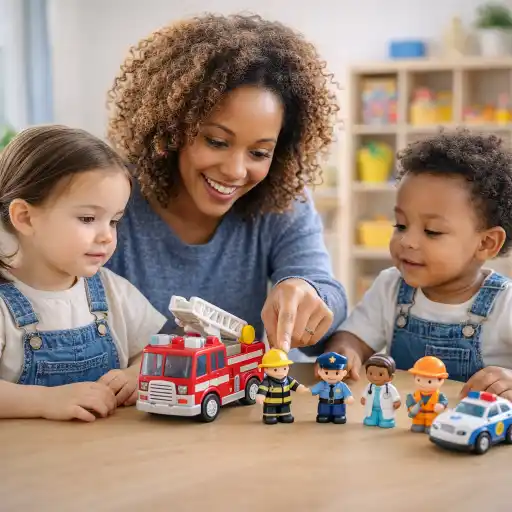
Quick, scaffolded activities you can launch with little prep:
- 📬 Mail Sort Sensory Bin: numbered envelopes + toy letters for matching and gross-motor delivery. (Low cost; supports literacy and math.)
- 🩺 Pretend Clinic Mini-Lesson: teach 3 new words (stethoscope, thermometer, bandage), model 2-line scripts for role-play, then rotate helpers.
- 🚶 Neighborhood Walk Checklist: assign jobs (photo-taker, map holder) and collect 3 observations to share at circle time.
- 🎨 Community Helpers Art Gallery: invite families to contribute photos of parents at work or create a classroom “I want to be…” portrait station; Preschool planning sites offer printable ideas — see Preschool-Plan-It and printable packs at KidSparkz.
- 📘 Make an 8-page Community Helpers booklet using simple folding instructions — a ready printable and assembly guide is available from ChildCareEd: Folding Instructions for Community Helpers Booklet Buy Now $0.00.
Keep materials culturally responsive and reflective of children’s lives; rotate to keep engagement high. For quick, dramatic, tactile, and sensory play ties, see Dramatic Play and Sensory Play Activities.
How do I assess learning, avoid common mistakes, and follow licensing expectations?
Assessment should be simple, strengths-based, and tied to observable behaviors:
- 📝 Use a 3-point checklist for each child: participation, vocabulary use (2–3 target words), and cooperative play behaviors.
- 📸 Collect work samples: drawings, dictations, or the community booklet; photos of role-play can document progress.
- 🔁 Quick formative checks: 2-minute snapshot questions in circle time: “Who helps us at the grocery?”
Common mistakes and how to avoid them:
- ⚠️ Too many helpers at once — limit to 1–2 per week and deepen instead of broadening.
- ⚠️ Overly adult-led play — model briefly, then let children lead; prompt only when needed.
- ⚠️ Materials that exclude identities — include diverse uniforms and tools that reflect your community.
For paperwork and community coordination best practices, adapt templates from ChildCareEd’s field-trip and community partnership resources: How Daycares Can Plan Field Trips Without Transportation and Resources - Community Partnerships.
Conclusion — What are quick takeaways and common FAQs?
Quick takeaways:
- 🎯 Focus on 1–2 helpers per week and build repeated, scaffolded experiences.
- 🤝 Engage families and local partners through clear, flexible invitations and reciprocity.
- 🔄 Use dramatic play + SEL scaffolds to make learning sticky and measurable.
FAQ
- Q: How long should a community helpers lesson last? A: 10–30 minutes for a whole-group anchor plus 20–45 minutes of center-based practice depending on age.
- Q: Can I use virtual guest visits? A: Yes — virtual visits are excellent substitutes when in-person guests aren’t available; see virtual field-trip ideas at Simple Field Trip Ideas Without Leaving the Classroom.
- Q: How do I include non-English-speaking families? A: Offer translated notes, picture-based permission forms, and invite families to contribute photos or short audio/video clips.
- Q: What if a child is anxious about a helper (e.g., uniforms)? A: Use picture stories, gradual exposure in play, and family collaboration to normalize the helper role.
- Q: Where can I get printables and activity packs? A: Start with ChildCareEd resources (booklet folding and activity ideas: folding guide Buy Now $0.00, activity ideas) and supplement with free printables from sites like KidSparkz and Super Teacher Worksheets.
You’re already doing the most important part: making connections between children and their world. Start small, choose one helper, and build a week of joyful, inclusive learning. #community #helpers #play #learning #families
- Teach with Respect ONLINE
- Bienvenido! Welcoming All Families
- CDA Bridge Bundle: Family Child Care without Portfolio Review
- Play with Purpose: Supporting Children with Autism
- Texas Director Credential
- Montessori Cultural Activities: Exploring the World Through Play and Learning
- Building Bridges for Dual Language Learners
- Wellness in Action: Teaching Healthy Habits to Children
- Brighter Futures: Social Emotional Development
- Why Celebrate Labor Day?
- CDA Certification en Español: Recursos y Consejos para Educadores Bilingües
- 🔍 ¿Qué ves cuando observas a un niño aprender?
- Proporciones de Cuidado Infantil y Tamaños de Grupo por Edad en Nueva Jersey (Guía Rápida para Centros y Hogares)
- Cómo Trabajar en el Cuidado Infantil en Carolina del Norte: Requisitos y Pasos
- Cómo Ser Maestra de Preescolar en Maryland
- Labor Day Activities for Kids at Home or in the Classroom
- Memorial Day Activities for Kids: Simple Ways to Honor the Day
- Teaching Kids About Memorial Day Through Crafts and Activities
- How Did Oklahoma’s Week of the Young Child Resource Fair Show Why Community Partnerships Matter?
- Celebrando la amistad en el cuidado infantil durante el Día de los Mejores Amigos
- Canciones, juegos y preguntas de círculo para niños
- Superhero Theme Activities for Preschool and Child Care
- How can Michigan providers teach community and citizenship for the 250th anniversary?
- Can Superhero Day Capes and Pretend Play Teach Children to Help Others?
- How can we teach community and country to young children in simple, respectful ways?
- How Can We Teach Young Children About Community Helpers and Work?
- Social Studies Activities for Toddlers: Start With Home, Helpers, and Their Little World
- How Can Child Care Providers Help Children Understand How Community Helpers Contribute?
- How Can Community Helper Activities Build Career Awareness in Early Childhood?
