Young toddlers learn social studies first through the people, places, and routines they experience every day. With simple, playful invitations connected to home and familiar helpers, providers can build language, belonging, empathy, and curiosity; Teacher & Me Playtime  Buy Now $24.00 offers focused professional learning on developmentally appropriate activities for children from birth through age three. For a broader planning framework, explore Playing with a Purpose: Infant/Toddler Lesson Planning Buy Now $24.00, which can help turn everyday observations into meaningful learning experiences.
Why does social studies belong in a toddler classroom?
Social studies with toddlers is not a miniature history course. It is the gradual development of identity, relationships, place, responsibility, and awareness of other people. When a child recognizes a family photograph, helps put away cups, notices the mail carrier, or points to the grocery store on a walk, the child is building early concepts about community and interdependence.
The NAEYC discussion of social studies in early childhood emphasizes that young children learn best when social studies is integrated across the curriculum and connected to their own lives. For toddlers, that means keeping experiences concrete, brief, repetitive, and emotionally secure.
These experiences matter because they help children:
- Develop a sense of belonging and identity.
- Use language to describe people, places, and routines.
- Practice cooperation, responsibility, and kindness.
- Notice similarities and differences without ranking them.
- Begin understanding that people contribute to one another’s well-being.
Think of social studies as helping toddlers answer an essential question: “Who am I, who cares for me, and how are we connected?”
How can home become the first social studies setting?
Home is an accessible and meaningful starting point because every child has experiences of belonging, caregiving, routines, or important objects. Families may be organized in many ways, so avoid assuming that every child lives with a mother, father, siblings, or one particular structure. Use inclusive language such as “the people who care for you” and invite children to represent the people, pets, and places that matter to them. When toddlers have siblings, Montessori-informed ways to support sibling relationships can offer ideas for fostering cooperation and empathy.
Try a “home and people I love” basket with laminated photographs supplied by families, fabric squares, safe household objects, and dolls representing varied ages, abilities, and appearances. During small-group play, name what children notice: “You found your grandmother,” “This is where you sleep,” or “Your family cooks together.” Encourage children to point, gesture, imitate, and use home-language words.
- Build houses with large blocks, boxes, or cushions.
- Create a family photo book for the quiet-reading area.
- Invite children to match household objects to routines such as eating, cleaning, or sleeping.
- Set up a baby-care or household-help dramatic-play space.
- Ask families to share a song, greeting, recipe, or everyday tradition.
The Family and Home planning ideas illustrate how house-building, family collages, baby-care play, and home photographs can support language, fine-motor development, and belonging. Always protect privacy: obtain permission before displaying family images and provide an alternative for families who prefer not to participate.
Which community helpers are most meaningful for toddlers?
Begin with helpers toddlers encounter or can easily recognize: caregivers, cooks, custodians, bus drivers, grocery workers, mail carriers, librarians, doctors, nurses, and firefighters. The goal is not memorizing job titles. It is understanding simple relationships between a person, a place, a tool, and an act of helping.
Introduce one helper at a time using a photograph, object, short book, song, and repeated phrase. For example: “The mail carrier brings letters. The mail carrier helps families.” Then offer a related play experience. Toddlers might place envelopes in a box, carry a small mailbag, and deliver mail to classmates’ labeled baskets.
Helpful activity pairings include:
- 🧸 Caregivers: dolls, blankets, bottles, and nurturing routines.
- Cooks and grocery workers: play food, baskets, menus, and washing pretend vegetables.
- Mail carriers: envelopes, stickers, bags, and classroom delivery routes.
- Health helpers: stuffed-animal patients, bandages, and comforting scripts.
- Builders: large blocks, cardboard tubes, and simple “fixing” tools used with supervision.
Resources such as community helpers and work and community helper theme activities offer ideas for dramatic play, sensory experiences, and classroom books. Represent helpers broadly, including people who clean, maintain, grow, transport, care, teach, and organize—not only emergency workers.
How can play make toddlers’ little world visible?
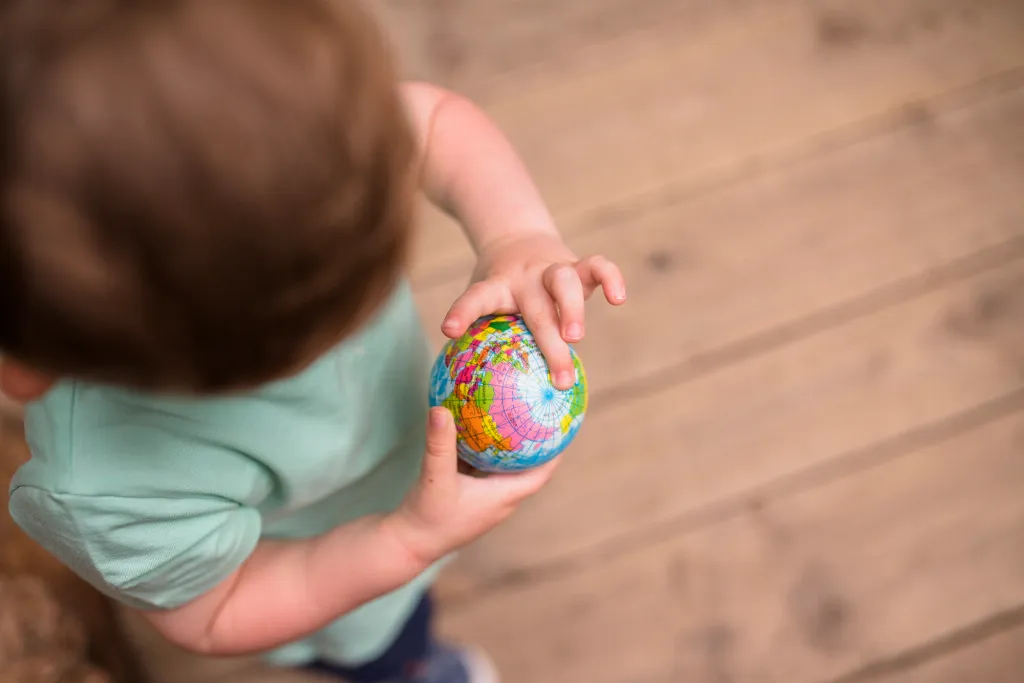
Play gives toddlers a way to explore social roles before they can explain them abstractly. A small-world neighborhood can include homes, a park, a store, a bus, people figures, animals, and familiar signs. Keep the arrangement simple enough to invite action rather than overwhelm children with detail.
Follow children’s interests and narrate without taking over: “You drove the bus to the house,” “The baby needs help,” or “The worker is carrying food.” Add vocabulary gradually—home, neighbor, help, carry, deliver, fix, safe, together. Toddlers benefit from gestures, photographs, objects, and repeated sentence patterns.
Plan short play invitations across the day:
- Morning: greet each child and locate their family photograph or home symbol.
- Small group: read a short book about one familiar helper and act out one action.
- Centers: provide props for mail delivery, cooking, caregiving, or building.
- Outdoor time: notice vehicles, signs, buildings, workers, and sounds safely.
- Closing routine: revisit one helpful action children observed or practiced.
The NAEYC social studies resources highlight curiosity, inquiry, leadership, and play as appropriate foundations for early civic learning. Even a toddler choosing who gets the next block or helping return materials is practicing participation in a group.
How can providers make these activities inclusive and culturally responsive?
Inclusive social studies begins with representation that reflects children’s actual lives and the wider community. Audit photographs, dolls, books, uniforms, tools, and dramatic-play materials. Do children see varied skin tones, family structures, languages, disabilities, occupations, ages, and ways of contributing? Avoid presenting one cultural tradition as universal or treating unfamiliar traditions as spectacles.
Ask families what names, words, celebrations, foods, and routines are meaningful to them. A home-language greeting or label can communicate that children’s identities belong in the classroom. For dual language learners, pair spoken words with gestures, real objects, photographs, and consistent repetition. Invite caregivers to contribute recordings or pictures when an in-person visit is not possible.
Use open-ended language:
- “How does your family do this?”
- “What do you notice?”
- “People may do this in different ways.”
- “Who helps in your home or neighborhood?”
Be careful with occupational stereotypes. Police officers, firefighters, doctors, and other helpers should be introduced honestly and sensitively, recognizing that children and families may have different experiences with institutions. Focus on safety, care, and asking trusted adults for help without suggesting that every uniformed person feels safe to every child. Family collaboration and respectful observation are essential.
How can directors and providers plan, assess, and avoid common mistakes?
Effective toddler social studies does not require expensive materials or elaborate theme weeks. Begin with an observation: a child points to a delivery truck, talks about a sibling, or imitates sweeping. Use that interest to plan one goal, such as naming a familiar helper, participating in a cooperative routine, or showing awareness of a place in the neighborhood.
Document learning through brief notes, photographs with permission, child dictation, and work samples. Look for observable behaviors rather than performance tests:
- Points to or names a familiar person, place, or tool.
- Uses a gesture, word, or home-language expression related to helping.
- Participates in pretend caregiving, delivery, cooking, or building.
- Joins a shared routine with adult support.
- Shows curiosity about similarities and differences.
Common pitfalls include introducing too many helpers at once, relying on worksheets, directing every moment of pretend play, and using stereotyped or inaccurate materials. Replace these with repetition, real objects, child-led exploration, and short adult modeling. Keep safety central: inspect props, avoid medication containers and sharp tools, supervise water and small objects, and follow required ratios and field-trip procedures. State requirements vary - check your state licensing agency.
Conclusion: How can toddlers begin learning about their world?
Social studies activities for toddlers should begin with the child’s immediate world: home, trusted relationships, familiar routines, and nearby places. From there, providers can introduce community helpers through photographs, songs, books, walks, dramatic play, and meaningful classroom jobs. The strongest experiences are concrete, repeated, inclusive, and connected to children’s questions.
Start this week with one simple sequence:
- Invite families to share a photograph or home-language word.
- Choose one familiar helper and one related prop.
- Read, sing, and act out one helping action.
- Observe how children participate and extend the play.
- Share the learning with families and invite their ideas.
When toddlers explore who cares for them, how homes differ, and how people contribute to a shared community, they are building early #belonging, #empathy, #community, #play, and #identity. Small experiences can create a lasting foundation for curious, connected, and capable citizens.
What courses can support continued professional learning?
- Teacher & Me Playtime Buy Now $24.00 — developmentally appropriate activities for infants and toddlers.
- Playing with a Purpose: Infant/Toddler Lesson Planning Buy Now $24.00 — practical planning for children from birth through age three.
- From Play to Planning: Building Culturally Competent, Child-Centered Curriculum Buy Now $55.00 — play-based, inclusive curriculum design.
- Coordinating with Community in Child Care Buy Now $24.00 — partnerships with families, colleagues, and community organizations.
- Building Bridges for Dual Language Learners Buy Now $25.00 — culturally and linguistically responsive support for young children and families.
Frequently asked questions
How long should a toddler social studies activity last?
Keep whole-group invitations brief—often five to ten minutes—and allow longer exploration in centers according to children’s interest and attention.
Do toddlers need to learn many job titles?
No. Prioritize meaningful connections among a person, a place, a tool, and a helping action.
How can families participate if schedules are demanding?
Offer flexible options such as photographs, translated prompts, short audio recordings, or a family contribution during arrival and pickup.
What if a child does not want to participate?
Provide observation, parallel play, and nonverbal choices. Participation should be invited, not forced.
Can social studies be integrated with other domains?
Yes. Mail play can include language and counting, house-building can include spatial reasoning, and helper songs can support movement and vocabulary.
- 45 Hour Child Growth and Development
- Positive Attention: Interactions and Supervision of Infants and Toddlers: For Workforce Solutions
- Pediatric RSV First Aid & CPR/AED
- CDA Bridge Bundle: Infant/Toddler without Portfolio Review
- 45-Hour Infant and Toddler Curriculum
- Texas Director Credential
- Montessori Cultural Activities: Exploring the World Through Play and Learning
- Building Bridges for Dual Language Learners
- CDA Certification en Español: Recursos y Consejos para Educadores Bilingües
- Cómo Abrir Una Quardería En Casa Sin Dinero?
- ¿Cuáles son los pasos, requisitos y opciones en línea para la certificación de 90 horas en cuidado de Infantes/Toddlers en Maryland?
- Actividades de Fiesta para Niños de Preescolar y Primaria
- Cómo Iniciar el Proceso de Obtención de la Licencia de Cuidado Infantil
- Cómo Empezar una Guardería en Casa: Requisitos y Pasos
- ¿Cómo solicito la licencia para una guardería en California?
- Proporciones de Cuidado Infantil y Tamaños de Grupo por Edad en Nueva Jersey (Guía Rápida para Centros y Hogares)
- Proporciones de Cuidado Infantil y Tamaños de Grupo por Edad en Virginia (Guía Rápida para Centros y Hogares)
- Lista para Guardería en Casa en Illinois: Cómo Iniciar una Guardería en el Hogar
- Lista para Guardería en Casa en Texas: Cómo Iniciar una Guardería en el Hogar
- Temas y Actividades para el Día Nacional del Kindergarten para Proveedores
- Las Mejores Ideas de Excursiones para Guarderías en Georgia
- Memorial Day Activities for Kids: Simple Ways to Honor the Day
- How can rainy day indoor activities help preschoolers learn kindness and cooperation in Georgia?
- How can we teach community and country to young children in simple, respectful ways?
- How Can We Teach Young Children About Community Helpers and Work?
- Proporciones para guarderías en casa bajo el Título 22: Cómo la mezcla de edades cambia su capacidad en California
- Social Studies Activities for Toddlers: Start With Home, Helpers, and Their Little World
