What do children notice when they color 2, 4, 6, 8, 10... on a hundreds chart? Visual patterns can make skip counting easier to see, understand, and remember. In this article, we’ll explore how educators can use patterns to teach counting by twos with support from No Such Thing as Boring Math  Buy Now $24.00 and the Color the Multiples of 2: Hundreds Chart Coloring Activity Buy Now $1.49.
Why do visual patterns make counting by twos easier to understand?
Counting by twos is an early form of repeated addition: 2, 4, 6, 8, and 10 represent one additional group of two each time. Children may memorize this sequence before they understand its quantity, so visual patterns help connect spoken numbers to structure. When children notice that every other number is highlighted, or that objects are arranged in pairs, they begin to see why the sequence works.
This matters because early mathematics is broader than reciting numbers. Research-informed early childhood practice emphasizes representation, comparison, patterning, and reasoning as foundations for later operations. The ChildCareEd article Making Math Count similarly highlights the value of intentional instruction that develops patterning and informal problem solving.
Visual patterns also make children’s thinking visible. A child who points to 2, 4, 6, and 8 on a chart is demonstrating a different kind of understanding from a child who recites the sequence without connecting it to quantities. Both need encouragement, but the second child benefits from returning to concrete pairs and visual models.
- Pair objects before introducing written numerals.
- Use color, spacing, movement, and sound to emphasize the repeating structure.
- Invite children to explain what they notice rather than supplying every answer.
How can providers begin with concrete pairs?
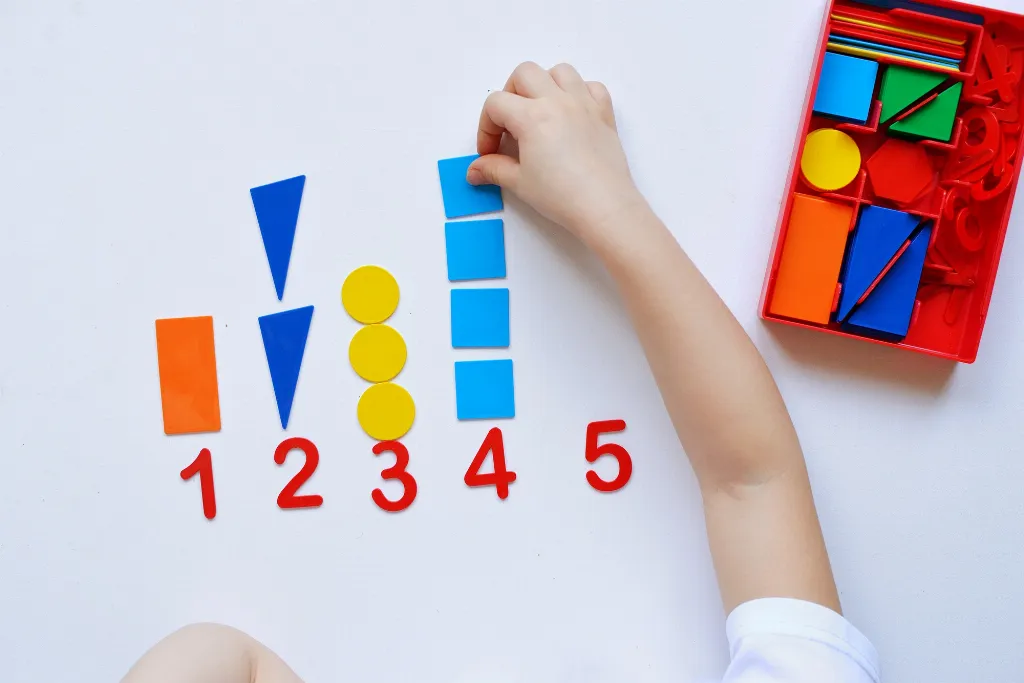
Begin with familiar objects that naturally occur in twos: socks, shoes, mittens, eyes, hands, wheels, or toy animals with two legs. Place two objects together and say, “This is one pair—two.” Add another pair and ask, “How many now?” Guide children to count 2, 4, 6, and so on while touching each pair.
A simple “pairing tray” works well in a small group. Provide baskets of large, safe manipulatives and invite children to sort them into pairs. Some children may initially count every object by ones. Validate that strategy, then model how pairing can make counting more efficient: “You counted each one. I see two in this group, so I can say two. There are three groups of two: 2, 4, 6.”
Be attentive to developmental readiness and safety. Use materials large enough to reduce choking risk, supervise closely, and adapt the activity for children with motor, visual, or language differences. For younger children, the goal may be noticing sameness and pairing rather than reaching a specific sequence.
Everyday routines offer authentic practice. During laundry sorting, children can match socks; during cleanup, they can find pairs of blocks; outdoors, they can count wheels on bicycles or legs on selected toys. These brief interactions align with the idea that number sense grows through repeated, playful experiences in ordinary routines, as described in everyday play and number sense.
Which visual tools best show the pattern?
A hundred chart, floor number line, ten-frame, or teacher-created card strip can make the pattern visible. On a number chart, highlight 2, 4, 6, 8, 10, and continue through 20. Use one color for the target numbers and a neutral color for the numbers children skip. Ask, “What do you notice about the highlighted numbers?” Children may observe that the highlighted numbers alternate with unhighlighted numbers or that the ones digits repeat in the order 2, 4, 6, 8, 0.
The 100 and 120 number charts Buy Now $0.00 resource can support this work with filled and blank charts. A blank chart is especially useful because children can color the pattern themselves, trace it with a finger, and compare their work with a partner.
- 🔢 Chart path: Have children trace from 0 to 2, 4, 6, and 8.
- Number-line jumps: Place a counter at 0 and move it two spaces at a time.
- Pattern cards: Arrange 2, 4, 6, 8 in order, then remove one card for children to replace.
- Ten-frame pairs: Fill two spaces at a time and say the running total.
Visual supports should remain flexible rather than becoming worksheets in disguise. Invite children to use crayons, counters, body movements, or magnetic numbers. If a child relies on the chart, that is not a failure; gradually reduce the support as the child develops confidence.
How can movement, music, and play reinforce the sequence?
Young children often remember mathematical relationships more readily when their bodies participate. Create a large floor number line and invite children to hop from 0 to 2, 4, 6, and 8. Emphasize that each hop has the same length: two spaces. Children can say the number when they land, clap twice before each jump, or carry a paired object from one station to the next.
Movement can also address the common confusion between counting by twos and doubling. Explain, “We are adding two each time. We are not making the number twice as big.” Demonstrate with counters: 4 becomes 6 when two counters are added, whereas doubling 4 would produce 8. Keep the explanation brief and concrete.
Songs and chants can support fluency, especially when combined with a visual display. Chant “2, 4, 6, 8” while pointing to matching cards. Pause before the next number and let children predict it. Try forward and backward sequences once forward counting is comfortable. Avoid treating speed as the primary goal; accuracy, participation, and explanation are more informative.
Play-based ideas include:
- A “pair parade” in which children carry two beanbags and add another pair at each stop.
- Hopscotch marked with even numbers, with odd numbers treated as spaces to jump over.
- A partner game where one child builds pairs and the other records the total on a card.
- A classroom search for objects that naturally come in twos.
Activities described in resources such as counting-by-twos activities similarly emphasize songs, actions, body parts, number lines, and real objects. Adapt any activity to the children’s interests and abilities rather than expecting every child to participate in the same way.
How can providers assess understanding and avoid common mistakes?
Assessment can be brief and embedded in play. Observe whether a child can make pairs, count the total by twos, identify a missing number, continue a visual pattern, and explain what changes between numbers. A child might successfully recite 2 through 20 but struggle to begin at 6 or identify the next number after 12. That information suggests a need for flexible practice rather than more repetition of the same chant.
Use prompts that reveal reasoning:
- “How many are in each group?”
- “What number comes after 8 if we add one more pair?”
- “Which number did we skip, and why?”
- “Can you show 10 in another way?”
- “How do you know this card belongs next?”
Common mistakes include introducing numerals before quantities, emphasizing speed, using too many materials at once, and correcting errors without investigating the child’s thinking. Another frequent issue is the omission of 12, which can occur because the word “twelve” does not sound like “two.” Deliberately model the transition from 10 to 12 with two added objects and invite children to say the sequence slowly.
Document one concise observation per child or small group. Note the support used and the next step—for example, “Counts pairs to 10 with counters; next, begin at 4 and continue to 16.” State requirements vary - check your state licensing agency when connecting professional development or documentation to compliance expectations.
How can directors build skip counting into an ongoing classroom plan?
Directors can support consistency by helping teachers agree on a shared progression: concrete pairs, visual representations, movement and language, then flexible problem solving. Provide common materials such as number cards, charts, counters, ten-frames, and floor tape. Short five-minute experiences several times a week are generally more sustainable than occasional extended lessons.
A simple planning cycle may include:
- Observe: Identify what children already notice about pairs and sequences.
- Plan: Choose one visual pattern and one open-ended question.
- Engage: Offer a hands-on activity during small group, centers, or routines.
- Reflect: Record children’s strategies and adjust the next experience.
Family partnerships can extend learning without assigning formal homework. Share suggestions such as matching socks, counting shoes, noticing pairs of wheels, or arranging snacks into groups of two. Invite families to use the child’s home language when discussing quantity and patterns; mathematical thinking is strengthened when children can explain ideas comfortably.
For providers seeking broader professional learning, Math Foundations in Early Childhood Buy Now $16.00 focuses on integrating hands-on math, play, exploration, and problem solving. Additional relevant options include No Such Thing as Boring Math Buy Now $24.00, Letter & Number Planning in Child Care Buy Now $24.00, and Early Mathematics Through Play Buy Now $24.00. Review each course description and confirm applicability with your state or registry before relying on it for a specific requirement.
Conclusion
Teaching skip counting by twos is most effective when children experience the pattern as a relationship between equal groups, movement, visual structure, and mathematical language. Start with concrete pairs, make even numbers visible on charts and number lines, add songs and movement, and assess understanding through flexible prompts rather than speed drills. The central question—how can providers teach skip counting by twos with visual patterns?—is answered through intentional, playful experiences that help children see why the sequence works. With brief practice woven into routines and centers, providers can nurture confident #learners, meaningful #patterns, strong #numberSense, purposeful #mathTalk, and lasting #reasoning skills.
- 45 Hour Child Growth and Development
- Early Mathematics Through Play
- CDA Home Visitor Subject Area 3 Part 3 Birth to 5
- Many Colors, One Canvas: MD ECE Conference
- 45 Hour Preschool Methods and Materials
- Power of Art: Bldg Self-Esteem & Positive Behavior for ALL Abilities
- Pediatric RSV First Aid & CPR/AED
- 45-Hour Infant and Toddler Curriculum
- Connections That Count: Building Relationships in Child Care
- Terrible Two's Can Be Terribly Fun!
- 🤯 ¿Por qué este niño está teniendo un comportamiento difícil de repente?
- What Preschool Math Skills Should I Teach and When?
- Ejemplos de Crianza Respetuosa vs. Crianza Permisiva
- Por Qué la Supervisión Activa Es Clave para la Seguridad en el Cuidado Infantil
- Retraso del Habla en la Guardería: Cómo Pueden Ayudar los Proveedores
- How can I turn viral crafts into real learning activities?
- Pumpkin Math Without the Worksheets: Hands-On Pre-K Learning
- How Can Preschool Math Become Meaningful, Playful, and Part of Every Day?
- How Can Task Cards Make Independent Center Time Run Smoothly?
- How Do Clip Cards Build Fine Motor Strength and Focus?
- How Can You Create Easy Preschool Math Centers with Print, Prep, and Start Learning?
- What Makes Task Cards a Great Tool for Mixed-Age Classrooms?
- How Can Clip Cards Build Focus and Fine Motor Skills?
- How Can Early Math Activities Build Young Children’s Mathematical Thinking?
- How Does Counting Shapes Build Early Number Sense Through Play?
- How Can Child Care Providers Integrate Counting into Seasonal Art Activities?
- How Can You Use a Hundreds Chart Beyond Rote Counting?
- ¿Cómo puede la retroalimentación visual apoyar la fluidez en la multiplicación?
- Teaching Syllables Through Play: What Should Preschoolers Notice?
