A hundreds chart can be much more than a place to practice saying numbers in order—it can help children notice patterns, compare quantities, and explain how numbers work. Explore playful ways to make the chart a tool for investigation, and consider No Such Thing as Boring Math  Buy Now $24.00 to deepen your approach to play-based math and classroom activity planning.
Why look beyond rote counting?
Reciting numbers is a meaningful beginning, but it does not always show that a child understands relationships among numbers. A child may count to 100 from memory while still needing help to identify which number is greater, predict what comes next, or explain why the pattern changes at the end of a row. A hundreds chart makes those relationships visible: numbers occupy connected positions, and movement across the grid can represent a change in quantity.
Used thoughtfully, the chart supports number sense, reasoning, language, and persistence. The goal is not to replace familiar counting songs or routines, but to extend them with prompts such as “What do you notice?” and “How could you check?” Children can point, move counters, draw, talk, or write, giving providers several ways to observe their thinking.
For a ready-to-use option, the Hundreds Chart Worksheet Buy Now $2.49 resource includes leveled missing-number pages, skip-counting practice, a reference chart, and a blank chart. Use it as one flexible material among many—not as a substitute for conversation and hands-on exploration.
How can a chart help children discover patterns?
Patterns are among the most useful features of a hundreds chart. In a standard 1–100 layout, numbers generally increase by one as children move right and by ten as they move down. Rather than explaining these rules all at once, invite children to find and describe them. Ask what stays the same in a column, what changes across a row, and what they predict will appear in an empty square.
- Give children counters or reusable markers and invite them to cover every other number. Ask what the marked spaces have in common.
- Color numbers ending in 0 or 5, then look together for a visible skip-counting pattern.
- Cover one number and ask children to use nearby numbers as clues to identify it.
- Try a “notice, predict, explain” routine: children describe a pattern, guess what comes next, and share their evidence.
Keep the emphasis on explanation rather than speed. Children may notice different features, and their observations give you a starting point for further questions. For example, if a child sees that the last digit repeats in a column, invite them to test that idea further down the chart. These small investigations encourage #reasoning and help children see numbers as connected rather than isolated symbols.
How can children use the chart to explore more and less?
A hundreds chart can act as a visual map for comparing numbers and exploring changes in quantity. Choose a number and ask children to find its “neighbors”—the numbers beside it and the numbers above and below it. In a conventional chart, moving one space horizontally usually changes the number by one, while moving one space vertically changes it by ten. Children can test those relationships with a finger, counter, or number card.
- Pick a number and ask, “What is one more? What is one less?” Invite children to show how they found each answer.
- Ask for ten more or ten less and let children move vertically to investigate.
- Compare two numbers by locating both on the chart: “Which is greater? What clues helped you decide?”
- Give a mystery-number clue, such as “I am in the 40s and have a 6 in the ones place.”
Children may use counting, position, or remembered patterns to solve these tasks. Encourage them to share their strategy without suggesting that there is only one acceptable way to think. If the row transition from 29 to 30 is confusing, pause and model what happens when one more is added. The chart can make that transition visible, while counters or a number line offer another representation. These activities build flexible #number-sense and give educators useful insight into each child’s developing understanding.
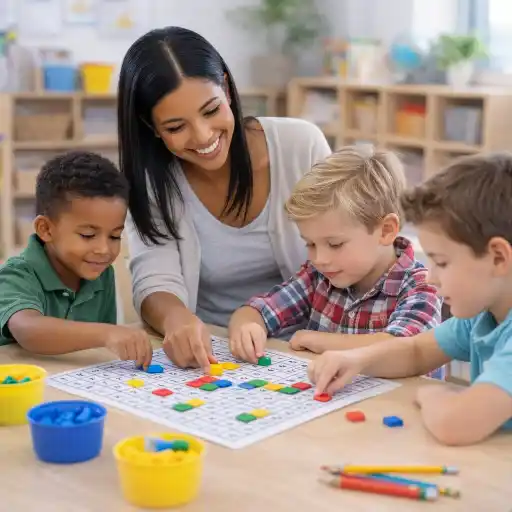
How can skip counting become a visual investigation?
Skip counting is more meaningful when children can see and represent the equal jumps—not just repeat a memorized sequence. On a chart, children can mark multiples of two, five, or ten and observe where the numbers appear. Pair this visual work with objects, movement, and conversation so children connect numerals to quantity. For example, make groups of five counters, count each group, and then locate those totals on the chart.
- Mark every second number and ask children what they notice about the pattern.
- Find numbers ending in 0 and count by tens while moving down the relevant column.
- Build equal groups of five, then predict where each total will appear.
- 💡 Invite children to trace a skip-counting route on a floor chart, stepping or pointing to each marked number.
As children work, ask “How much did we add each time?” or “Can you start at a different number and continue?” These questions help distinguish understanding of a relationship from simple recitation. For developing learners, keep the range small and use objects they can move. Children ready for a challenge might count backward, begin at a nonzero number, or compare two marked patterns. A chart is especially useful when children can touch, cover, or change it as they test an idea. The aim is active #exploration, not a colorful page completed without discussion.
How can the chart become a game or a problem-solving tool?
Games give children a reason to revisit a chart, practice mathematical language, and make decisions with peers. They also let educators observe how children approach a problem without turning every interaction into a formal assessment. Keep the rules simple, the materials accessible, and the focus on thinking together rather than winning quickly.
- Mystery number: Give clues about a number’s row, column, or neighbors. Children locate it and explain which clue helped most.
- Chart detective: Cover a small group of numbers with sticky notes. Partners use the visible sequence to uncover the missing values.
- Build the chart: Cut a copy into sections and invite children to reassemble it using number order and neighboring clues.
- Move toward a goal: Start a marker on a number and take turns moving one or ten spaces. Ask players to name the new number and describe the move.
Adjust the challenge to children’s current experience. One child might match number cards to visible squares, while another might solve a riddle involving ten more or a missing number. Invite children to create clues for a peer; making a clue requires them to consider what information is useful. If a child makes an error, ask them to retrace their path and check nearby numbers rather than immediately giving the answer. This supports #problem-solving and keeps the chart a shared tool for inquiry.
How can providers adapt, assess, and extend chart activities?
In a mixed-age child care group, children may be working on very different goals. Some are learning to recognize numerals, others are filling gaps in a sequence, and some are ready to investigate place value or mental addition. Differentiation means offering an appropriate entry point while preserving the opportunity to think, talk, and participate.
- For children learning early number order, work with a section such as 1–20 and use large, clear cards.
- For children ready to extend a sequence, remove selected numbers or ask them to count by a chosen interval.
- Offer oral responses, pointing, tactile markers, partner support, or adapted writing tools as needed.
- Document the strategy: for example, “Used the number above to identify ten less” is more informative than “completed the chart.”
Avoid treating accuracy on one page as proof of broad understanding. Change the starting number, use a different material, or ask the child to explain the same relationship in another way. Avoid rushing children or correcting without first listening to their reasoning. Keep charts, counters, number cards, and dry-erase tools available so children can return to their investigations. For another hands-on perspective, explore how Montessori math can foster joyful engagement with numbers in early childhood. Early Mathematics Through Play Buy Now $24.00 offers further professional learning about number sense, patterns, reasoning, and practical math experiences across routines and play. Math Foundations in Early Childhood Buy Now $16.00 also focuses on hands-on approaches for making math engaging and accessible. State requirements vary - check your state licensing agency when connecting training or documentation to local expectations.
Conclusion: What can a hundreds chart teach beyond counting?
A hundreds chart can help children see number relationships, find and explain patterns, compare quantities, explore one more or ten more, and use skip counting in a visual way. It can also become a flexible game board for riddles, partner challenges, and shared problem-solving. Across all these uses, the chart works best when children actively move, mark, discuss, and test ideas rather than simply recite or copy.
Start with one question that invites children to notice something: “What do you see in this column?” or “How could we find the missing number?” Listen for their strategies, provide a helpful next step, and revisit the idea through play and routines. That approach turns a familiar classroom resource into an accessible tool for curiosity, confidence, and growing #mathematics understanding.
- 45 Hour Child Growth and Development
- Early Mathematics Through Play
- CDA Home Visitor Subject Area 3 Part 3 Birth to 5
- 45 Hour Preschool Methods and Materials
- Children at the Wheel: Emergent Curriculum
- Pediatric RSV First Aid & CPR/AED
- 45 Hour School Age Methods and Materials
- Connections That Count: Building Relationships in Child Care
- Texas Director Credential
- ❤️ ¿Cómo ayudan los educadores a las familias a acceder a los servicios que necesitan?
- 💛🧩 ¿Cómo puedo hacer que mi enseñanza sea inclusiva para los niños con autismo?
- Recursos en Español sobre el Sueño Seguro del Bebé
- ¿Cómo puedo enseñar habilidades de primeros auxilios con escenarios de juego de roles?
- 10 Ejemplos de Cómo la Cultura Influye en el Desarrollo Infantil
- Cómo Empezar una Guardería en Casa: Requisitos y Pasos
- Proporciones de Cuidado Infantil y Tamaños de Grupo por Edad en Maryland (Guía Rápida para Centros y Hogares)
- Proporciones de Cuidado Infantil y Tamaños de Grupo por Edad en Nueva Jersey (Guía Rápida para Centros y Hogares)
- Proporciones de Cuidado Infantil y Tamaños de Grupo por Edad en Virginia (Guía Rápida para Centros y Hogares)
- Actividades de Otoño Fáciles para Preescolares esta Temporada
- Por Qué la Supervisión Activa Es Clave para la Seguridad en el Cuidado Infantil
- Cómo Trabajar en el Cuidado Infantil en Carolina del Norte: Requisitos y Pasos
- Celebrando la amistad en el cuidado infantil durante el Día de los Mejores Amigos
- Canciones, juegos y preguntas de círculo para niños
- Cómo simplificar la capacitación para sus empleados de daycare
- Cómo Planificar Actividades al Aire Libre Seguras Durante el Calor y la Mala Calidad del Aire
- Teaching Math to Young Children: Why Counting to 20 Doesn’t Mean They Understand 20
- How Can Child Care Providers Build One-to-One Correspondence with Small Objects?
- How Can Child Care Providers Integrate Counting into Seasonal Art Activities?
- How Can You Use a Hundreds Chart Beyond Rote Counting?
