A child who confidently says “2, 4, 6, 8” may still pause when asked to count by sixes—and that difference can tell you more than whether the sequence was memorized. Build more responsive math experiences with Supporting School Age Development ONLINE  Buy Now $24.00, a three-hour course on developmentally appropriate instruction and adapting learning for individual needs. For practical, ready-to-use sequence practice, Task Cards - Skip Counting Buy Now $2.49 offers missing-number problems involving 2s, 5s, and 10s; use it alongside observation and hands-on teaching to help children make sense of number patterns.
Why is counting by twos often easier than counting by sixes?
Skip counting means moving through numbers by a consistent interval: 2, 4, 6, 8 adds two each time; 6, 12, 18, 24 adds six. A child may learn the first sequence early because pairs are easy to model with familiar objects—shoes, mittens, or two counters at a time—and because the pattern appears often in songs and classroom activities. Counting by sixes is less commonly rehearsed and requires holding a larger jump in mind.
There is also a difference between recalling a familiar verbal sequence and applying a rule. A child may recite “2, 4, 6” from memory without connecting each word to two more objects. Starting at six and adding six repeatedly may require the child to understand equal groups, the size of the interval, and how the next total relates to the previous one. These capacities develop together, but not always at the same pace. Research on early number sense describes interconnected knowledge of number, number relations, and operations, with meaningful individual variation among children.
So, success with twos and difficulty with sixes does not by itself indicate a problem. It gives educators a useful starting point: find out whether the child understands the pattern, can represent it, and can transfer the idea to a less familiar interval.
What building blocks support skip-counting development?
Skip counting draws on several foundations. Children need a stable counting sequence, one-to-one correspondence when counting objects, and cardinality—the understanding that the last number said tells how many are in the set. They also benefit from seeing quantities as groups, rather than treating every object as an isolated item. For example, a child who sees three groups of two can count 2, 4, 6 instead of counting all six objects individually.
Concrete experiences help connect number words, quantities, and written numerals. Arrange counters in equal groups, make jumps on a floor number line, and record the resulting sequence.
- Begin with objects and groups the child can touch and rearrange.
- Link each group to a spoken total and then to its numeral.
- Use questions such as “How many did we add?” and “How do you know what comes next?”
- Move from familiar intervals toward less familiar ones without expecting every sequence to develop at the same rate.
These foundations help a child interpret skip counting as a consistent change in quantity, not merely a chant to repeat.
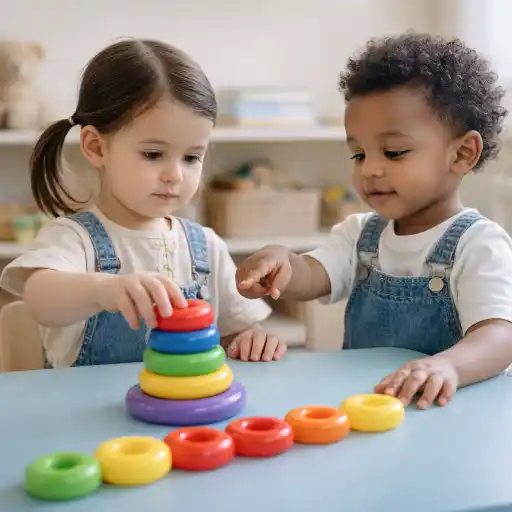
What might difficulty with number patterns look like?
Notice how a child approaches a sequence across different formats and days. A child may recite a familiar sequence but lose the pattern when asked to start at a different number, fill in a missing term, count backward, or continue past a decade boundary. For example, a child might say 6, 12, 18 when starting at zero, but be unsure what follows 14 when counting by sixes. Such responses can suggest that the child relies on a memorized sequence rather than a flexible understanding of the interval.
Look for patterns in performance, not a single mistake. Ask the child to build equal groups, point to each jump on a number line, or explain what is added between terms. Compare responses when the child sees objects, hears number words, and reads numerals. A child may understand the quantity but need help connecting it to symbols—or may recite the symbols without grasping the quantity. Research on number-sense development emphasizes that representations and set size affect how children demonstrate their understanding.
- Can the child identify the interval between successive numbers?
- Can they continue a sequence after a missing number?
- Can they begin from a nonzero starting point?
- Does the child use a visual or concrete strategy, or depend only on recitation?
Document what you observed and what support was offered. These notes make it easier to plan a helpful next step without labeling a child on the basis of one challenging task.
How can educators teach less familiar intervals like sixes?
Start with equal groups and make each jump visible. Build groups of six counters, count the total after each group, and record 6, 12, 18, 24. Then show those totals on a number line or hundreds chart. Children can step, clap, or move a marker forward by six spaces, connecting the spoken sequence to a consistent action. Visuals and movement are not just ways to make practice entertaining; they offer additional routes for noticing and representing the rule.
Gradually reduce the support. First model the sequence while children point to each group. Next, pause before a total so children can predict it. Then cover one number or ask them to start at 12 and continue by sixes. If they get stuck, return to a concrete model and ask what changed from the previous total. Avoid asking for speed as the main measure; accuracy and explanation reveal more about understanding.
- Use counters, linking cubes, or another safe classroom material to make groups of six.
- Mark multiples on a number line or chart and trace the same-sized jumps.
- Connect a sequence to a meaningful context, such as six items in each group.
- Use Task Cards - Skip Counting Buy Now $2.49 for missing-number practice with 2s, 5s, and 10s, then create or adapt similar prompts for sixes.
Task cards are a practice resource, not a diagnostic by themselves. Pair them with discussion, manipulatives, and observations of how a child reasons.
How can providers decide whether a child needs additional support?
Use brief, low-pressure observations to identify what the child can do independently and what helps. Offer a small set of tasks: count groups of objects by a familiar interval, continue a sequence from a nonzero number, identify a missing term, and show the pattern with objects or movement. Note whether the child understands the equal jump, loses the count, confuses the numeral names, or becomes uncertain at a place-value transition.
Consider the full learning context. Has the child had varied opportunities to practise? Are directions clear and accessible? Does the child respond differently when materials, language, or visual supports change? A practical record might say, “Counts groups of two to 12 with counters; for groups of six, accurately builds totals but needs prompts to name each total.” This points to a next step more clearly than “struggles with skip counting.”
If a difficulty persists across activities, settings, and representations, share specific observations with the appropriate school team or family, following program procedures. Child care providers can observe, document, adapt instruction, and communicate; they should not diagnose a learning disability. State requirements vary - check your state licensing agency when connecting documentation or professional development to local expectations.
For a broader look at responsive school-age instruction and adapting activities to individual needs, providers can explore Supporting School Age Development ONLINE Buy Now $24.00. The course focuses on developmentally appropriate practice, learning-environment adjustments, and positive guidance—useful foundations for thoughtful observation and planning.
Conclusion: What does it mean when a child can count by twos but not by sixes?
It often means the child has learned a familiar sequence but is still developing the flexible number sense needed to apply a larger, less-practised interval. Counting by twos may be supported by visible pairs and repeated classroom exposure; counting by sixes asks the child to coordinate equal groups, number relationships, and a larger step. One uneven skill profile is not a diagnosis, but it can guide intentional teaching.
Start with concrete groups, show the pattern visually, invite the child to predict and explain, and observe performance across different starting points and representations. Use practice tools such as skip-counting task cards as one element of a broader approach, and record the strategies and supports that help. The central question is not simply whether a child can recite the sequence, but whether they can understand, represent, and use the number pattern.
- 45 Hour Child Growth and Development
- 45-Hour School Age Curriculum
- 45 Hour Preschool Methods and Materials
- CDA Family Child Care Credential with Portfolio Review
- 45 Hour Infant and Toddler Methods and Materials
- 45 Hour School Age Methods and Materials
- 45-Hour Infant and Toddler Curriculum
- Texas Director Credential
- Estudio de caso de TDAH
- 🥦✨ ¿Cómo apoyar a los niños selectivos a probar nuevos alimentos sin presión?
- 🍑 ¿Qué capacitación requiere DECAL cada año para el personal de cuidado infantil en Georgia?
- 🚨 Reporte Obligatorio en Nevada
- Adequate Supervision in Childcare: Strategies That Keep Kids Safe
- What should be on a playground safety checklist for child care centers?
- Apoyo en Español para Capacitaciones Grupales Presenciales y por Zoom en Cursos Selectos
- Texas Daycare Rules Providers Should Know: A Simple Guide
- ¿Cuáles son las mejores actividades del Día de la Tierra para niños en casa o en el aula?
- 10 Ejemplos de Cómo la Cultura Influye en el Desarrollo Infantil
- Why Active Supervision Is One of the Most Important Safety Practices in Child Care
- Por Qué la Supervisión Activa Es Clave para la Seguridad en el Cuidado Infantil
- Cómo Trabajar en el Cuidado Infantil en Georgia: Requisitos y Pasos
- Celebrando la amistad en el cuidado infantil durante el Día de los Mejores Amigos
- Cómo simplificar la capacitación para sus empleados de daycare
- Teaching Math to Young Children: Why Counting to 20 Doesn’t Mean They Understand 20
- How Can You Teach Numbers to Ten with Ten-Frames and Visual Models?
- How Can Concrete Models Help Children Understand Subtraction Before Worksheets?
- How Can You Use a Hundreds Chart Beyond Rote Counting?
- Why Can a Child Skip Count from Two but Not from Six?
