What if a pot of pretend autumn soup could spark rich conversations, meaningful math, and teamwork—all in one classroom center? Set up a seasonal café with menus, recipe boards, and order slips, and explore the Math Foundations in Early Childhood course  Buy Now $16.00 to build practical strategies for weaving counting and problem-solving into play. The ideas below can help you make the center inviting, purposeful, and child-led.
Why does a pretend soup kitchen make learning feel meaningful?
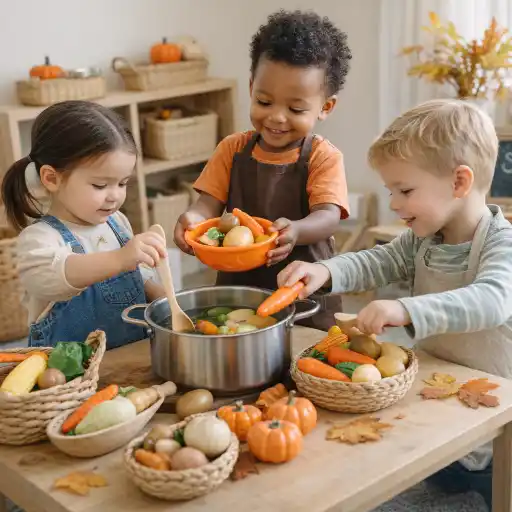
A pretend soup café gives children a familiar story to shape together: customers choose a dish, servers record orders, and chefs prepare a recipe. As children move through these roles, they practice communicating, planning, and solving small problems. Play creates a low-pressure setting for trying out ideas, making choices, and learning from peers.
It also brings academic concepts into an authentic context. A menu gives print a purpose, an order slip invites marks and numerals, and a recipe board provides a reason to count, compare, and talk about sequence. PBS SoCal’s guide to practicing math through restaurant play describes how educators can naturally introduce number sense, sorting, and sequencing while children pretend.
For providers and directors, the center offers a practical way to connect multiple developmental domains without turning play into a worksheet activity. The seasonal theme can invite curiosity about fall foods, colors, and community traditions, while the children remain the authors of the café’s story.
- Children count ingredients and connect quantities to numerals.
- They use language and early writing to order, prepare, and serve.
- They practice #cooperation by sharing roles and solving disagreements.
- They build confidence as their ideas become part of a shared #classroom experience.
How can you set up a welcoming autumn soup café?
Start with a compact, clearly organized space. A table can serve as the café counter, while a nearby shelf or play kitchen becomes the preparation area. You do not need elaborate props: bowls, spoons, a pot, play food, fabric leaves, baskets, paper, and crayons can carry the scenario. Use clean, safe materials already available in your program, and include picture cues so children who are not yet reading can use the materials independently.
Feature the Autumn Soup Café Menus, Recipe Boards, and Order Slips as the center’s functional print. Put menus where customers can reach them, place the recipe board near the pretend kitchen, and keep order slips and writing tools beside the counter. These materials are most useful when children can alter them: invite them to draw a new soup, add a symbol, or decide what the café should call its daily special.
- Display an “Open” sign, menus, and a simple seating area.
- Offer order slips with space for a picture, tally mark, or numeral.
- Make recipe cards with a few ingredients and visual quantity cues.
- Use labels or picture outlines to support independent cleanup.
- Include pretend ingredients such as fabric vegetables, large blocks, or play dough.
Children’s home experiences can inspire the theme. Invite families to share optional food words or soup ideas, and represent the group’s languages and traditions respectfully. NAEYC’s example of culturally rich dramatic play shows how listening to children’s and families’ everyday experiences can help educators build relevant, language-rich centers.
Which math ideas fit naturally into soup-making play?
Let the café’s story provide the reason for the math. When a chef reads a recipe calling for three pretend carrots, children can count them into a pot, touch each item once, and check whether the quantity matches the numeral or dots on the recipe board. If a customer orders two bowls, the server can prepare two place settings and confirm the count.
Counting is only one possible focus. Children can sort ingredients by type or color, compare which group has more, and use words such as same, fewer, larger, or smaller. They might make a repeating pattern with pretend vegetables or tally which soup customers choose most often. These experiences are especially valuable when adults invite children to explain their thinking rather than expecting one predetermined answer.
- Count ingredients into a pot, one item for each number word.
- Match a numeral or dot card to the number of bowls ordered.
- Compare ingredient groups: “Which has more? How can we check?”
- Make an ingredient pattern, such as carrot-potato-carrot-potato.
- Use a tally to record the café’s most popular pretend soup.
Keep quantities manageable and adjust the challenge to children’s current understanding. Some may count one-to-one with a few objects; others may combine two small groups or create their own pattern. For a deeper professional learning experience focused on counting, number sense, patterns, and other early math concepts, explore ChildCareEd’s Math Foundations in Early Childhood Buy Now $16.00.
How can recipe boards and order slips support literacy and sequencing?
Functional print helps children see that marks and words communicate information. A child might draw a bowl on an order slip, make a mark for each ingredient, copy a familiar word, or dictate an order to a peer. Each of these ways of participating can contribute to the play, even if children are not yet writing conventional letters or numerals.
Recipe boards also provide a natural context for sequencing. Use simple phrases such as “first,” “next,” and “last” while children act out the recipe: first choose ingredients, next count them into the pot, and last serve the soup. Model the words during play and then pause for children to contribute. Avoid turning each step into a quiz; a conversational prompt like “What should we do next?” can keep the story moving while inviting language.
- Invite children to draw or dictate a new soup recipe.
- Use picture cards to show ingredients and steps in order.
- Have the server mark each item ordered with a drawing, tally, or numeral.
- Encourage chefs to describe what they are adding and what comes afterward.
- Offer key vocabulary in children’s home languages where possible.
These materials can be adapted for different communication and motor needs. Children may point, use picture choices, dictate, gesture, or work with larger writing tools. The focus is meaningful participation: each child should have a way to help the café communicate its orders and recipes.
What teaching moves help children cooperate without taking over?
Cooperation develops through practice, and dramatic play gives children a shared purpose. They may need to decide who will be the chef, how many customers can sit at the table, or what to do when two people want the same role. Rather than settling every disagreement for them, help children hear each other and consider possible solutions. Offer role cards or rotate roles when helpful, while respecting a child’s choice to observe or take part in a quieter way.
Join the play briefly when a small contribution could extend it, then step back. You might say, “The order slip says two bowls. How can we make sure both customers get one?” or “The café is out of spoons. What could we use instead?” These prompts connect number thinking with shared problem-solving, but leave the children in charge of the scenario.
- Model courteous phrases such as “May I have a turn?” and “What do you think?”
- Offer flexible roles: chef, customer, server, menu maker, or kitchen helper.
- Notice and name helpful actions: “You waited while your friend finished writing.”
- Give children time to negotiate before stepping in to resolve a minor conflict.
- 🧡 Celebrate teamwork and inventive solutions, not only a finished pretend meal.
Watch for ways to extend participation: a child can sort ingredients or point to a menu picture without taking a speaking role. Educators can support #language by narrating actions, introducing a useful word, or echoing a child’s idea in a fuller sentence. Brief, responsive interactions often keep the play lively without shifting control to the adult.
How can you adapt the center and avoid common pitfalls?
Keep the center safe, accessible, and flexible. Choose props appropriate to the children’s ages and abilities, check materials regularly, and maintain clear paths for movement. Avoid real food unless your program’s policies, family information, and food-safety practices support its use. If real produce or scented items are considered, check relevant allergy and sensory needs first. State requirements vary - check your state licensing agency.
One common pitfall is over-scripting the play: assigning fixed roles, requiring children to follow an exact recipe, or correcting every number and word can drain the joy from the experience. Another is providing so many props that children cannot find or restore materials. Start with a small set, observe how children use it, and add items in response to their interests.
- Offer pictures, gestures, and multiple ways to communicate an order.
- Use large, sturdy items when small parts pose a choking concern.
- Provide alternative roles for children who prefer less verbal or sensory-intensive play.
- Observe before intervening; add a question, prop, or word only when it may help.
- Keep the theme open to family food traditions and children’s own ideas.
After play, make a brief note about what children tried: for example, “Two children counted four felt vegetables into the pot and checked the recipe picture together.” Such documentation can help staff plan a manageable next step, such as adding a new tally chart or inviting children to make recipe illustrations.
Conclusion: How does a pretend soup kitchen bring play and learning together?
A pretend fall soup café brings dramatic play, counting, language, and cooperation into a shared experience that children can shape. Menus, recipe boards, and order slips give children meaningful reasons to use print, represent quantities, sequence actions, and work through decisions with peers. The strongest setup is not the most elaborate one; it is an inviting, safe space with flexible materials and an attentive adult who knows when to join and when to let children lead.
Begin with a few props, introduce a simple recipe, and watch what the children do with it. Extend their thinking through gentle math talk, inclusive materials, and opportunities to share roles. To deepen your own early math practice, consider the relevant ChildCareEd course Math Foundations in Early Childhood Buy Now $16.00, which focuses on making math engaging and accessible through hands-on learning.
- Early Mathematics Through Play
- 45 Hour Preschool Methods and Materials
- No Such Thing as Boring Math
- Math Foundations in Early Childhood
- Connections That Count: Building Relationships in Child Care
- Texas Director Credential
- Montessori Cultural Activities: Exploring the World Through Play and Learning
- Environments That Inspire Independence and Exploration
- CDA Certification en Español: Recursos y Consejos para Educadores Bilingües
- Recursos en Español sobre el Sueño Seguro del Bebé
- Cómo ser director de cuidado infantil en Maryland
- ¿Cómo puedo usar escenarios de juego de roles de primeros auxilios en mi aula?
- Actividades de Motricidad Gruesa que Desarrollan el Equilibrio, la Coordinación y la Fuerza
- 10 Ejemplos de Cómo la Cultura Influye en el Desarrollo Infantil
- Capacitación en Salud y Seguridad Preventiva en Línea para Proveedores de Cuidado Infantil
- Proporciones de Cuidado Infantil y Tamaños de Grupo por Edad en Maryland (Guía Rápida para Centros y Hogares)
- Proporciones de Cuidado Infantil y Tamaños de Grupo por Edad en Wisconsin (Guía Rápida para Centros y Hogares)
- Proporciones de Cuidado Infantil y Tamaños de Grupo por Edad en Nueva Jersey (Guía Rápida para Centros y Hogares)
- Proporciones de Cuidado Infantil y Tamaños de Grupo por Edad en Virginia (Guía Rápida para Centros y Hogares)
- Actividades de Otoño Fáciles para Preescolares esta Temporada
- Por Qué la Supervisión Activa Es Clave para la Seguridad en el Cuidado Infantil
- Cómo Trabajar en el Cuidado Infantil en Carolina del Norte: Requisitos y Pasos
- Celebrando la amistad en el cuidado infantil durante el Día de los Mejores Amigos
- Canciones, juegos y preguntas de círculo para niños
- Cómo simplificar la capacitación para sus empleados de daycare
- How Can Restaurant Order Tickets Give Preschool Writing a Real Audience?
- How Can You Extend Fall Dramatic Play into November Without Starting Over?
- How Can a Pretend Soup Kitchen Combine Fall Dramatic Play, Counting, and Cooperation?
