Can simple blocks change how children think about space, shapes, and numbers? If you want clear, classroom-ready strategies that strengthen early #spatialskills and prepare children for math, block play is one of the highest-return activities you already have on your shelf. For practical training that connects research to lesson-level practice, consider Math Foundations in Early Childhood  Buy Now $16.00 to add intentional math during block work, or explore play-focused scaffolds in The Best Promotion is Play Buy Now $24.00—both courses show concrete ways to document learning and strengthen teacher prompts without eliminating child agency. For a broader look at how playtime supports communication, creativity, and problem-solving across early childhood, see how learning through play builds bright minds.
How does block play build spatial thinking and why does it matter?
Research linking play with spatial development is robust. Large-scale analyses and experimental studies find that frequent play with blocks, puzzles, and construction toys correlates with stronger spatial reasoning and later gains in #math and STEM outcomes (see the Association for Psychological Science summary: Jirout & Newcombe) and meta-analyses confirm a moderate relation between spatial and mathematical skills across ages (Atit et al.). Spatial skills—mental rotation, structure copying, and magnitude representation—help children visualize problems, reason about shape and measurement, and translate real objects into symbolic math.
Why it matters: stronger spatial thinking predicts better problem solving, smoother transitions into formal math, and improved STEM readiness. Evidence also suggests block play disproportionately benefits children from lower-SES backgrounds when the play is scaffolded, making it an equity-oriented lever for early learning (Purdue study).
Practical takeaway: schedule regular, purposeful block invitations and pair them with focused language and short teacher prompts to amplify learning. State requirements vary - check your state licensing agency.
Hashtags: #blockplay #spatialskills #math #preschoolers #play
What block-play activities most reliably boost spatial skills and early math?
Not all block play is equal. Studies show that semi-structured or goal-directed block experiences—brief prompts, replication tasks, pattern challenges, and iterative design tasks—produce larger gains than unguided free play alone (Schmitt et al., Purdue; Golinkoff et al., UD). Effective activities target specific spatial skills:
- Copy-the-structure tasks (visual matching and spatial orientation).
- Pattern and symmetry challenges (repeating sequences, mirror builds).
- Measurement experiments using nonstandard units (compare tower heights using paperclips or hands).
- Design constraints: "Build a stable bridge for a toy car" to practice balancing and prediction.
- 🔧 Prompted iteration: give a single scaffold and ask children to improve stability or height over trials.
Language matters. Capture spatial and quantitative words during play—terms like over/under, rotate, mirror, taller/shorter—because combined spatial-language and block tasks predict stronger outcomes (see the Spatial and Quantitative Mathematical Language Coding System research: Simms et al.).
Practical tip: brief, repeated prompts (2–3 questions) and modeling of spatial vocabulary during play produce measurable benefits without taking control of the child’s activity.
How should teachers set up a block center and scaffold play for learning?
Designing the environment makes learning visible. A high-quality block center is predictable, resourced, and intentionally organized. Child care resources emphasize clear setup and progression—see ChildCareEd’s outcome on creating a successful block center as part of teacher planning (create a successful block center).
Key elements to include:
- Defined space with a stable surface and clear boundaries (rug, low shelf).
- Variety of blocks (unit blocks, dramatic blocks, loose parts) and simple props (cars, figurines).
- Visual invitations and a rotating set of challenge cards to encourage different goals (copy, balance, pattern).
- Brief teacher prompts and sample models placed nearby to spark ideas—then step back.
For team training that connects environment and practice, explore Teacher & Me Playtime Buy Now $24.00$19.00 (block center outcomes) and Play, Learn, Grow Buy Now $25.00 for coaching strategies. When coaching staff, use short video clips or photos to reflect on spatial talk and teacher prompts during team meetings.
Why schedule block time? Blocks invite problem-solving, negotiation, and persistent effort—skills that matter for classroom culture and learning.
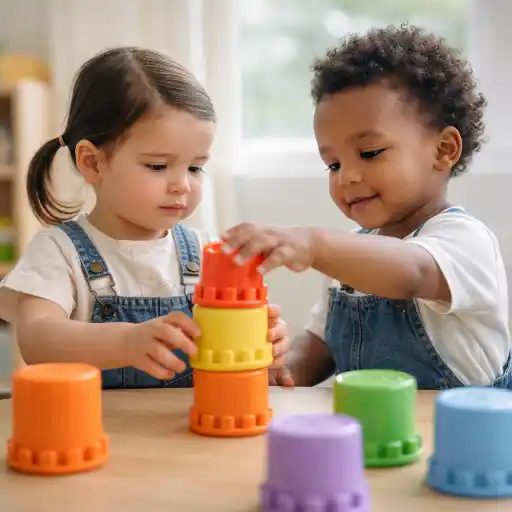
What common mistakes reduce the learning value of block play and how can providers avoid them?
Common pitfalls are easy to fix and often reduce the potential benefits of block time:
- Over-directing: adults who redesign children’s builds interrupt problem solving—fix by asking one open question and waiting.
- Too little variation: offering only one type of block or single-use toys limits spatial reasoning—rotate materials and add loose parts.
- Short, fragmented play times: brief interruptions prevent deep planning—protect longer, uninterrupted blocks of play.
- Ignoring language: failing to name spatial relations and measurement misses a teachable moment—embed 2–3 target words per week.
How to avoid pitfalls: plan invitations, set a simple learning target, and document one short observation per child. Many centers underuse small scaffolds; semi-structured prompts (e.g., "How could you make that stronger?") are low-cost but high-impact.
Why it matters: when block play is intentionally supported, it becomes a reliable strategy for narrowing gaps—especially for children with fewer home materials. For practical activity ideas that integrate blocks with STEM, see ChildCareEd’s guide on using blocks for early STEM explorations (Blocks and STEM).
How should providers assess, document, and communicate spatial learning?
Assessment should be quick, play-based, and informative for planning. Use short performance tasks (copy-a-structure, pattern-completion) and observational notes focusing on the child’s strategy, language, and tool use. Research-based tools and coding systems capture both spatial action and math language; see the Spatial and Quantitative Mathematical Language Coding System for an approach to capturing language-in-play (Simms et al.).
Suggested easy protocol (10–15 minutes):
- Set a focused task (copy a pictured build or make a bridge that holds a car).
- Record one short observation: materials chosen, spatial language used, problem-solving sequences.
- Note the next instructional step (e.g., introduce mirror symmetry vocabulary next session).
FAQ (practical):
- Q: How often should I assess block skills? A: Short, play-based checks every 4–6 weeks are sufficient for instructional planning.
- Q: Will these observations meet licensing needs? A: Brief documentation is usually acceptable—state requirements vary - check your state licensing agency.
- Q: What if a child struggles? A: Offer scaffolded tasks, pair with a peer, and increase spatial language exposure; consider targeted small groups if concerns persist.
- Q: Can families support this at home? A: Yes—share one simple take-home invitation (copy a simple structure, count blocks, talk about above/below).
Final practical resources: pair classroom practice with short professional learning (for example, No Such Thing as Boring Math Buy Now $24.00) to help teachers translate block play into measurable learning moments.
Conclusion: What should you do next?
Block play is a powerful, evidence-backed pathway to stronger spatial thinking and early #math success. Start by protecting regular block time, introduce one semi-structured prompt per session, and intentionally use spatial language. Document a single observation per child each week and use those notes to set small next-step goals.
If you want a clear next step for classroom implementation, consider enrolling in Math Foundations in Early Childhood Buy Now $16.00 or The Best Promotion is Play Buy Now $24.00 to align block practices with intentional math goals. For quick in-center team training, use Teacher & Me Playtime Buy Now $24.00$19.00, classroom coaching in Play, Learn, Grow Buy Now $25.00, or deepen your math connections with No Such Thing as Boring Math Buy Now $24.00.
Summary of takeaways: schedule purposeful block invitations, scaffold with short prompts and spatial language, document learning briefly, and use targeted professional learning to scale impact. Small changes to the block center can yield meaningful advances in children’s spatial and mathematical development.
- Spatial Awareness: How to Stop Your Kids from Walking into Walls
- CDA Certification en Español: Recursos y Consejos para Educadores Bilingües
- 10 Ejemplos de Cómo la Cultura Influye en el Desarrollo Infantil
- Celebrando la amistad en el cuidado infantil durante el Día de los Mejores Amigos
- Canciones, juegos y preguntas de círculo para niños
- How Does Guided Play Build School-Ready Skills in New York Preschoolers?
- Why Does Old‑School Play (Blocks, Mud, Cardboard) Still Win?
- How can preschool classrooms effectively support early math skills?
- What Can Child Care Providers Learn from Children's Favorite Games?
- Can Block Play Build Children's Spatial Skills?
- What Are the Benefits of Open-Ended Play Materials for Young Children?
- How Much Structured Learning Do Preschoolers Really Need?
- How Can Early Math Activities Build Young Children’s Mathematical Thinking?
- What Can Providers Learn From the Toys Children Choose Repeatedly?
- How Can Teachers Turn Everyday Play Into Learning Opportunities?
- When Does an Adult’s Help Take Over Toddler Block Play?
- What Does a Toddler Block Area Need for Real Experimentation?
- How Does Building from Another Photograph Angle Change Children’s Thinking?
- What Are Simple Ways to Build Early Math Skills During Daily Classroom Routines?
