What if the games children choose for fun could map directly to the skills you need to teach? Observing favorite #games gives child care teams a practical roadmap for building language, self-regulation, spatial thinking, and social skills—without creating new lessons. If you want a focused next step, consider The Best Promotion is Play Buy Now $35.00 or Role of Play in Learning  Buy Now $16.00 for concrete strategies and certificates you can use with staff. These courses support everyday practice—strengthening your program’s #play and #learning routines while helping staff document progress and earn training hours.
What do children’s favorite games really reveal about learning?
Children’s go-to games are rich, repeated experiments: they show what interests them, which social roles they practice, and which cognitive strategies they reuse. A block builder returns to balance, planning, and trial-and-error; a child who loves pretend stores rehearses perspective-taking and language; a group that chooses tag is practicing rules, impulse control, and gross-motor planning. Treating these preferences as data (rather than just play choices) helps you identify targets for growth, prioritize materials, and set short-term goals.
Why it matters: favorite games predict which skills will develop faster if you scaffold them. Observing patterns across days gives you natural learning targets and avoids one-size-fits-all lessons. Use quick notes, photos, or a two-sentence observation to capture what a child does during play; these entries become evidence for planning. For research on play and thinking, see Play-Based Learning and Cognitive Growth as part of practical evidence you can apply.
Practical tip: use one observation per child each week to convert play patterns into a 1-week goal. This makes your #children’s interests the engine of instruction.
How can providers turn favorite games into intentional learning opportunities?
Turning play into planned learning doesn’t mean stopping play—it's about adding small, focused moves that increase the learning yield of a favorite game. Start by naming the skill you see ("You’re building taller towers—great planning!") and then layering one small prompt: add vocabulary, pose a prediction question, or introduce a counting twist. Use the child’s chosen materials so the activity stays joyful and self-driven.
Design a micro-plan: 1) Identify the game and the observable skill; 2) Choose a 1–2 minute scaffold (model, add a prop, or ask an open question); 3) Offer a simple adaptation for a peer to join. Keep these micro-plans visible on a pocket chart or staff whiteboard so substitutes and aides can use them too.
- 🎲 Use quick prompts: add a counting challenge to block play or a new role in dramatic play.
- Make materials open-ended: swap single-use toys for loose parts to broaden thinking.
- Share one-liners for families: tell them the goal and a one-sentence home activity.
Small, repeated scaffolds like this convert everyday #play into measurable learning without adding planning time.
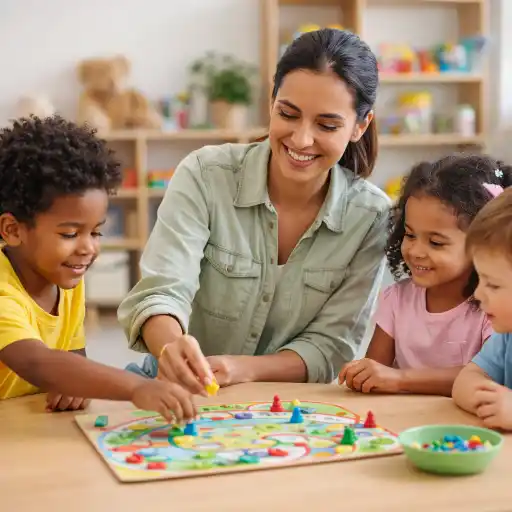
Which types of games best support key skills — and why?
Different games map to distinct domains of development. Knowing the connection helps you choose resources and training:
- Blocks, puzzles, and construction games boost #spatial reasoning and early STEM — see research showing a link between spatial play and spatial skills (Association for Psychological Science). For practical puzzle activities you can use to boost spatial reasoning and creativity, see our collection of National Puzzle Day activities.
- Pretend and dramatic play support language, narrative skill, and perspective-taking; researchers describe links between pretend play and higher-level social cognition (ECRP).
- Fast-paced group games (tag, circle games) strengthen self-regulation, turn-taking, and gross-motor coordination.
- Short song-and-movement games build phonological awareness and memory for words, which supports early literacy.
Give staff targeted course options: if you want to intentionally expand block/puzzle play try No Such Thing as Boring Math Buy Now $24.00; to deepen general play practice, the Play, Learn, Grow Buy Now $16.00 course links developmental milestones to play-based activities. These trainings help you choose materials and plan layered challenges that match each child’s level.
How do you adapt children’s games for inclusion, culture, and developmental differences?
Favorite games are an excellent starting point for inclusion because they already motivate children. To adapt: simplify rules, provide multiple response modes (words, sign, gesture, drawing), and use peer partners. When a game includes language or cultural content, invite families to share adaptations — but always keep participation optional and respectful. Remember: state requirements vary - check your state licensing agency.
Practical adaptations:
- Offer sensory-friendly options (quiet corner, visual cue cards) for children who need breaks.
- Provide role adaptations: a child who is not verbal can be a score-keeper or prop manager.
- Use multicultural game variants and invite family contributions rather than assuming traditions; see ideas in Simple Multicultural Games for Child Care Programs.
For focused inclusion strategies, consider Play with Purpose: Supporting Children with Autism Buy Now $55.00$40.00 and From Play to Planning: Building Culturally Competent, Child-Centered Curriculum Buy Now $55.00. Both offer practical scaffolds and documentation techniques to ensure games are meaningful for every learner.
How can providers assess and document learning that comes from games?
Assessment here should be lightweight and purposeful. Use play observations to tie what you see to a one-week goal, then collect two to three brief artifacts: a photo with a caption, a child quote, and a short staff note about a skill observed. Over a month these micro-evidence pieces show growth and inform next steps.
Simple system to try:
- Pick one target skill per child based on play (e.g., turn-taking in a board game).
- Record one 30–60 second observation and one photo during play each week.
- Create a one-line family note: what you noticed and one easy home activity.
To support staff skill-building in linking play to outcomes, the From Play to Planning Buy Now $55.00 and Play, Learn, Grow Buy Now $16.00 courses show templates for observation and family communication. Common mistakes to avoid include over-scaffolding (don’t take over the play), using games as rewards only, and failing to share small wins with families.
Conclusion
Children’s favorite games are not just entertainment: they are diagnosis, curriculum, and assessment wrapped into joyful activity. By observing choices, adding micro-scaffolds, adapting for inclusion, and documenting small wins, providers can turn play into measurable progress. Revisit the central question—what can you learn from a child’s game today?—and use brief, repeated actions to make those lessons count. If you want guided practice and staff certificates, start with The Best Promotion is Play Buy Now $35.00 and Role of Play in Learning Buy Now $16.00, then expand into courses like Play with Purpose Buy Now $55.00$40.00, From Play to Planning Buy Now $55.00, and Play, Learn, Grow Buy Now $16.00 to build staff confidence and program coherence. Your attention to play transforms momentary fun into long-term #development.
FAQ
- Q: How long should I observe a child’s game before planning? A: One focused 5–10 minute observation each week is enough to set a short goal.
- Q: Will documenting play take too much time? A: Use micro-evidence (photo + one-sentence note) to keep documentation under five minutes per child per week.
- Q: How do I involve families without pressuring them? A: Offer one simple, optional share—name a favorite family game or a short greeting in the home language.
- Q: Which staff training is best to start with? A: For foundations, choose The Best Promotion is Play Buy Now $35.00 or Role of Play in Learning Buy Now $16.00.
- 45 Hours Director-Administration ONLINE
- Pediatric RSV First Aid & CPR/AED
- 24 Hour Texas Pre-Service
- CDA Bridge Bundle: Family Child Care without Portfolio Review
- CDA Bridge Bundle: Infant/Toddler without Portfolio Review
- CDA Bridge Bundle: Preschool without Portfolio Review
- Texas Director Credential
- Preventative Health and Safety
- CDA: Curriculum Alignment & Materials
- DIY Snow Globes: The Fine Motor Craft That’ll Keep Kids (and Adults) Busy for Hours
- CDA Certification en Español: Recursos y Consejos para Educadores Bilingües
- 10 Ejemplos de Cómo la Cultura Influye en el Desarrollo Infantil
- Proporciones de Cuidado Infantil y Tamaños de Grupo por Edad en Maryland (Guía Rápida para Centros y Hogares)
- Proporciones de Cuidado Infantil y Tamaños de Grupo por Edad en Virginia (Guía Rápida para Centros y Hogares)
- What are fun language-learning games preschool teachers can use?
- How can music and movement strengthen early childhood programs in North Dakota?
- Celebrando la amistad en el cuidado infantil durante el Día de los Mejores Amigos
- National Ice Cream Day: Sweet Activities for Preschoolers
- Circle Time Songs, Games, and Questions for Kids
- Canciones, juegos y preguntas de círculo para niños
- Teaching Sign Language Through Songs, Games, and Play
- How can music and movement help New York preschoolers?
- Can Screen-Free Board and Movement Games Help Young Children Learn and Stay Calm?
- What Can Child Care Providers Learn from Children's Favorite Games?
- Can Counting Activities Really Feel Like Play?
- After School Activities for Elementary Kids Who Finish Homework Early
- How Do Memory and Matching Games Support Visual Discrimination?
- How Can Visual-Motor Practice Strengthen Alphabet Order?
- How Can Child Care Providers Respond When a Child Publicly Names a Favorite Teacher?
