Old-school materials—wooden blocks, mud and water, loose natural items, and large cardboard boxes—may look simple, but they provide exceptionally rich opportunities for learning. Unlike many single-purpose toys, these open-ended materials allow children to decide what to build, create, investigate, and imagine. Through unstructured and gently guided #play, children strengthen language, creativity, self-regulation, spatial reasoning, problem-solving, motor coordination, and social skills. This article explains why traditional play materials remain so effective, how child care providers and directors can organize safe and purposeful experiences, and which common pitfalls—such as over-directing play or limiting exploration—can reduce their value.
To deepen your understanding of play-based learning, explore ChildCareEd’s self-paced online course Role of Play in Learning  Buy Now $16.00. The course examines how play supports children’s growth and helps educators provide developmentally appropriate opportunities for imagination, exploration, communication, and active learning. Providers can apply these principles by protecting uninterrupted play periods, offering adaptable materials, observing children’s ideas, and using thoughtful prompts without taking control of the experience. State requirements vary, so always check with your state licensing agency.
How do blocks, mud, and cardboard support core development?
- 🧩 Cognitive & spatial skills: Block play and construction prompt planning, measurement and early math vocabulary (see Play‑Based Learning and Cognitive Growth) and long‑term gains in spatial reasoning documented in reviews. Montessori approaches offer concrete, hands‑on math progressions that intentionally move children from manipulatives to symbolic understanding; see Montessori Math: Preparing Children for Abstract Thinking and Cognitive Development.
- 🗣️ Language: During pretend play,y children narrate, assign roles, and use new words—rich contexts for vocabulary and conversational turns (pretend play reviews).
- 🤝 Social‑emotional learning: Shared building or a mud kitchen requires turn‑taking, negotiation and empathy; these are rehearsal spaces for perspective taking (The Power of Play).
- 🏃 Motor & sensory development: Mud, water, digging and manipulating cardboard build fine/gross motor control and sensory integration—especially in outdoor settings (Outdoor Play).
- 💡 Creativity & executive function: Open‑ended materials (called "loose parts") spark divergent thinking and problem solving—see Loose Parts and practical how‑tos on Loose Parts Play.
Put simply, these materials give children practice with the very skills predictive of later success in literacy and mathematics (school readiness reviews).
What practical setups encourage open‑ended, safe messy play?
- 🪵 Environment: Create 3–4 clear zones (blocks/engineering, mud/sensory, cardboard/construction, quiet/story) and keep materials reachable (Open‑Ended Activities).
- 🔁 Rotation & provocation: Rotate a few bins weekly (loose parts, boxes, kitchen tools). Use a single provocation question: "How can we make a bridge that holds three toys?"
- 🛡️ Safety routine: Teach a short daily hazard scan and zone supervision script; collect permissions for sunscreen/repellents and store first‑aid nearby (Outdoor Play safety). State requirements vary - check your state licensing agency.
- 💧 Mess systems: Use aprons, outdoor wipes, and a rinse station. Plan quick, shared cleanup rituals that make children co‑responsible (see Mud Theme ideas and mud kitchen guidance at Creative Activity).
Why it works: short, repeatable systems reduce staff stress and let children focus on exploration—simple changes like a rinse station or labeled bins have huge payoff.
How can teachers guide without taking over?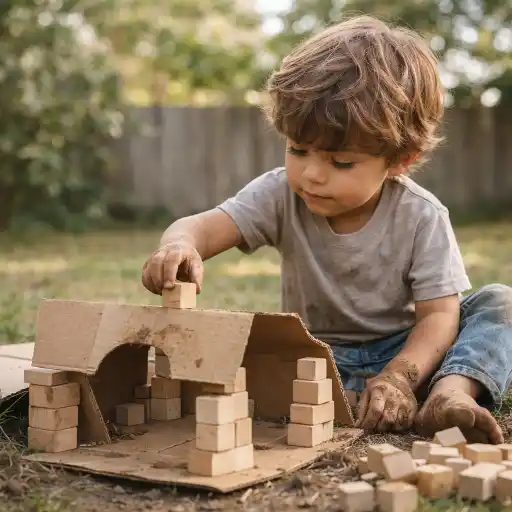
- 👀 Observe first: 2–3 minutes of unobtrusive watching to identify interests and social dynamics (Play & cognitive growth).
- 💬 Descriptive language: Name actions—"You are balancing the long block on the small one"—to extend vocabulary rather than supply answers.
- ❓One‑question prompt: Ask a single open question to nudge thinking: "What will make that tower steadier?"
- ➕ Add a material: Introduce one new loose part (a funnel, a cardboard wedge) to create a fresh problem without controlling the play.
- 📸 Document & reflect: Quick notes or photos connect play to goals you can share with families and administrators (ChildCareEd resources).
Evidence supports this balance: guided play can be as effective as direct instruction for early math and vocabulary when adults scaffold just enough (research summary).
How do recycled and loose parts (cardboard, boxes) boost equity and curriculum?
Cardboard and found objects are high‑leverage curriculum tools: low cost, age‑flexible, and culturally inclusive. Use numbered strategies to embed them into learning plans:
- 📦 Multi‑purpose units: Convert large boxes to forts, ramps, dramatic play kitchens or measurement labs—each conversion maps to math, literacy or science standards (Cardboard science).
- 🌍 Accessible materials: Ask families and local businesses for clean donations; keep a "gear library" for outdoor boots/coats to reduce barriers.
- 🔬 STEM integration: Use cardboard ramps to test motion, blocks to explore balance and counting, and mud kitchens for measurement and cause/effect experiments (Loose Parts book).
- 🤝 Inclusion & mixed‑age play: Mixed ages make resource sharing and mentoring natural—older children scaffold younger ones in construction and storytelling (Play, Learn, Grow training)
Practical tip: keep a labeled box for fast repairs (duct tape, scissors, markers), so cardboard activities are reliable and low stress.
What common mistakes do providers make,e and how do we avoid pitfalls?
Here are numbered pitfalls and quick fixes—use these in staff huddles or onboarding:
- ❌ Mistake: Rushing play. ✅ Fix: Schedule at least one long block (30–60 minutes) and protect it from interruptions (Play‑based scheduling).
- ❌ Mistake: Over‑directing. ✅ Fix: Use the one‑question rule and add only one material at a time.
- ❌ Mistake: No safety routine for outdoor/messy play. ✅ Fix: Teach the daily hazard scan, post zone maps, and collect permissions. State requirements vary - check your state licensing agency.
- ❌ Mistake: Single‑use toys that limit creativity. ✅ Fix: Replace some single‑use items with loose parts rotation bins (Loose parts guide).
- ❌ Mistake: Not involving families. ✅ Fix: Send one photo + 1‑line learning note weekly and invite simple at‑home play ideas (mud sensory tubs, box forts).
Conclusion
Old‑school materials win because they are flexible, research‑aligned and deeply equitable. Use numbered systems—zones, daily safety scans, one‑question prompts—and brief staff coaching to make these practices sustainable. Start small: add a loose‑parts basket, plan one mud‑kitchen rotation, or protect a 45‑minute block of uninterrupted play this week. For practical courses and downloadable resources, explore The Power of Play, Play‑Based Learning and Cognitive Growth, and the free resources page at Resources - Nurture Me. Your investment in simple, messy materials returns in stronger language, social skills, and reasoning for the children you serve. #play #blocks #mud #cardboard #children
FAQ
- Q: How long should a block of open play be? A: Aim for 30–60 minutes for preschoolers; toddlers benefit from shorter, repeated blocks.
- Q: Are mud kitchens hygienic? A: Yes, with routines—handwashing stations, rinsing, and keeping food/drink separate; follow your health guidance.
- Q: How do I justify messy play to parents? A: Share concrete skill outcomes (language, math, self‑control) and a weekly photo with a caption linking play to learning (ChildCareEd summaries).
- Q: Where to find training? A: ChildCareEd offers practical classes like Play, Learn, Grow and Play‑focused workshops (Play, Learn, Grow).
- Q: Licensing concerns? A: State requirements vary - check your state licensing agency for supervision ratios and documentation rules.
- CDA Home Visitor Subject Area 3 Part 3 Birth to 5
- CDA Home Visitor Subject Area 2 Part 3 Birth to 5
- Birth to Five CDA Credential with Portfolio Review
- Using Toys to Support Learning
- 45 Hour School Age Methods and Materials
- CDA Bridge Bundle: Family Child Care without Portfolio Review
- CDA Bridge Bundle: Infant/Toddler without Portfolio Review
- CDA Bridge Bundle: Preschool without Portfolio Review
- 45-Hour Preschool Curriculum
- 45-Hour Infant and Toddler Curriculum
- Valentine’s Day Activities for Kids That Will Make Their Hearts Melt!
- 🌙 ¿Cómo afecta el tiempo frente a las pantallas el sueño y el comportamiento infantil? 😴
- 🪁¿Cómo puede el juego apoyar de manera poderosa a los niños con autismo?🧩
- Que Se Necesita Para Trabajar En Un Daycare?
- Cómo Abrir Una Quardería En Casa Sin Dinero?
- ¡Obtén Tu Certificación de Cuidado Infantil de 90 Horas En Línea!
- ¿Cuáles son las mejores actividades del Día de la Tierra para niños en casa o en el aula?
- ¿Cómo puedo usar escenarios de juego de roles de primeros auxilios en mi aula?
- 10 Ejemplos de Cómo la Cultura Influye en el Desarrollo Infantil
- Normas de Licenciamiento de Cuidado Infantil en Virginia para Centros Diurnos Infantiles y Hogares Diurnos Familiares
- Lista para Abrir una Guardería en Casa en Virginia: Cómo Empezar
- Canciones, juegos y preguntas de círculo para niños
- Cómo simplificar la capacitación para sus empleados de daycare
- Why Does Old‑School Play (Blocks, Mud, Cardboard) Still Win?
- School-Age Activities With Everyday Materials: Big Fun on a Small Budget
- What Are the Benefits of Open-Ended Play Materials for Young Children?
- How Can Providers Bring Nature-Based Learning Into Any Program?
- How Can Child Care Providers Help Families See the Learning Hidden Inside Messy Play?
- How Can You Welcome a Family Back After a Long Child Care Absence?
- What Low-Cost Preschool Materials Still Meet Your Learning Goals?
