Preschoolers need intentional learning, but they also need time to play, move, talk, imagine, and follow their interests. For practical guidance on designing developmentally appropriate experiences, explore DAP for Preschool  Buy Now $24.00, which can strengthen classroom practice while supporting relevant professional learning goals.
Why does the balance between structure and play matter?
The question is not whether preschool should be structured or unstructured. The more useful question is how educators can provide enough structure to ensure meaningful learning while preserving the agency, curiosity, and joy that characterize early childhood. Young children benefit from predictable routines and intentional teaching, but they also learn through social interaction, movement, exploration, repetition, and imaginative play.
Research reflects this balance. A 2024 field experiment involving 691 five-year-olds in 71 Norwegian preschools found that a structured curriculum with intentional activities in mathematics, language, social skills, and executive functioning improved children’s skills, with particularly strong effects in mathematics. The effects were most pronounced in centers that had offered fewer structured learning opportunities before the intervention (Størksen et al., 2024).
However, the study does not suggest that every minute should be teacher-directed. The intervention included age-appropriate activities, teacher training, and additional supports, so it should not be interpreted as proof that worksheets or lengthy academic lessons are appropriate. Instead, it highlights the value of intentionality, consistency, and equitable access to high-quality learning experiences.
Developmentally appropriate practice also requires attention to children’s age, individual differences, cultural and linguistic backgrounds, and social context. NAEYC describes developmentally appropriate practice as an approach grounded in research on how children learn and in knowledge about educational effectiveness (NAEYC).
How much direct instruction is appropriate for preschoolers?
There is no universal number of minutes that fits every preschool classroom. The appropriate amount depends on the children’s ages, developmental needs, group size, instructional goal, and the quality of adult-child interaction. Brief, focused lessons are generally more compatible with preschool development than extended periods of passive listening or paper-and-pencil work.
Direct instruction is most useful when it introduces a concept, models a strategy, or gives children a shared experience that they can later explore independently. For example, a teacher might model how to compare two quantities, demonstrate a calming strategy, introduce a new vocabulary word, or show how to use classroom materials safely. Children then need opportunities to apply the idea through centers, games, conversation, movement, and play.
- Use short group lessons: Keep whole-group experiences focused and interactive, with opportunities for children to respond, move, and contribute.
- Teach in small groups: Small groups allow educators to adjust language, pacing, materials, and challenge level.
- Embed learning throughout the day: Count during snack, compare sizes during block play, and discuss feelings during transitions.
- Watch for engagement: If children are consistently disengaged, the activity may need to be shortened, adapted, or relocated into play.
The Institute of Education Sciences practice guide recommends intentional instruction in social-emotional skills, executive function, mathematics, mathematical language, vocabulary, letters and sounds, and shared book reading (WWC: Preparing Young Children for School). These recommendations support purposeful teaching, not an overly academic schedule.
How can play become intentional learning?
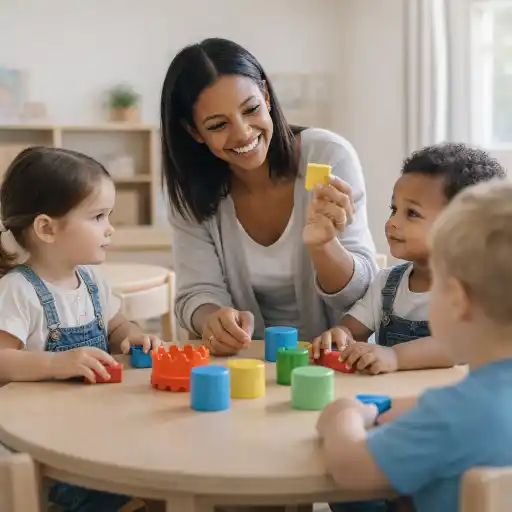
Play is not the opposite of learning. It is one of the primary contexts in which preschoolers practice language, problem-solving, cooperation, self-regulation, motor coordination, and symbolic thinking. The educator’s role is to prepare the environment, observe carefully, and intervene thoughtfully rather than directing every action. For more examples of how these experiences support communication, creativity, and problem-solving, see how learning through play builds young children’s skills.
Intentional play begins with a learning purpose but leaves room for children’s choices. For example, a block area can support spatial reasoning, measurement, collaboration, and vocabulary. A dramatic-play restaurant can support counting, writing, sequencing, oral language, and social negotiation. A nature collection can encourage classification, prediction, descriptive language, and scientific thinking.
- 🧩 Add materials that invite investigation, such as measuring tools, clipboards, maps, natural objects, puppets, or pattern pieces.
- Ask open-ended questions: “What is your plan?” “How could we make it stronger?” or “What do you notice?”
- Introduce precise vocabulary without interrupting the child’s ownership of the activity.
- Offer a manageable challenge, then allow children time to experiment and revise.
- Document children’s words, strategies, relationships, and emerging skills.
ChildCareEd’s article on how play supports physical, cognitive, and social growth describes play as a context for integrated development. This is especially important for children who may not demonstrate skills during formal tasks but show sophisticated thinking during construction, pretend play, conversation, or movement.
Educators can deepen their practice through From Play to Planning: Building Culturally Competent, Child-Centered Curriculum Buy Now $55.00, which focuses on scaffolding, emergent learning, inclusive environments, and culturally responsive curriculum design.
How should teachers individualize structured learning?
Structure is only effective when it is responsive. A single lesson may be developmentally appropriate for one child and inaccessible or insufficiently challenging for another. Teachers should use observation and formative assessment to determine how children participate, what they understand, what support they need, and what they are ready to attempt next.
Individualization may involve changing the size of a group, adding visual cues, modeling a task, providing adaptive tools, using a child’s home language, extending wait time, or offering a more complex challenge. Children with disabilities, developmental differences, or emerging language skills should participate in shared experiences with meaningful adaptations rather than being routinely separated from peers.
- For children who need more support: simplify directions, demonstrate each step, use gestures and visuals, and provide repeated practice.
- For dual language learners: connect new words to objects, actions, pictures, family knowledge, and home-language resources.
- For children ready for greater challenge: invite prediction, explanation, leadership, comparison, or multi-step planning.
- For children who avoid group lessons: offer the same goal through movement, sensory materials, partner work, or a quieter setting.
Observation should focus on strengths as well as concerns. A brief note such as “Leo counted six blocks accurately, explained that one tower was taller, and invited a peer to add another block” provides useful information for planning. It also communicates a fuller picture of learning than a worksheet score.
When developmental concerns persist, document patterns, collaborate with families, and follow referral procedures. State requirements vary - check your state licensing agency.
What common mistakes should programs avoid?
The most common error is treating structure as a synonym for control. A quiet classroom with identical completed papers may look organized, but it does not necessarily demonstrate deep learning. Conversely, a classroom that relies only on spontaneous activities may miss important opportunities to build language, mathematics, executive function, and social-emotional skills consistently.
- Over-scheduling: Avoid filling the day with short adult-directed activities. Protect sustained play, outdoor time, and meaningful routines.
- Academic drilling: Replace repetitive worksheets with games, manipulatives, stories, movement, and real-world problems whenever possible.
- Using one pace for everyone: Plan multiple entry points and adjust expectations based on observation.
- Confusing compliance with learning: Look for children’s explanations, strategies, questions, and ability to apply skills in new contexts.
- Ignoring relationships: Warm, responsive interactions are not separate from instruction; they create the security needed for children to take risks and persist.
Directors can help by reviewing lesson plans, observing classroom schedules, providing planning time, and discussing evidence of learning with staff. A curriculum should be a framework rather than a script. Head Start curriculum guidance emphasizes research-based curricula, clear scope and sequence, staff support, alignment with learning outcomes, and standardized training materials (Head Start curriculum resources).
Family communication is equally important. Explain that structured learning includes stories, conversations, games, projects, routines, and play—not only worksheets. Share photographs, children’s words, and brief documentation that shows how classroom experiences support development.
Summary: How much structured learning do preschoolers really need?
Preschoolers need enough structure to experience predictable routines, intentional teaching, repeated practice, and equitable access to important learning opportunities. They do not need a school-like schedule dominated by long lectures, worksheets, or constant adult direction. The strongest approach combines brief, purposeful instruction with extended play, movement, conversation, exploration, relationships, and rest.
The central goal is not to maximize the amount of structured time. It is to maximize the quality and usefulness of children’s experiences. Ask whether each activity is developmentally appropriate, connected to a meaningful goal, responsive to individual children, and balanced with opportunities for choice and active engagement.
For continued professional learning, consider these relevant ChildCareEd courses:
- DAP for Preschool Buy Now $24.00
- Lesson Planning for Preschoolers Buy Now $24.00
- Curriculum Planning Buy Now $24.00
- From Play to Planning Buy Now $55.00
- Early Mathematics Through Play Buy Now $24.00
When structure and play work together, preschool classrooms can be purposeful without becoming pressured, and joyful without becoming aimless. That balance is the foundation of responsive early learning.
- Moving About the Classroom: Effective Transitions for Everyday
- DAP for Preschool
- Birth to Five CDA Credential with Portfolio Review
- Children at the Wheel: Emergent Curriculum
- CDA Bridge Bundle: Family Child Care without Portfolio Review
- CDA Bridge Bundle: Infant/Toddler without Portfolio Review
- CDA Bridge Bundle: Preschool without Portfolio Review
- Creating Engaging and Meaningful Learning Experiences
- Texas Director Credential
- Roadmapping Preschool Curriculum
- 👧 ¿Cómo iniciar y abrir una guardería en Texas? Lo que necesitas saber
- Qué capacitación se requiere para ser director de cuidado infantil en Texas?
- Capacitación en Salud y Seguridad Preventiva en Línea para Proveedores de Cuidado Infantil
- Normas de Licenciamiento de Cuidado Infantil en Virginia para Centros Diurnos Infantiles y Hogares Diurnos Familiares
- Lista para Abrir una Guardería en Casa en Virginia: Cómo Empezar
- Actividades de Otoño Fáciles para Preescolares esta Temporada
- Lista para Guardería en Casa en Illinois: Cómo Iniciar una Guardería en el Hogar
- Lista para Guardería en Casa en Texas: Cómo Iniciar una Guardería en el Hogar
- Ejemplos de Crianza Respetuosa vs. Crianza Permisiva
- Cómo Ser Maestra de Preescolar en Dakota del Norte
- Capacitación Previa al Servicio para Proveedores de Cuidado Infantil en Dakota del Norte
- Cómo Ser Maestra de Preescolar en Virginia
- How can child care programs boost physical activity for young children?
- Celebrando la amistad en el cuidado infantil durante el Día de los Mejores Amigos
- Canciones, juegos y preguntas de círculo para niños
- Cómo simplificar la capacitación para sus empleados de daycare
- What simple early literacy activities really help children learn?
- How Much Structured Learning Do Preschoolers Really Need?
- How Much Outdoor Play Do Preschoolers Need Each Day?
- Is Your Preschool Day Too Sedentary—and How Can You Tell?
