Play is more than recreation: it is a context in which children investigate ideas, practice relationships, and make meaning from experience. A block structure, a pretend scenario, or a sandbox exploration can invite problem-solving, collaboration, and creativity. Educators can make these experiences purposeful by observing children’s interests and responding with thoughtful materials, language, and support. For professional learning about development and play, explore the 45-Hour Growth and Development Birth–Age 12 Course and 9-Hour Communication Course  Buy Now $99.00; confirm with your employer or licensing agency whether a course applies to your requirements.
🧠 Why Is Play So Important for Development?
Play supports learning across developmental domains: children encounter language, relationships, problem-solving, and opportunities to explore their bodies and surroundings.. For educators, the practical implication is to treat play as meaningful learning time, not merely a break between lessons. For more on how play engages children in learning, read A Path to Engaged Learning: Play!.
In fact, structured and unstructured play both contribute to essential milestones covered in our 45-Hour Growth and Development Birth–Age 12 Course.
You’ll explore how each age learns differently, and how to create play environments that nurture curiosity and support children's ongoing development.
How Can Educators Observe and Extend Children’s Play?
Observation helps educators respond to children’s thinking without taking over the activity. Notice what a child returns to, the materials they select, the questions they ask, and how they approach a challenge. These details can reveal emerging interests and skills more clearly than a finished product alone.
Use a brief observe–interpret–respond cycle:
- Observe: Record what the child says and does, without immediately assigning a motive or developmental label.
- Interpret: Consider what the play may show about the child’s current interests, strategies, or questions.
- Respond: Offer a relevant material, an open-ended question, or time to continue, then watch how the child uses that support.
For example, if children repeatedly build and rebuild a tower, add varied blocks or loose parts and ask what they notice about balance. Allow children to test their own ideas before offering a solution. This approach keeps the play child-centered while giving educators a purposeful way to extend exploration.
For more ideas on connecting play with whole-child development, read How Does Play Support Children’s Physical, Cognitive, and Social Growth?.
🧩 How Can Educators Create Meaningful Play Experiences?
It starts with observation and intention. Watch what fascinates each child—then use that curiosity to guide your setup.
Here are a few ways to elevate everyday play:
-
Encourage storytelling through puppets and #pretendplay, and invite children to #communicate their ideas, #collaborate with peers, and explore #creativity through open-ended activities.
-
Incorporate morning message activities like this Morning Message Card Exchange Buy Now $0.00 to blend literacy and community.
How Can Play-Based Learning Support 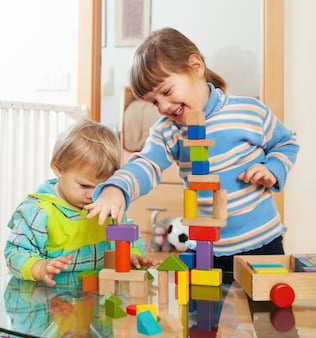 Early Literacy and Math?
Play creates authentic reasons to use early academic concepts. In dramatic play, children may read or make signs, write a shopping list, compare quantities, or negotiate roles. With blocks, they can describe shapes, estimate height, sort materials, and test ideas about space. These experiences are most useful when educators make concepts available without turning every moment into a quiz.
To support literacy, keep books, writing tools, labels, and familiar print within reach of play areas. Join a child’s pretend scenario and introduce language that fits the activity, such as names for tools, actions, or descriptive details. Pause to let children respond and build on one another’s ideas. To invite mathematical thinking, offer materials that can be sorted, counted, compared, arranged, and measured, and use questions such as “What do you notice?” or “How could we find out?”
Follow children’s lead and adapt the level of support to their communication, interests, and developmental readiness. For further strategies, see How Can Child Care Providers Build Early Literacy Skills Through Play?.
💬 How Does Play Support Communication?
Play provides recurring opportunities for children to practice expressive language, attentive listening, and negotiation with peers.
When educators model clear, respectful communication, they support the development of social-emotional competence.
Learn how communication can strengthen classroom relationships in our article:
👉 Talk, Listen, Grow: Why Communication Is the Superpower of Early Childhood Professionals.
And if you’d like to strengthen these skills, take our 9-Hour Communication Course Buy Now $99.00—it is designed to help educators use empathy and intentional language to connect with children effectively.
How Can Educators Make Play Inclusive and Accessible?
Meaningful play depends on whether each child can enter, understand, and influence the activity. Consider children’s communication styles, sensory preferences, mobility, cultural experiences, and familiarity with the materials. Offer choices in how to participate—for example, children might speak, gesture, use visual supports, observe before joining, or take on different roles in a shared scenario.
Adapt the environment before assuming a child is uninterested. Reduce unnecessary noise or clutter when helpful, place materials within reach, and provide duplicates when competition for a resource is interrupting play. Use familiar objects and varied materials so children can connect play to their experiences while exploring new ideas. Observe whether an adjustment increases access and engagement, and revise it in response to what the child shows you.
For ideas about building peer connections, read Supporting Social Relationships Among Young Children.
🎨 How Can You Balance Structure and Freedom?
Children need both autonomy to explore and guidance from trusted adults.
Using visual aids like Calm-Down Cue Cards Buy Now $0.00 helps maintain structure while giving children independence to manage emotions.
This balance turns your classroom into a space that’s both joyful and secure.
How Can Educators Assess Learning During Play?
Assessment during play can be observational rather than disruptive. Note examples of children’s language, persistence, planning, collaboration, and approaches to problems. Capture specific actions or words instead of relying on broad labels; for instance, record how a child tested two bridge designs or invited a peer to contribute.
Use these observations to plan what comes next: keep a successful challenge available, introduce a related material, or provide support for a skill that is emerging. Share meaningful examples with families while protecting children’s privacy and following program practices for documentation. Assessment should inform responsive teaching, not turn play into a performance or require every child to produce the same outcome.
For additional ideas about engaging children in classroom learning, explore Spark Their Love for Learning: Tips for Exciting Young Minds in the Classroom!.
💡 Ready to Make Playtime Purposeful?
If you’re ready to learn how developmental stages connect to everyday play, explore:
Before you enroll, don’t forget to check our coupon and savings page for current discounts!
Summary: What Should Educators Remember About Learning Through Play?
Play supports development when educators observe carefully, provide accessible materials, and respond to children’s ideas without directing every step. Use children’s interests to connect play with language, early literacy, mathematics, relationships, and problem-solving. Adjust the environment so every child can participate, and use specific observations to plan meaningful next experiences. The goal is purposeful support that protects children’s agency and enjoyment.
- The Best Promotion is Play
- Teacher & Me Playtime
- From Play to Planning: Building Culturally Competent, Child-Centered Curriculum
- Pediatric RSV First Aid & CPR/AED
- Creating Environments that Nurture Growth and Community
- CDA Home Visitor Credential Birth to 5
- Texas Director Credential
- History, Policy, and Practice in ECE
- Montessori Cultural Activities: Exploring the World Through Play and Learning
- Mindful Supervision: Balancing Safety & Independence in Montessori
- The Power of Play
- CDA Certification en Español: Recursos y Consejos para Educadores Bilingües
- A Path to Engaged Learning: Play!
- 🎈 Better Together: Why Little Friends Make a Big Difference in Early Childhood
- 🌟How Can Playtime Build Bright Minds? The Power of Learning Through Play in Early Childhood
- 😫🧸 ¿Qué hacer cuando un bebé no quiere dormir la siesta en el aula?
- 🍑 ¿Qué capacitación requiere DECAL cada año para el personal de cuidado infantil en Georgia?
- 👶 ¿Cuáles son las proporciones y grupos requeridos en Dakota del Norte? 🏫
- Cómo Abrir Una Quardería En Casa Sin Dinero?
- Recursos en Español sobre el Sueño Seguro del Bebé
- 10 Ejemplos de Cómo la Cultura Influye en el Desarrollo Infantil
- Proporciones de Cuidado Infantil y Tamaños de Grupo por Edad en Virginia (Guía Rápida para Centros y Hogares)
- Cómo Trabajar en el Cuidado Infantil en Carolina del Norte: Requisitos y Pasos
- Cómo Ser Maestra de Preescolar en Illinois
- Learning Through Creative Daycare Activities
- Capacitación CDA gratuita en Illinois
- Canciones, juegos y preguntas de círculo para niños
- Cómo simplificar la capacitación para sus empleados de daycare
