Watching children closely helps us know what they can do, what they need next, and how to plan teaching that fits them. This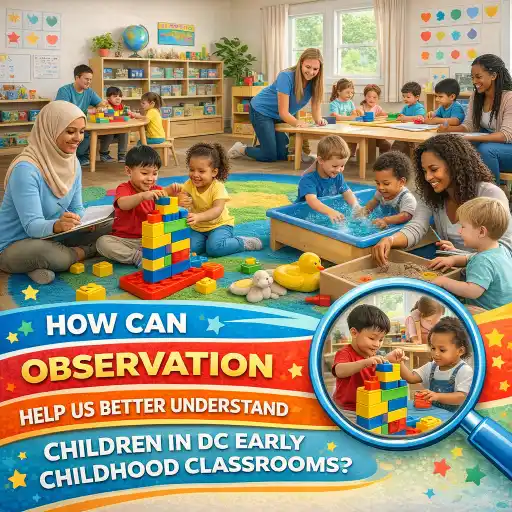 short guide is for DC child care providers and directors who want clear steps for doing helpful, fair observations. You will find simple methods, tools, tips for sharing with families, and ideas for program supports. For hands-on courses and forms, see ChildCareEd resources like How do I run effective classroom observations (Checklist included)? and the course Assessing through Observation Buy Now $35.00. Remember: state requirements vary - check your state licensing agency.
What is observation, and why does it matter in DC classrooms?
2) Why it matters (short):
- 😊 It shows what children actually do in real moments.
- 👀 It helps teachers plan learning and supports.
- 🏥 It helps catch needs early so families can get help.
- 🤝 It builds trust with families when you share clear examples.
3) Quick reasons for DC programs: observation improves teaching quality, supports # children's growth, and guides referrals if needed. For more on why early monitoring matters, see the CDC’s Watch Me training Module 1. Use observation to center each child’s strengths and next steps. Add notes to your daily routine so observation becomes normal, not extra work. In your notes, include one of these hashtags to tag the topic: #observation #children #assessment #families #development.
How do we do fair, useful observations step by step?
2) Choose a method. Try 1–2 of these for a month and keep what works:
- ⏱ Time sampling — record if a behavior happens during short intervals.
- 🎯 Event sampling — note each time a specific event happens.
- 📝 Anecdotal note — a short factual story of one moment (use the template in What Is an Anecdotal Record?).
3) Watch objectively. Write only what you see and hear (for example: “Sam stacked 6 blocks,” not “Sam is good at building”). To reduce bias, have another staff member watch the same moment sometimes and compare notes. ChildCareEd courses like Assessing through Observation Buy Now $35.00 teach these skills step by step.
4) Use tools and digital help. If you record video, get family permission, and keep files private. Use simple checklists and the free resources in the Assessing through Observation resources.
How do we turn observations into goals and share them with families and teams?
2) Make 1–3 small goals. Good goals are short and measurable. Example: "Maya will name 3 colors during art time in 4 of 5 tries." Link goals to routines so teaching is part of the day.
3) List teacher supports. Pick 2–3 simple supports tied to the child’s day. Example supports:
- 😊 Model words during art time.
- 🧩 Offer choices of two crayons and ask the child to name the color.
- 🔁 Re-check in two weeks and note progress.
4) Share with families. Use strengths-first language and short examples. Invite family input and home ideas. Keep records private and follow program policy. For forms and templates, see ChildCareEd’s guides like How do I run effective classroom observations.
5) Know when to refer. If goals do not show progress, document carefully and consult specialists. Follow local referral steps and remember: state requirements vary - check your state licensing agency. The CDC and local early intervention systems can guide next steps; use the CDC’s milestone tools, Watch Me for examples.
How can programs support teachers and avoid common mistakes?
1) Provide training and coaching. Offer short courses and live coaching so teachers can practice observation with feedback. ChildCareEd offers courses like Assessing through Observation Buy Now $35.00 and Tracking Progress, Shaping Futures  Buy Now $55.00.
2) Use a simple system. Make a schedule for who observes and when. Rotate children so observations cover everyone. Use shared templates so notes are consistent across staff. See the handy checklist in How do I run effective classroom observations.
3) Avoid common mistakes. Here are quick fixes:
- ❗ Mistake: Writing opinions. ✅ Fix: Stick to facts and quotes.
- ❗ Mistake: Only watching problem moments. ✅ Fix: Observe play and routines to see strengths.
- ❗ Mistake: No follow-up. ✅ Fix: Pair observation with a goal, supports, and a re-check date.
4) Measure progress simply. Count brief one-to-one moments, number of specific praises, or look for the goal behavior during the same routine each week. Celebrate small wins to keep staff motivated.
5) FAQs (short):
- Q: How often to observe? A: Quick notes daily; deeper observations monthly.
- Q: Who records? A: Staff who know the child best; add a second observer when possible.
- Q: How long keep records? A: Follow program policy and state rules.
- Q: What if families disagree? A: Listen, show examples, and invite their observations.
Programs that train staff, offer coaching, and use simple forms make observation doable and useful. Use ChildCareEd resources like Assessing through Observation resources and reflection tools like the Observation Reflection Jar Buy Now $0.00 to build a strong observation system. Your careful watching helps teachers meet each child’s needs and strengthens partnerships with families in DC classrooms.
Conclusion
Observation is a small daily habit that leads to smarter teaching. Start with one routine, use a clear method, write short objective notes, turn them into a goal, and share with families. Train staff, keep tools simple, and celebrate small wins. For DC providers, ChildCareEd has many practical courses and templates to help your team get started: ChildCareEd. Your careful watching makes a big difference for every child.
1) Pick a clear focus. Choose one skill or setting (for example: sharing at snack, language at circle, or gross motor on the playground). Short, focused checks are faster and more useful than long, vague notes. See practical steps in How do we observe with purpose in early childhood assessment?.1) What is observation? Observation means watching children on purpose to learn about their play, language, movement, feelings, and thinking. It is not just looking — it is focused and written down clearly. A quick tool is an anecdotal record that captures the who, what, when, and where of a moment.1) Make a summary. After you watch, write a 1–2 sentence summary (who, what, where, when). Example: “On 5/4 at circle, Maya labeled 3 colors while pointing to crayons.” This gives a clear start for a goal.
- Childhood Obesity
- Moving About the Classroom: Effective Transitions for Everyday
- Children at the Wheel: Emergent Curriculum
- CDA Bridge Bundle: Family Child Care without Portfolio Review
- CDA Bridge Bundle: Infant/Toddler without Portfolio Review
- CDA Bridge Bundle: Preschool without Portfolio Review
- Texas Director Credential
- Anxiety: Signs & Strategies
- Technology as a Classroom Tool
- Lesson Planning for Infants and Toddlers
- CDA Certification en Español: Recursos y Consejos para Educadores Bilingües
- Cómo Trabajar en el Cuidado Infantil en Carolina del Norte: Requisitos y Pasos
- What should DC child care providers know about CDA trainings?
- How can DC early learning programs improve teacher-child interactions?
- What Should DC Early Childhood Teachers Know About Pay Equity Right Now?
- How Does DC’s QRIS Affect Capital Quality, Child Care Programs, and Teachers?
- What's new for child care in Washington, DC?
- How can DC early childhood educators keep classrooms safe in busy urban child care settings?
- What new child care news in DC should providers know and how can training help?
- How can we build strong work ethics in DC early childhood classrooms?
- How can observation help us better understand children in DC early childhood classrooms?
- How do ChildCareEd's urban childcare courses help Michigan providers in high-density communities?
- What can DC early childhood educators learn by watching children play?
- How can DC classrooms welcome every child and make inclusion real?
- How can DC child care centers market smarter and fill open spots easily?
- Will DC’s Early Childhood Educator Pay Equity Fund Survive?
- After DC Early EdX 2026: Why Do Early Educator Mental Health and Advocacy Matter More Than Ever?
- How Did DC’s Pay Equity Fund Help Early Educators Be Seen as Professionals?
- How Can DC Providers Support Infants During the Child Care Subsidy Waitlist?
