When a child colors a dinosaur, the page can become much more than an art project: it can spark questions, new vocabulary, and careful observation. Try the printable Dinosaur Coloring Activity Buy Now $0.99as a starting point, and deepen your planning with Basic Science in Early Childhood Buy Now $25.00, a two-hour training focused on meaningful investigations and children’s scientific reasoning. Pair it with Building Vocabulary  Buy Now $16.00 to strengthen your strategies for supporting children’s language through content-area learning.
Dinosaur coloring is familiar, inviting, and easy to prepare. With a few intentional prompts and simple extensions, providers can turn it into a connected learning experience that honors children’s interests while building early science and communication skills.
Why can a coloring page support meaningful learning?
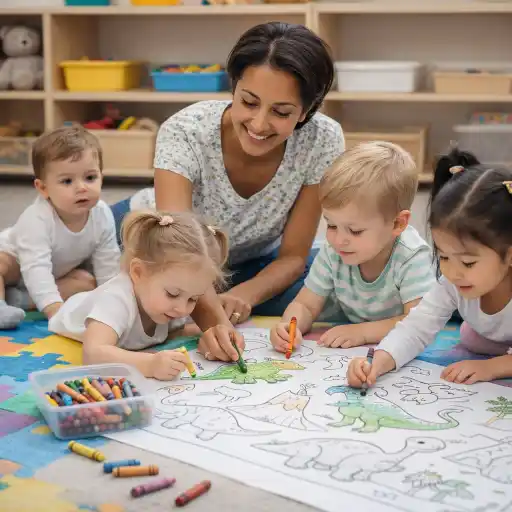
Coloring itself invites children to look closely, make choices, and represent ideas. When an educator adds conversation and purposeful follow-up, those actions become opportunities to practice observation, comparison, descriptive language, and early reasoning. A dinosaur image offers children a concrete subject to notice: body parts, shapes, patterns, colors, and differences among species.
The goal is not to turn a relaxing art experience into a quiz. Instead, join children in their curiosity. A child may notice that one dinosaur has a long neck or ask why another has sharp teeth. A thoughtful response can extend the idea without taking over: “You noticed its long neck. What might it help the dinosaur reach?” That exchange encourages a child to observe, explain, and listen to other ideas.
Art also gives children a way to communicate when they are not yet ready to explain everything in words. Their choices of color, marks, and details offer openings for discussion. Educators can document a child’s words alongside the finished work, making thinking visible for colleagues and families.
This approach connects creative expression with early #science and language learning while keeping the activity playful and developmentally appropriate. Dinosaur themes can also lead naturally into broader hands-on inquiry, including simple investigations that prompt children to predict, observe, and discuss results, as in ChildCareEd’s frozen dinosaur STEM activity.
How can educators prepare the activity with a clear learning purpose?
Begin with a simple objective that fits the children in your group. For example: children will describe one visible feature, compare two dinosaur images, or use a new word while sharing their artwork. A focused purpose helps educators choose prompts and avoid overwhelming children with too many facts or directions.
Prepare age-appropriate dinosaur coloring sheets, crayons or washable markers, and a comfortable work surface. Offer a range of colors and allow children to choose their own approach. If helpful, include a small selection of books, picture cards, or toy dinosaurs nearby so children can look, compare, and draw inspiration. Make sure materials are suitable for the children’s ages and abilities, and supervise closely.
- Introduce one or two useful words, such as “fossil,” “tail,” “claws,” “scales,” or “paleontologist.”
- Invite children to study the illustration before coloring: “What do you notice first?”
- Offer adaptive tools or larger images as needed so every child can participate comfortably.
- Keep the focus open-ended; a child’s imaginative color choices can be a starting point for conversation rather than something to correct.
Planning is especially helpful when an activity combines art, science, and oral language. Consider which children may benefit from visual choices, additional wait time, a peer partner, or a chance to point instead of speak. These small supports help create an inclusive experience without lowering expectations for curiosity and participation.
What questions turn coloring into science and language practice?
Strong prompts invite children to notice, describe, compare, and imagine. Ask one question at a time, then pause long enough for children to respond in their own way. A brief exchange can be more valuable than a long explanation from an adult.
- “What parts of the dinosaur do you see?”
- “How is this dinosaur different from the one beside it?”
- “What do you think this dinosaur might eat? What makes you think so?”
- “Which colors or patterns did you choose? Tell me about them.”
- “What could we find out by looking at a book or another picture?”
Use #vocabulary naturally in context. If a child says “big teeth,” you might respond, “Yes, those sharp teeth stand out. What do you think they were used for?” Recasting a child’s phrase with a more precise word models language while respecting the child’s contribution. For multilingual learners, invite children to share a dinosaur word in a home language as well as in English, and welcome gestures, drawings, and short phrases as meaningful communication.
Keep scientific claims accurate and appropriately qualified. For instance, educators can explain that scientists use fossil evidence to learn about dinosaurs, while acknowledging that children’s coloring choices are imaginative. If a question is uncertain, model inquiry: “Let’s look for a book or picture that might help us answer that.” The educator’s role is to support #inquiry, not to have every answer immediately.
How can one coloring activity connect to further investigations?
Extend children’s interest with a short follow-up that grows from what they noticed. If children are drawn to dinosaur footprints, compare pictures of tracks or press toy feet into play dough to observe the prints. If they wonder about fossils, examine safe replicas or make impressions in dough with leaves or toy dinosaurs. The aim is to give children a chance to explore an idea through more than one mode: looking, talking, making, and comparing.
A simple sequence can help providers plan without overcomplicating the day:
- Color and describe one dinosaur image.
- Compare a feature with a second picture or toy.
- Invite children to draw, dictate, or tell one fact or question about their dinosaur.
- Return to their questions later with a book, a classroom display, or a hands-on investigation.
Children can also create a class “dinosaur museum.” Display their coloring pages with dictated captions, invented dinosaur names, or questions they want to investigate. Ask children to sort images by an observable feature—such as long or short necks—rather than relying on facts they may not yet understand. This develops #observation and classification while giving children a meaningful reason to use language with peers.
Keep extensions flexible. Some children may want to talk at length; others may prefer to point, draw, or listen. Short, repeated experiences often provide more opportunity for learning than one elaborate project. Follow children’s interests and revisit their ideas over several days when possible.
How can educators adapt the experience and make learning visible?
Offer multiple ways to take part. A child might color, choose between two crayons, point to a feature, dictate a caption, or listen while a peer describes a picture. For children developing fine-motor control, use larger images, thick crayons, or a stable surface. For children who communicate in different ways, pair spoken prompts with gestures, visuals, and sufficient wait time. Adaptations should preserve the central invitation: noticing and communicating about dinosaurs.
Documentation does not need to be elaborate. Write down a child’s exact words, photograph the artwork according to program policy, or add a brief note about a question that emerged. These records can guide the next activity, help staff share observations, and give families a specific window into classroom learning.
Consider a simple observation note with three parts:
- What the child noticed: “This one has plates on its back.”
- What the child wondered: “Do they feel bumpy?”
- Possible next step: Compare dinosaur images, textures, or toy models.
Notice children’s participation, not just whether they complete the page or use a particular word. A child’s sustained attention, willingness to compare, attempt to explain, or question for a peer may all show engagement. When planning to continue the work, explore Lesson Planning for Preschoolers Buy Now $24.00 for guidance on purposeful, developmentally appropriate planning, or Language Development in Early Childhood Buy Now $16.00 for strategies that support communication across daily experiences.
What common pitfalls should providers avoid?
A common pitfall is treating the coloring sheet as a test of factual knowledge. Young children do not need to name every species or produce scientifically precise artwork to benefit. Keep the invitation open and value questions, observations, and creative decisions.
Another pitfall is asking too many questions in quick succession. A rapid series can feel like a quiz and may limit children’s initiative. Ask one open question, wait, and follow the child’s response. Also avoid correcting imaginative choices unnecessarily. If a child colors a dinosaur purple, the educator can acknowledge the choice and invite description rather than insisting that the image match a particular representation.
Keep safety and access in view: select age-appropriate supplies, supervise shared materials, and consider children’s individual needs. Do not use small objects with children who may mouth them. State requirements vary - check your state licensing agency for applicable rules and expectations.
- Instead of emphasizing a perfect finished product, value the child’s process and explanation.
- Instead of supplying every answer, model how to look for information together.
- Instead of assuming all children will participate in the same way, offer verbal, visual, and hands-on options.
- Instead of ending when coloring is finished, use children’s questions to shape a manageable next step.
These adjustments make the activity more welcoming and academically meaningful while keeping its central pleasure intact: children get to explore a topic they enjoy.
Conclusion: How can dinosaur coloring become a richer learning experience?
Dinosaur coloring becomes a science and language experience when educators pair children’s creative choices with thoughtful conversation, close observation, and a relevant extension. Prepare a clear, flexible purpose; use open-ended prompts and accurate vocabulary; provide multiple ways to participate; and document a question or observation that can inform what comes next.
The main goal is not to turn every art moment into formal instruction. It is to recognize the learning already present and gently extend it. A page, a child’s observation, and one responsive question can lead to an engaging exploration of fossils, animal features, classification, or storytelling. For a deeper foundation in planning investigations and supporting young children’s reasoning, explore Basic Science in Early Childhood Buy Now $25.00. To continue building communication strategies, consider Building Vocabulary Buy Now $16.00.
- Creating the Natural Outdoor Classroom
- Many Colors, One Canvas: MD ECE Conference
- Power of Art: Bldg Self-Esteem & Positive Behavior for ALL Abilities
- 45 Hour School Age Methods and Materials
- Art from the Heart for Preschoolers: Open Ended Art Projects that Build Self-Esteem
- 45-Hour Infant and Toddler Curriculum
- Texas Director Credential
- Building Vocabulary
- Montessori Cultural Activities: Exploring the World Through Play and Learning
- CDA Certification en Español: Recursos y Consejos para Educadores Bilingües
- Cómo Abrir Una Quardería En Casa Sin Dinero?
- Requisitos Para Ser Maestra Principal En Un Daycare: Lo Que Necesitas Para Empezar
- Recursos en Español sobre el Sueño Seguro del Bebé
- 10 Ejemplos de Cómo la Cultura Influye en el Desarrollo Infantil
- Normas de Licenciamiento de Cuidado Infantil en Virginia para Centros Diurnos Infantiles y Hogares Diurnos Familiares
- Proporciones de Cuidado Infantil y Tamaños de Grupo por Edad en Maryland (Guía Rápida para Centros y Hogares)
- Proporciones de Cuidado Infantil y Tamaños de Grupo por Edad en Nueva Jersey (Guía Rápida para Centros y Hogares)
- Proporciones de Cuidado Infantil y Tamaños de Grupo por Edad en Virginia (Guía Rápida para Centros y Hogares)
- Lista para Guardería en Casa en Texas: Cómo Iniciar una Guardería en el Hogar
- Apoyo en Preescolar para Retrasos del Habla: Estrategias Simples que Ayudan
- Retraso del Habla en la Guardería: Cómo Pueden Ayudar los Proveedores
- Cómo Trabajar en el Cuidado Infantil en Wisconsin: Requisitos y Pasos
- Cómo Ser Maestra de Preescolar en Illinois
- Cómo Ser Maestra de Preescolar en Maryland
- Celebrando la amistad en el cuidado infantil durante el Día de los Mejores Amigos
- Canciones, juegos y preguntas de círculo para niños
- Cómo simplificar la capacitación para sus empleados de daycare
- How Can Dinosaur Coloring Become a Science and Language Experience?
- ¿Todos los niños deben participar en el tiempo de círculo?
