Ocean pictures can do more than keep little hands busy—they can launch rich conversations about animals, habitats, and the mysteries beneath the waves. Pair the ready-to-print Ocean Coloring Activity Buy Now $0.99 with Basic Science in Early Childhood Buy Now $25.00, a two-hour training that helps providers plan experiences where children explore, investigate, question, and experiment. As you read on, you’ll find practical ways to turn coloring into meaningful science and language learning.
Why use ocean art to build language and scientific curiosity?
For a young child, a picture of a whale or turtle is not simply an image to fill with color. It is an invitation to notice, name, compare, wonder, and tell a story. These conversations connect art with early science: children observe visible features, make predictions, and share explanations in their own words.
Art also gives children a concrete reference point. A provider can point to a fin, shell, or tentacle while introducing a new word, then return to the same detail as the child colors or describes the animal. This visual support can be especially helpful for children who are developing expressive language, learning English, or communicating in multiple ways.
Coloring offers opportunities to practice pencil control and hand-eye coordination, too. The Ocean Coloring Activity Buy Now $0.99 features marine animals and underwater scenes, making it a low-prep option for learning centers, quiet time, or an ocean theme. The learning deepens when an adult joins the child’s attention without directing every choice.
- Invite children to notice before naming: “What do you see on this animal?”
- Pause for children’s questions instead of rushing to supply every answer.
- Welcome different colors and imaginative choices; the goal is exploration, not a perfect picture.
Which marine words can children explore through pictures?
Choose a small set of useful words and revisit them throughout the day. Young children learn vocabulary through repeated, meaningful encounters—not by hearing a long list once. Begin with familiar animal names, then introduce words for body parts, movement, and place. For example, a child might first say “fish,” then learn to notice its fins and describe how it swims.
Keep definitions short and connected to what children can see. “A fin helps a fish move through water” links a new term to an observable feature. You can use the same approach with shell, scales, tentacle, flipper, coral, and habitat. Not every child needs to use each word independently right away; pointing, gesturing, matching, or using a home-language word are meaningful forms of participation.
Try prompts that invite more than a one-word answer:
- “What do you notice about this turtle’s shell?”
- “How might this animal move?”
- “Which animal has fins? Which has a shell?”
- “What would you like to find out about the octopus?”
How can coloring become an inquiry-based science experience?
Science learning begins with attention and questions. Before children color, invite them to look closely at one animal. Ask what they already know, what they notice in the picture, and what they wonder. You might hear, “Why is the whale so big?” or “Does a crab swim?” Record children’s questions on a chart or dictate them beside their artwork. This signals that curiosity is valued and gives the group a reason to investigate further.
A simple inquiry sequence might look like this:
- Observe: “What details do you see?”
- Question: “What are you curious about?”
- Explore: Look at a book, model, or picture together.
- Represent: Add a new detail to the art or explain it aloud.
This process keeps science active and appropriately open-ended. Children do not need to memorize a catalogue of marine facts; they benefit from practicing how to notice, ask, investigate, and revise an idea.
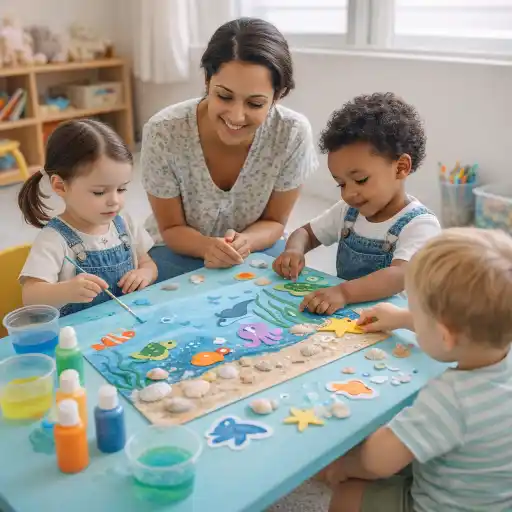
How can educators extend the artwork into play and conversation?
A finished picture can become the beginning of a larger learning invitation. Ask children to describe their scene, tell what might happen next, or invent a story about the animal. A child who colors a shark might explain where it is going; a classmate might add a question about what sharks eat. These exchanges support oral language, listening, and shared meaning-making.
Build on the artwork with simple, flexible extensions:
- Sort animal pictures by visible features, such as shells, fins, or tentacles.
- Use blocks, fabric, or paper shapes to make a sea-floor or open-water setting.
- Invite children to move like a gliding ray, swimming fish, or crawling crab.
- Make a class display with each child’s animal name and a question they asked.
When adults describe actions without taking over—“You added long tentacles” or “You placed the crab near the sand”—children hear useful language connected to their own decisions. This kind of interaction turns art time into a social, playful opportunity for learning.
How can providers make the activity inclusive and developmentally responsive?
Children approach art and conversation in different ways. Some may name several animals; others may point, use gestures, make sounds, or watch before joining. Offer multiple ways to participate and avoid treating speech, coloring precision, or factual recall as the only signs of learning.
Consider these adaptations:
- 🖍️ Offer thicker crayons, adaptive grips, larger images, or a stable surface for children who benefit from motor support.
- Provide animal picture cards, gestures, and key words in children’s home languages when possible.
- Reduce the number of choices or present one image at a time if a busy page feels overwhelming.
- Let children dictate a caption, select a picture, or contribute by pointing and matching.
- Choose age-appropriate materials and supervise children according to your program’s procedures.
Notice each child’s strategy and interest. One child may focus on color patterns; another may repeatedly ask about a particular animal. Those observations can guide follow-up books, dramatic play, or a small-group exploration. If the experience leads to water or loose-parts play, plan the materials and supervision accordingly. State requirements vary - check your state licensing agency.
Responsive teaching does not mean lowering expectations. It means providing accessible ways for children to engage with the same shared idea and recognizing the strengths they bring.
How can teams plan, observe, and extend learning?
Keep the plan focused: choose one or two intended outcomes, such as using a new marine-life word or asking a question about an animal. Prepare the coloring pages, crayons, a few reference images or books, and space to display children’s work. A short invitation with time for conversation is often more effective than trying to cover many facts in one session.
During the activity, observe what children do and say. Record specific evidence rather than broad judgments. For example: “Jordan pointed to the turtle’s flippers and said they help it swim,” or “Mina chose a fish picture, matched it to the word card, and asked where it lives.” These notes help educators plan meaningful next steps and share children’s discoveries with families.
- Before: Preview the images and select a few vocabulary words.
- During: Ask open questions, listen closely, and add language without correcting imaginative choices unnecessarily.
- After: Revisit a child’s question with a book, picture, movement game, or habitat-building invitation.
For professional learning on intentional science experiences, explore Basic Science in Early Childhood Buy Now $25.00. Providers who want to strengthen their language supports can also explore Building Vocabulary  Buy Now $16.00, Reading Aloud and Storytelling Buy Now $16.00, Language Development in Early Childhood Buy Now $16.00, and Building Early Science Foundations Buy Now $16.00.
Conclusion: How can ocean art spark vocabulary and curiosity?
Ocean art builds marine vocabulary and curiosity when providers treat each picture as a starting point for observation, conversation, and investigation. Introduce a few concrete words, connect them to visible features, welcome children’s questions, and follow their interests with books, movement, sorting, or habitat play.
The essential goal is not a uniform finished product or a long list of facts. It is a welcoming experience in which children can express ideas, practice developing skills, and see themselves as curious learners. A coloring page may be simple, but a thoughtful adult’s questions can open a whole ocean of discovery.
- Language and Literacy Foundations in Pre-K
- Building Early Science Foundations
- Power of Art: Bldg Self-Esteem & Positive Behavior for ALL Abilities
- Healing Young Hearts: Stress and Grief
- Texas Director Credential
- Building Vocabulary
- Mind's Medicine: Music in Early Childhood
- Montessori Cultural Activities: Exploring the World Through Play and Learning
- CDA Certification en Español: Recursos y Consejos para Educadores Bilingües
- 🔍 ¿Qué ves cuando observas a un niño aprender?
- 👶 ¿Cuáles son las proporciones y grupos requeridos en Dakota del Norte? 🏫
- Celebra El Cumpleaños de Dr. Seuss En Tu Guardería Con Actividades Fáciles y Divertidas!
- Apoyo en Español para Capacitaciones Grupales Presenciales y por Zoom en Cursos Selectos
- 10 Ejemplos de Cómo la Cultura Influye en el Desarrollo Infantil
- Proporciones de Cuidado Infantil y Tamaños de Grupo por Edad en Maryland (Guía Rápida para Centros y Hogares)
- Proporciones de Cuidado Infantil y Tamaños de Grupo por Edad en Nueva Jersey (Guía Rápida para Centros y Hogares)
- Proporciones de Cuidado Infantil y Tamaños de Grupo por Edad en Virginia (Guía Rápida para Centros y Hogares)
- Lista para Guardería en Casa en Illinois: Cómo Iniciar una Guardería en el Hogar
- Las Mejores Ideas de Excursiones para Guarderías en Dakota del Norte
- Las Mejores Ideas de Excursiones para Guarderías en Texas
- How can Washington aquariums and marine field trips spark curiosity for young children?
- Canciones, juegos y preguntas de círculo para niños
- Pool Noodle Sea Creatures: A Fun Ocean Craft for Preschoolers
- Cómo simplificar la capacitación para sus empleados de daycare
- Why Is Animal Bingo a Great Way to Introduce Habitats and Classification?
- How Do Classification Questions Build Marine Science Vocabulary?
- How Can Ocean Animal I Spy Combine Counting, Visual Scanning, and Ocean Science?
- How Can Ocean Art Build Marine Vocabulary and Curiosity in Young Children?
