A child’s wish to erase, cover, or take away their mark from a shared mural can feel like a sudden problem—but it is also a meaningful moment to support autonomy, communication, and belonging. The Connections That Count: Building Relationships in Child Care  Buy Now $55.00 course offers practical learning about positive guidance, cooperation, and self-regulation; explore it to strengthen the relationship-centered skills behind a calm, respectful response.
Why does a child want to remove their part of the artwork?
Start by getting curious rather than assuming the child is being disruptive or rejecting the group. A child may dislike how their work looks, feel embarrassed by a peer’s comment, want control over their own materials, or simply have changed their mind. They may also be communicating a need for space, a break, or help expressing a strong feeling. Young children’s ideas about ownership, permanence, and collaboration are still developing, so the request can be understandable even when it affects a shared project.
Pause and notice the context. Was the child invited to contribute freely, or did they feel pressured to make a particular mark? Did someone add something over their work? Is the artwork being displayed in a way that feels exposing? A warm, open question—“You want to take your part off. Tell me what’s bothering you”—can reveal more than a quick instruction to leave it alone.
Collaborative art is about shared experience as much as the finished object. Research describes collaboration as communication, shared goals, problem-solving, and negotiation—not simply producing a joint product. A child’s concern is therefore an opportunity to practice #communication and respect while protecting their sense of agency. Treat the child’s perspective as real, even if the adults’ first instinct is to preserve the mural.
How can you respond in the moment without escalating the conflict?
Keep your voice steady, move close enough to support safety, and acknowledge what you hear before proposing a solution. For example: “You don’t like that mark now. You’re asking to remove it.” This neutral description helps the child feel heard without promising that the shared artwork can be changed in any particular way.
If the child is upset, allow a brief pause before discussing options. Naming a possible feeling tentatively can help: “Are you feeling frustrated or unsure about it?” Avoid insisting on an emotion or asking a rapid series of questions. NAEYC’s three-step conflict approach recommends identifying behavior and feelings, explaining implications, and then guiding children toward an appropriate next step. Applied here, the adult can explain that removing a section may change the group’s work, then invite a workable choice.
- “Would you like to look at it with me, or take a short break first?”
- “Would you like to add a new layer, cover just your mark, or leave it for now?”
- “Let’s ask the group before changing a part that others have added to.”
- 🖍️ “You can choose another paper to make a version that feels right to you.”
Offer a few genuine, safe options rather than a false choice. If the child is pulling or tearing the mural and others’ contributions are at risk, calmly block damage and state the limit: “I won’t let the paper tear. I’ll help us find another way.” This combines empathy with a clear boundary and avoids turning the moment into a power struggle.
How do you balance a child’s ownership with the group’s shared work?
Children deserve a voice in what happens to their own contribution, and peers also have a stake in a genuinely collaborative piece. Avoid treating either principle as absolute. A young child’s mark may overlap another child’s work, the group may have planned a shared surface, and the artist may still need a way to revise, pause, or step away. The educator’s role is to help children make these interests visible and negotiate a fair solution.
When emotions settle, bring the involved children into a short, supported conversation. Help each child say what they want and listen to the other’s view. You might say: “Ari wants to cover this blue line. Mateo wants it to stay because he painted beside it. What could work for both of you?” Children can suggest adding a border, placing a removable overlay, making a separate drawing, or agreeing to leave the mural unchanged until the next art period.
Do not require a child to keep contributing or to endorse the final artwork. Participation can include making a mark, choosing materials, watching, dictating an idea, or deciding to stop. Inclusive practice means adjusting how children take part so their voices and abilities are respected. When useful, refer back to a simple group agreement created before the project: everyone may choose whether and how to contribute; ask before changing another person’s work; and seek help if a change affects the shared piece. Co-created agreements make expectations understandable rather than arbitrary.
What preventive planning makes collaborative art feel safer?
Many tense moments can be softened before the first brushstroke. Explain the project’s shared and individual parts, how long it will remain available, and what choices children will have if they change their minds. Set out a separate practice area or individual sheets alongside the group surface. For a multi-day mural, make it clear that children can return to it, but that additions may become part of a shared composition.
Use a brief, child-friendly agreement and revisit it without turning it into a lecture. Invite children to help phrase the expectations. A simple visual reminder might show: “Ask before changing another person’s mark,” “You can choose to stop,” and “We can find another paper.” Agreements work best when adults consistently model listening and negotiation, not just when conflict appears. The Kennedy Center’s guidance for creative group projects likewise emphasizes clarifying participation and expectations, listening carefully, and helping learners find solutions that honor different ideas.
Plan the environment to support success:
- Use a large, stable surface with enough room for children to work without crowding.
- Offer washable, age-appropriate materials and a nearby place for individual work.
- Photograph the work at agreed points, if appropriate, so children can explore revisions without feeling the original must be destroyed.
- Build in time to pause and return; large collaborative projects may grow over several sessions.
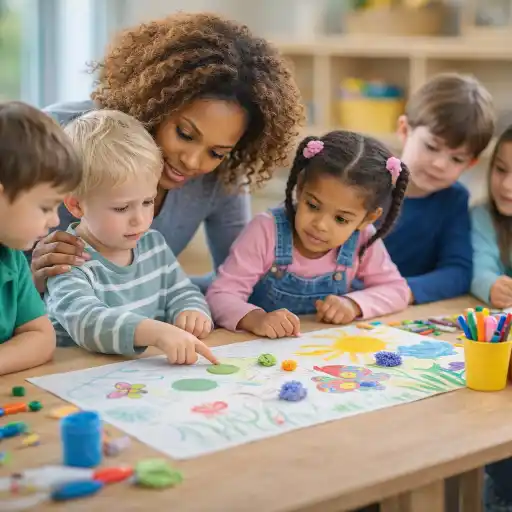
Open-ended, process-focused art has no single correct outcome. A collaborative artwork can evolve, remain unfinished, or look different from what adults imagined. This framing reduces pressure to protect a polished product and keeps attention on exploration, ideas, and relationships.
What common responses should educators avoid?
“You made it, so you have to leave it” may seem fair, but it can dismiss a child’s current feelings and turn participation into an obligation. Likewise, “Don’t ruin everyone’s art” can shame the child and frame them as the problem rather than identifying the specific concern. Instead, describe what is happening, affirm the child’s right to express a preference, and clarify that shared materials or another child’s contribution also need protection.
Another pitfall is deciding immediately that the adult’s preferred outcome is the only reasonable one. A mural does not need to remain unchanged to count as successful learning. At the same time, allowing one child to remove or cover the entire group’s work without discussion may disregard peers. Make the decision with the children when possible, and provide an alternate way for the child to revise or create independently if a shared change cannot be agreed upon.
Be cautious about praising only the finished display or insisting everyone sign their name. That can create pressure, especially for children who are perfectionistic, hesitant, or uncomfortable being publicly associated with a mark. Invite children to decide whether they want their contribution identified, displayed, photographed, or kept private, within program practices and family expectations.
Finally, avoid treating every disagreement as misbehavior. Conflict can offer practice in self-regulation, perspective-taking, language, and problem-solving. Use calm, specific coaching; step in more directly when safety or damage is at issue; and reflect afterward on whether the project design made participation equitable. State requirements vary—check your state licensing agency for any applicable art-material and supervision requirements.
How can you turn this moment into a learning opportunity?
Once the immediate concern is addressed, help children reflect without demanding an apology or a tidy moral. Ask, “What helped us decide?” or “What could we try next time?” Keep the conversation short and concrete, especially for younger children. Name useful actions you observed: “You told us you wanted a change,” “You listened to Mateo’s idea,” or “You chose another paper while we figured it out.” Specific feedback helps children notice strategies they can use again.
Document the moment briefly if it helps your team understand patterns: what happened before the request, what the child communicated, which options were offered, and what seemed helpful. If a child repeatedly feels distressed about group art, consider whether the project has enough individual choice, whether peer comments are affecting participation, or whether sensory, communication, or accessibility adjustments are needed. Coordinate with families and colleagues when appropriate, focusing on the child’s strengths and the supports that help them participate comfortably.
As a next step, providers can explore the relevant professional learning options below. These English-language courses connect relationship-building, conflict coaching, and open-ended art practice to everyday classroom work:
- Connections That Count: Building Relationships in Child Care Buy Now $55.00 — strengthen positive guidance, cooperation, and supportive relationships.
- You’re Not My Friend Anymore: Learning Conflict Resolution Buy Now $16.00 — explore developmentally appropriate approaches to children’s peer conflicts.
- Social Foundations and Responsive Classrooms Buy Now $24.00 — build strategies for self-regulation, positive guidance, and problem-solving.
- Open Heart, Open Art Buy Now $16.00 — learn about open-ended art and its connection to social-emotional development.
- Art from the Heart for Preschoolers: Open Ended Art Projects that Build Self-Esteem Buy Now $35.00 — explore process art experiences that support confidence and choice.
For programs preparing a shared project, the Collaborative Art Agreement Kit can provide a practical structure for discussing contributions, boundaries, and what to do when a child wants to change their work. Pairing a clear agreement with responsive adult coaching helps children experience group art as a place where they can contribute, revise, pause, and belong.
Conclusion: What is the most respectful response?
When a child wants to remove their contribution from group artwork, begin with curiosity and acknowledge the child’s feelings and agency. Set a clear safety boundary if needed, explain how a change may affect the group, and guide children toward choices that respect both individual expression and shared ownership. A child may revise, cover, pause, create separately, or decide not to continue; the response should be developmentally appropriate and shaped with the children whenever possible.
Thoughtful planning makes these moments easier: clarify expectations beforehand, provide individual alternatives, allow the artwork to evolve, and model listening and negotiation. The goal is not simply to preserve a mural. It is to help children practice #respect, #choice, and #problem-solving while making a classroom where each contribution—and each child—matters.
- 👧 ¿Cómo iniciar y abrir una guardería en Texas? Lo que necesitas saber
- 🚨 Reporte Obligatorio en Nevada
- Qué capacitación se requiere para ser director de cuidado infantil en Texas?
- Recursos en Español sobre el Sueño Seguro del Bebé
- Apoyo en Español para Capacitaciones Grupales Presenciales y por Zoom en Cursos Selectos
- Que es Título 22 en California?
- 10 Ejemplos de Cómo la Cultura Influye en el Desarrollo Infantil
- Capacitación en Salud y Seguridad Preventiva en Línea para Proveedores de Cuidado Infantil
- Lista para Guardería en Casa en Illinois: Cómo Iniciar una Guardería en el Hogar
- Lista para Guardería en Casa en California: Cómo Iniciar una Guardería en el Hogar
- Lista para Guardería en Casa en Texas: Cómo Iniciar una Guardería en el Hogar
- Retraso del Habla en la Guardería: Cómo Pueden Ayudar los Proveedores
- Cómo Trabajar en el Cuidado Infantil en California: Requisitos y Pasos
- Cómo Ser Maestra de Preescolar en Dakota del Norte
- Capacitación Previa al Servicio para Proveedores de Cuidado Infantil en Dakota del Norte
- Celebrando la amistad en el cuidado infantil durante el Día de los Mejores Amigos
- Cómo simplificar la capacitación para sus empleados de daycare
- What Should You Do When a Child Wants to Remove Their Contribution from Group Artwork?
- Should You Ask Children’s Permission Before Displaying Their Artwork?
- How Can You Keep a Group Story Going When Children Introduce Conflicting Characters?
